Manual Takeoffs: The Time Sink Killing Your Bid Speed
Let’s be honest, manual takeoffs are a slog. You’re staring at drawings, tracing every beam, wall, and column, then keying numbers into Excel. It’s tedious, error-prone, and eats up 40 hours on average for a single bid. That’s two full days of labor from two estimators. Multiply that by 5-8 GMP pursuits a year, and you’re looking at hundreds of hours wasted.
The kicker? Those hours could’ve been spent chasing more bids, negotiating with subs, or refining your margins. Instead, you’re stuck tracing lines. Not ideal.
Real-World Example: The Cost of Inefficiency
Consider a mid-sized general contractor (GC) bidding for six GMP projects a year. With two estimators each spending 40 hours per bid, that’s 480 hours annually. At an average hourly rate of $75, this translates to $36,000 dedicated solely to manual takeoffs. And that’s just for one part of the preconstruction phase. Factor in errors, missed deadlines, and opportunity costs, and the inefficiency compounds.
AI Takeoffs: What 10 Minutes Looks Like
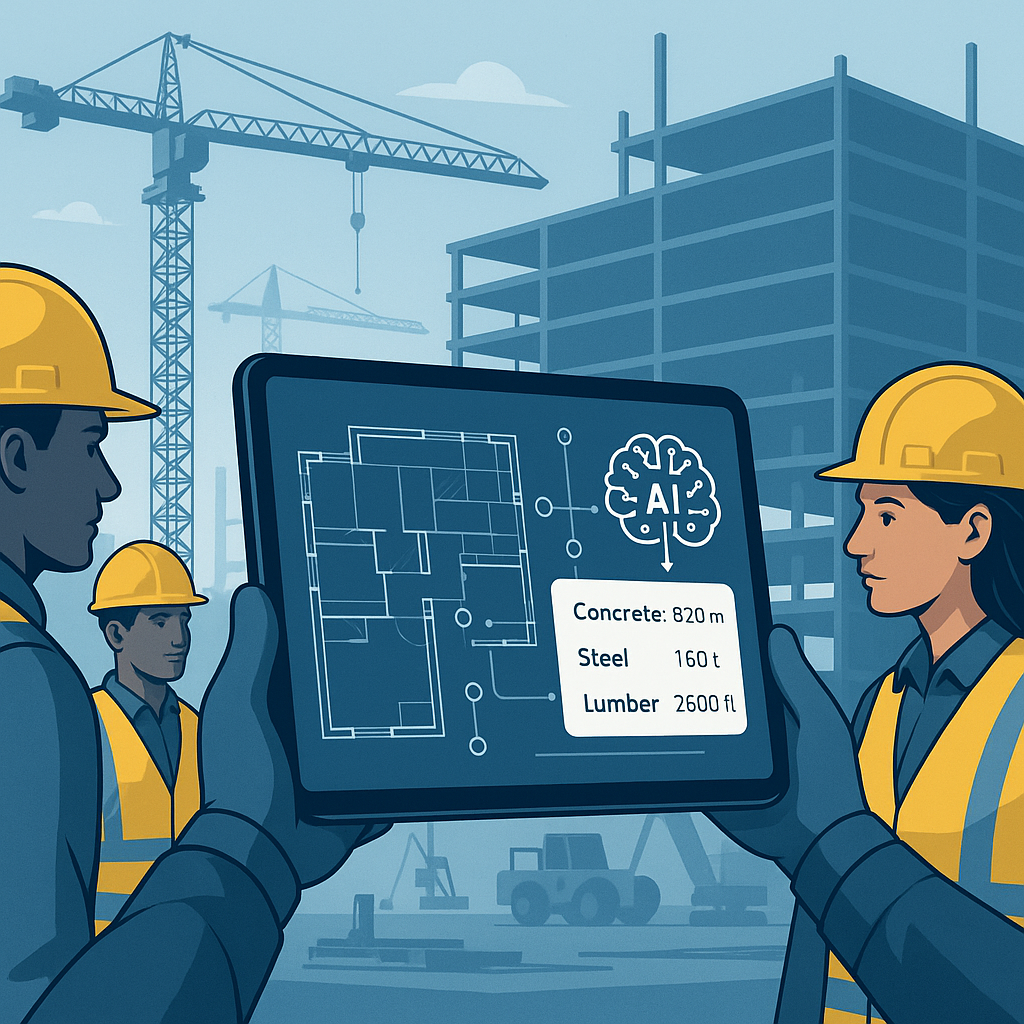
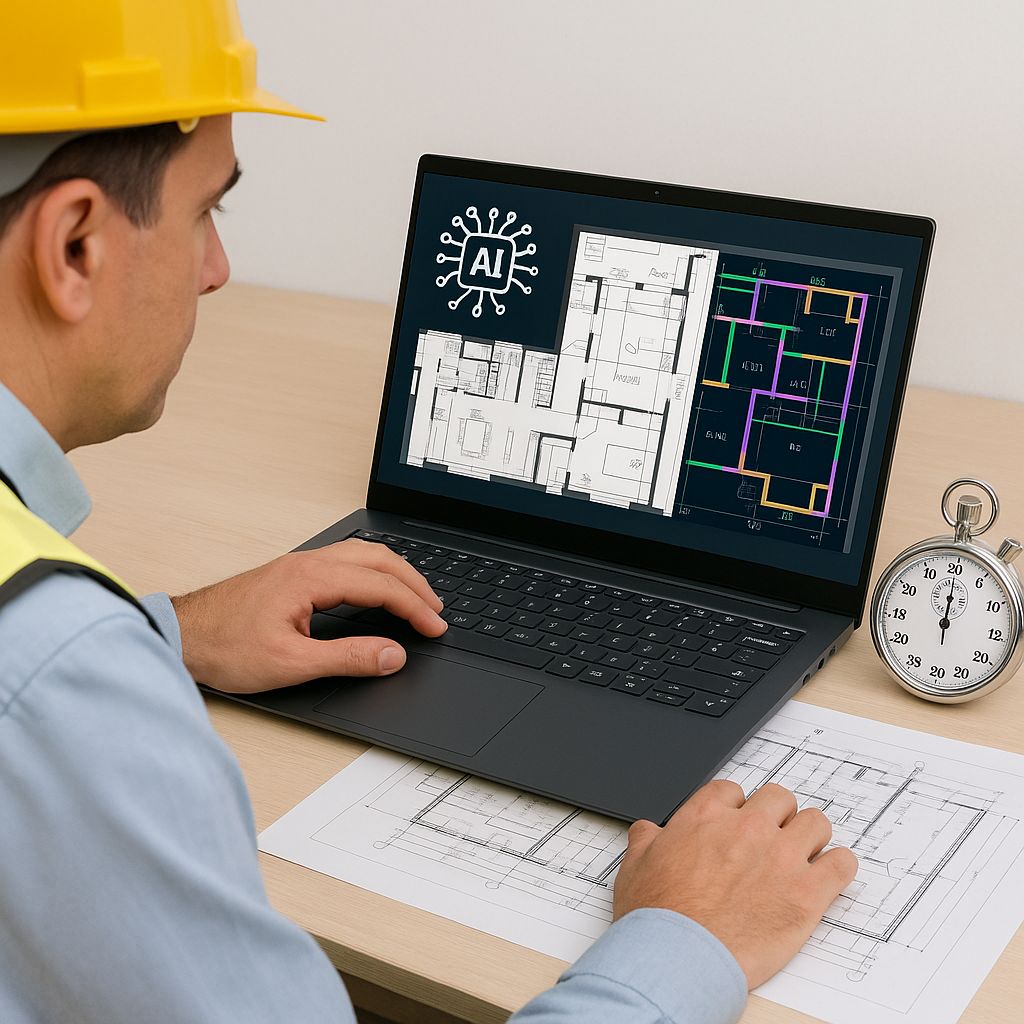
EstimateNext’s Vision AI changes everything. Instead of manual tracing, you upload your PDF drawings. The AI scans them, extracts quantities, and organizes them into a structured QTO. Concrete columns, wall lengths, room areas—it’s all done automatically. What used to take 40 hours now takes 10 minutes. That’s a 240X speed improvement[^2].
Case Study: High-Rise Bid Efficiency
One mid-sized GC tested this on a 22-story high-rise bid. They saved 120 hours—two full weeks of labor—on a single project[^2]. Their preconstruction director shared: “It’s like hiring a full-time estimator without the payroll hit.” Beyond the time savings, they submitted their bid three days earlier than competitors, giving them a significant edge.
How It Works: A Step-by-Step Breakdown
- Upload Your Drawings: Drag and drop PDFs or CAD files into the platform.
- AI Processing: The system identifies key elements—walls, beams, slabs—and measures quantities automatically.
- Structured Output: View results in a clean, exportable QTO format.
- Review and Adjust: Use built-in tools to verify measurements and tweak outputs as needed.
The Accuracy Question
You might be thinking, “Sure, it’s fast, but can AI really match the precision of manual takeoffs?” Good question. AI isn’t perfect, but it’s close. EstimateNext tools come with confidence scoring and manual overrides, so your team can review and adjust as needed[^5].
Data-Backed Accuracy Metrics
In a 2022 study comparing traditional and AI-powered takeoffs, AI tools achieved an average accuracy rate of 96%[^4]. For context, manual takeoffs often hover around 90-95% accuracy, depending on estimator skill and time constraints.
Example: Reducing Errors with AI
One civil contractor reported an 80% reduction in takeoff discrepancies after adopting AI tools. They cited consistent measurement practices and fewer overlooked elements as major contributors to this improvement[^1].
Actionable Tip: Clean Inputs for Best Results
AI tools are only as good as the data you feed them. Ensure your drawings are complete, legible, and properly annotated. If your input data is messy, the AI will struggle. Think of it as a partnership: the AI handles the heavy lifting, but your expertise ensures quality control.
Why Speed Matters
Speed isn’t just about saving time—it’s strategic. Faster takeoffs mean faster bid submissions. And faster submissions mean you’re ahead of competitors still stuck on their spreadsheets. It’s a way to win more bids without adding staff.
Subcontractor Example: MEP Firms
Take subcontractors as an example. MEP firms responding to 30-60 bid packages a year often miss deadlines because manual takeoffs take 3 days. With AI tools, they can deliver quotes in 4 hours[^6]. That’s an 18X speed boost, which translates to more bids responded to—and more wins.
Competitive Advantage
In a crowded market, being first matters. A 2021 survey of contractors found that 62% of winning bids were submitted earlier than competitors[^7]. Faster takeoffs don’t just save time; they increase your odds of closing deals.
The ROI Math
What’s the real cost of not adopting AI? Let’s break it down.
General Contractors
If you're a GC director, you save 40 hours per estimate at $130/hour. That’s $5,200 saved per pursuit. Multiply that by 8 GMP bids a year, and you’re looking at $41,600 saved annually[^6]. Now compare that to EstimateNext’s $99/month subscription—52X ROI.
Subcontractors
For subs, the math is even more compelling. Responding to 50% more bids could mean 4-8 extra wins annually. At $200K average revenue per win, that’s $800K-$1.6M in incremental revenue[^6].
Decision Framework: Manual vs. AI Takeoffs
| Factor | Manual Takeoffs | AI Takeoffs |
|---|---|---|
| Time Per Bid | 40 hours | 10 minutes |
| Accuracy | 90-95% | 96% (avg.) |
| Cost (Annual) | $36,000 (avg. GC) | $1,188 (EstimateNext plan) |
| Scalability | Limited by staff | Scales with workload |
The Obvious Objection: “But AI Can’t Think Like an Estimator”
I get this pushback all the time. You might be thinking, “Sure, AI is fast, but it doesn’t understand the nuances of construction.” That’s partially true—but it’s also missing the point. AI doesn’t replace your expertise; it amplifies it. You’re still the one making judgment calls, negotiating with subs, and deciding on markup. The AI just handles the grunt work[^8].
Example: Amplifying Expertise
A concrete subcontractor using EstimateNext shared that AI freed up their senior estimator to focus on complex tasks like value engineering and sub negotiations. The result? Higher-quality bids and stronger client relationships.
What About Multi-Market Complexity?
Estimating across multiple markets is a nightmare. Labor rules, tax regimes, measurement standards—they all change depending on the country. EstimateNext’s MarketProfile architecture simplifies this by handling CSI, NRM2, CPWD, CESMM3, and other standards in one platform[^6].
Cost Comparison: High-End vs. Affordable Tools
For example, GCC contractors often struggle with CostX’s $15K/year price tag. EstimateNext offers a professional tool at AED 130/month with multi-country rates[^6]. That’s 1% the cost, with less complexity.
FAQ: Common Questions About AI in Estimation
Q: Can AI tools handle smaller projects?
A: Absolutely. AI scales to any project size, whether you’re handling a $1M renovation or a $1B rail bridge[^1].
Q: How long does it take to learn AI estimation tools?
A: Most platforms are user-friendly. Training typically takes under two weeks[^1].
Q: What if my rates are custom or project-specific?
A: AI tools like EstimateNext allow you to upload custom rate catalogs. The system integrates them seamlessly[^3].
Q: Can I integrate AI tools with my existing software?
A: Yes. Most AI platforms offer integrations with common tools like Procore, Bluebeam, and Excel[^9].
Q: How secure is my data on AI platforms?
A: Leading platforms prioritize security with encryption, secure cloud storage, and user access controls[^10].
Call to Action: Save 40 Hours per Bid
If you're dealing with slow, manual takeoffs, EstimateNext can help. Get started free →