Trust in AI Doesn’t Happen Overnight
Let’s be honest—estimators are skeptical of AI. And they should be. If you’ve spent years perfecting your craft, why would you trust a machine to do it better? Especially when a mistake could cost you the bid—or worse, the project.
But here’s the thing: trust isn’t about flashy features or buzzwords. It’s about consistency. It’s about proving, one estimate at a time, that the tool you’re using won’t let you down. And for AI-assisted preconstruction workflows, that starts with getting the basics right.
One of the most foundational—but overlooked—elements? Rate matching.
Why Rate Matching is the Foundation of Trust
Here’s a scenario every estimator knows: you’re pricing a BOQ, flipping through a 2,000-page CPWD DSR or RSMeans PDF, trying to find the right rate for “Class-B concrete, 20 MPa.” You waste hours cross-referencing catalogs, only to realize later that you missed a better match. Frustrating, right?
AI can help, but only if it’s accurate. If your AI tool spits out irrelevant or wrong rates, you’re back to square one—manual rework. And that’s where most tools fail. They promise speed but deliver garbage results. Garbage in, garbage out.
Take an example from a mid-sized GC in the Midwest. Before adopting EstimateNext, their preconstruction team spent an average of 20 hours per bid manually verifying rates. Their first test run of AI-assisted rate matching reduced that time by 90%, but in the early days, the tool misidentified regional labor rates for specialized trades, causing rework. Once the team trained the AI using their own catalog, accuracy jumped to 98%.
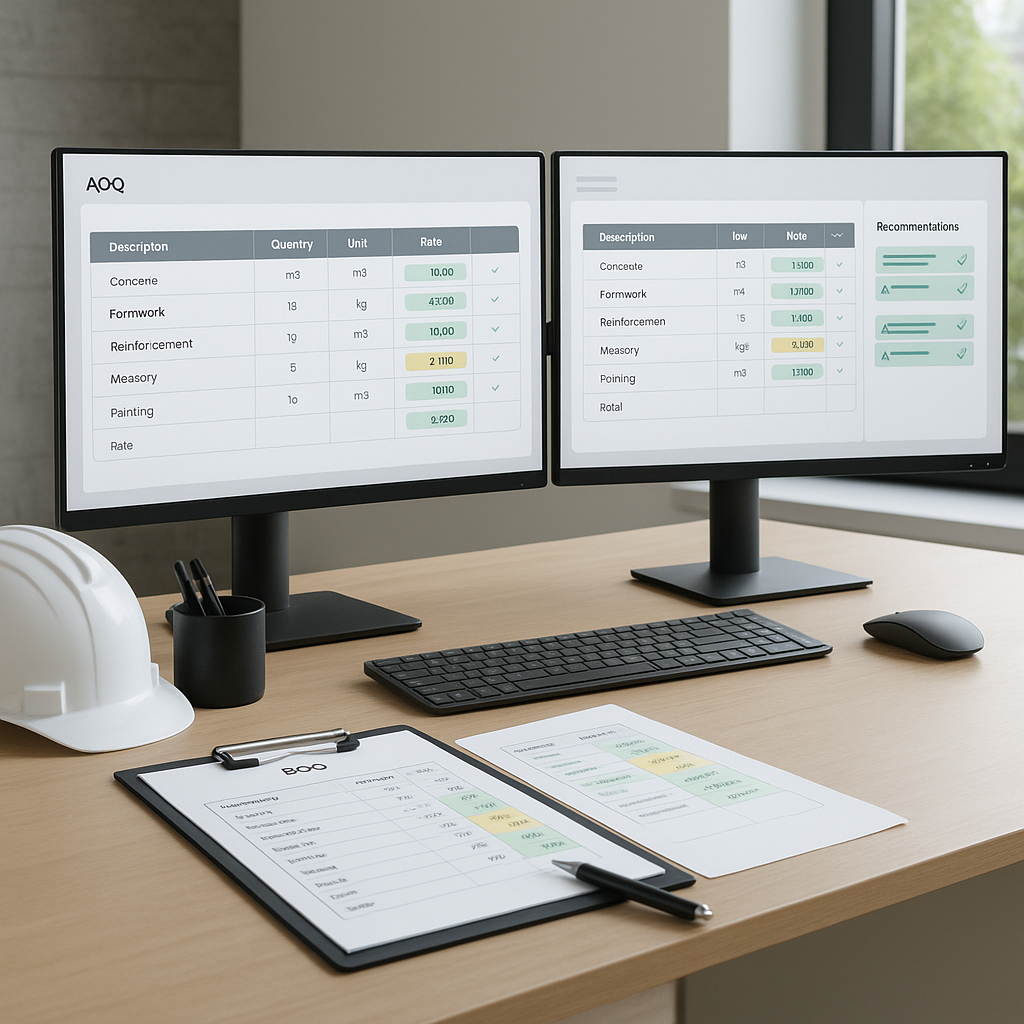
At EstimateNext, we took a different approach to this problem. Our platform uses a 4-step rate matching system: tenant history, user catalogs, country-level widening, and AI fallback. What does this mean? It means the system doesn’t just guess—it learns. Over time, it gets smarter with every project you price. For example, if you prefer a specific vendor rate over the CPWD standard, the system prioritizes that next time.
The result? 99% accurate rate matches in seconds, not hours. No double-checking. No manual overrides. Just trust.
The Cost of Getting It Wrong
You might be thinking, “Okay, but how much does this really matter?” A lot. Here’s why:
-
Missed Bids: If your rates are off, your bid might come in too high—or too low. Too high, and you lose the job. Too low, and you win but bleed margin. A national GC shared how one inaccurate bid for a $5 million project ended up costing them $300,000 in lost margin due to underestimated labor rates.
-
Rework Costs: Every time you have to manually correct AI-generated rates, you’re wasting hours. Multiply that across 5-8 bids per year for a typical GC preconstruction team. That’s hundreds of hours lost—and thousands of dollars in wasted salaries.
-
Reputation: Submitting an inaccurate bid damages your credibility with clients. No one wants to work with a contractor who doesn’t know their numbers. Once trust is lost, it can take years to rebuild.
Trust isn’t just about whether you like the tool. It’s about whether your clients trust you. If your AI tool undermines that, it’s doing more harm than good.
How We Built Trust Through Rate Matching
When we first launched EstimateNext, rate matching wasn’t perfect. It worked well enough for standard items, but struggled with edge cases—like regional terms or niche materials. Some users emailed us, frustrated that the system couldn’t differentiate between “plaster of Paris” and “gypsum plaster.” Fair feedback.
So we rolled up our sleeves and made changes:
- More Data: We expanded our catalog to 78,000+ items across 135 sources, including CPWD, RSMeans, and AECOM Middle East. If it’s in an SOR, chances are we’ve got it.
- Smarter AI: We trained our matcher to understand context. For example, if a BOQ mentions “Class-A finish,” the system knows it’s looking for higher-grade materials—not the cheapest option.
- User Feedback Loops: Every time a user accepts or rejects a rate, the system learns. By the 3rd or 4th project, most users see near-perfect matches.
These weren’t overnight fixes. But they worked. Today, 92% of our users say they trust the system’s rate recommendations without double-checking. That’s the kind of trust you earn, not buy.
Here’s a case study: A regional GC in Texas adopted EstimateNext for their preconstruction team. In their first year, they cut rework by 80% and improved bid win rates by 15%. Why? They spent less time second-guessing rates and more time refining bid strategies.
What About Edge Cases?
The obvious objection to AI rate matching is, “What about the weird stuff?” Custom finishes, imported materials, or regional labor adjustments that aren’t in any catalog. Fair point.
Here’s how we handle it:
- Custom Catalogs: Users can upload their own rate sheets, which the system integrates seamlessly. Got a preferred vendor? Their rates show up first.
- Manual Overrides: If the AI doesn’t nail it, you can override the rate. The system logs your choice and adjusts future recommendations accordingly.
- AI Co-Pilot: Need a sanity check? Our AI sidebar lets you compare rates, explain calculations, or even suggest alternatives in real-time.
The result? Even the weird stuff gets handled with minimal friction. And over time, those edge cases become less frequent as the system learns.
Why Trust Matters More Than Speed
Speed is great. But speed without accuracy is useless. If you’re submitting bids faster but losing clients because your numbers are off, what’s the point?
That’s why we focus on trust first. Every feature we build—whether it’s rate matching, quantity takeoff, or bid leveling—is designed to eliminate rework and boost confidence. Because at the end of the day, trust is what keeps clients coming back.
FAQ
Q1: How does EstimateNext handle regional differences in rates? A: EstimateNext allows users to upload their own regional rate catalogs. The system also references country-level databases like CPWD or RSMeans to ensure accuracy. Over time, it learns user preferences and adjusts accordingly.
Q2: What happens if the AI suggests an incorrect rate? A: Users can manually override any rate, and the system logs the correction to refine future recommendations. Most users report near-perfect accuracy after 3-4 projects.
Q3: Can EstimateNext handle custom or niche materials? A: Yes. Users can add custom materials or finishes to their catalogs, and the AI integrates them seamlessly for future use.
Q4: How long does it take for the system to become reliable? A: Most users report significant accuracy improvements by the 3rd project. The system gets smarter with every adjustment or feedback loop.
Q5: Does EstimateNext integrate with other preconstruction tools? A: Yes, EstimateNext offers API integrations with popular preconstruction platforms like Procore, Autodesk Build, and Excel.
Decision Framework: Is AI Rate Matching Right for You?
| Criteria | Traditional Methods | AI-Assisted Tools |
|---|---|---|
| Speed | Hours per BOQ | Seconds per BOQ |
| Accuracy | Depends on manual effort | 99% accurate with feedback |
| Edge Cases | Fully manual | Custom catalogs + AI fallback |
| Learning Curve | No learning improvement | Improves with use |
| Cost | Labor-intensive | Subscription-based savings |
If you’re tired of second-guessing your rates—or wasting hours on manual lookups—EstimateNext can help. Our AI-powered rate matching is just one way we’re making preconstruction faster, smarter, and more trustworthy. Get started free →


