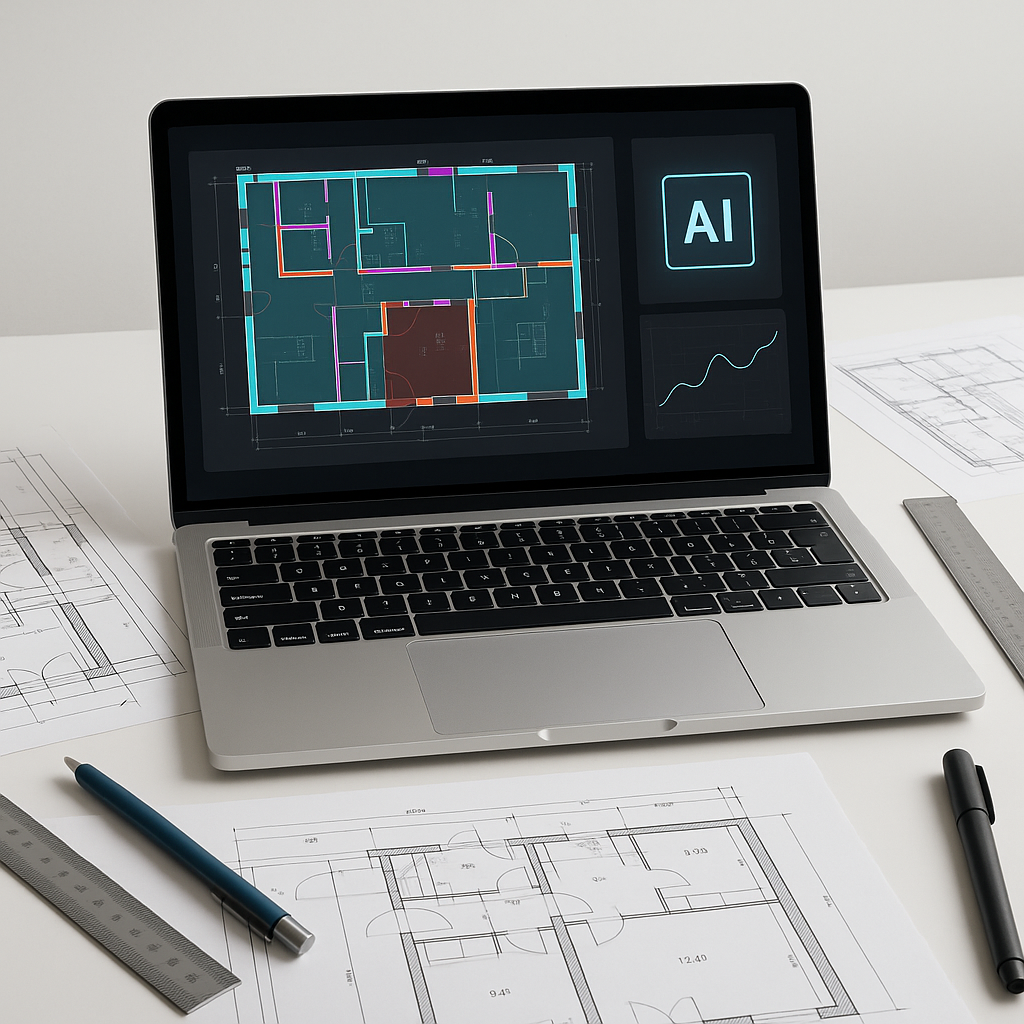
10 Minutes vs. 40 Hours: How AI Transforms Preconstruction Takeoffs
Ever spent two full days on a manual takeoff? If you’re in preconstruction, you’ve been there. PDF drawings, rulers, Bluebeam, and a spreadsheet that grows messier with every revision. Multiply that by five GMP pursuits a year, and you’ve burned 200+ hours just on takeoffs. The worst part? It’s all avoidable.
AI-powered tools are flipping this process on its head. And no, this isn’t some vague "future of construction" pitch. This is happening right now. Tools like EstimateNext are cutting takeoff times from 40 hours to just 10 minutes. Let’s break down why this matters—and how it works.
The Brutal Math of Manual Takeoffs
Here’s a real example. A general contractor (GC) in California recently bid on a $5 million school renovation. Their team spent 36 hours manually measuring quantities from PDF plans. Walls, doors, windows—every line had to be traced. Even with Bluebeam, someone had to double-check everything, and revisions meant starting over. They barely hit the deadline.
That’s not unusual. Manual takeoffs take roughly 40 hours per estimate. For GCs juggling multiple bids, it’s a bottleneck that kills efficiency. And if you’re a subcontractor? Good luck turning around 30 bid packages a month.
The time cost is staggering, but the financial cost is even worse. Let’s say your lead estimator earns $90/hour. A single 40-hour takeoff eats up $3,600. Do five of these a year, and you’re burning $18,000 just on labor—per estimator. For a mid-sized firm, that’s hundreds of thousands annually.
But what if you could cut that time to 10 minutes? That’s exactly what AI tools like EstimateNext’s Vision AI do. It’s not magic—it’s precision automation.
How AI Takeoffs Actually Work
Here’s the play-by-play:
-
Upload Your Drawings: Drop your PDF into the platform. No manual setup, no calibration nightmares.
-
AI Reads the Details: Vision AI scans the drawings, extracting quantities like room areas, wall lengths, and door/window counts.
-
Confidence Scoring: The tool highlights low-confidence lines for review. You’re not flying blind—AI flags what needs a second look.
-
Instant Revisions: Upload a new drawing set? The system compares changes and updates quantities automatically.
It sounds simple because it is. But the impact? Huge. That California GC saved 36 hours on their next project. For subs, it means quoting 50% more bids per month without adding staff.
A Concrete Example
Consider an electrical subcontractor bidding on a large hospital project. Pre-AI, their team spent 25 hours manually calculating conduit lengths and fixture counts. Using an AI-powered tool, the same process took just 12 minutes. The estimator reviewed flagged items in another 20 minutes, ensuring accuracy. What used to take three days was finished before lunch.
The Competitive Advantage
You might be thinking, “Okay, it’s faster. But does it really matter?” Absolutely. Here’s why:
1. Win More Bids
Faster takeoffs mean you can respond to more RFPs. For GCs, that’s the difference between landing five projects or just two. For subs, it’s the edge to beat competitors who miss deadlines.
2. Accuracy = Profit
Manual takeoffs are prone to errors—missed quantities, duplicated scopes, you name it. AI improves accuracy to 95-98%. That’s fewer surprises during construction. One study found that errors in takeoffs accounted for 15% of change orders, costing contractors an average of $28,000 per project. AI virtually eliminates these.
3. Focus on Strategy
When your team isn’t buried in takeoffs, they can focus on high-value tasks—like subcontractor negotiations, value engineering, or refining bid strategies.
Here’s the kicker: AI isn’t just about saving time. It’s about survival. The construction market is more competitive than ever. Clients expect faster bids and fewer mistakes. If you’re still stuck in the 40-hour manual grind, you’re at a disadvantage.
The Obvious Objection: “But AI Can’t Think Like an Estimator”
True, AI won’t replace your expertise. It’s not supposed to. Think of it as your apprentice—handling the repetitive stuff so you can focus on the big decisions. You’re still in control. The AI just saves you from tracing every single wall line.
Addressing Accuracy Concerns
For skeptics worried about accuracy, here’s the reality: Most users report significant improvements by their third project. The system learns from your feedback, getting smarter with every adjustment. By project five, it’s dialed into your workflow.
Moreover, AI tools don’t work in isolation. They highlight areas of uncertainty, ensuring you’re only reviewing the critical parts. This hybrid approach—AI plus human insight—produces results that are both fast and accurate.
Real-World ROI
Let’s get specific. A GC Director earning $130/hour saves 40 hours per estimate with AI. That’s $5,200 saved—per project. Multiply that by five GMP pursuits a year, and you’re looking at $26,000 in recovered time. Compare that to the $99/month cost of a tool like EstimateNext. It’s not even a question.
For subs, the ROI is even clearer. A mid-sized MEP contractor responding to 30 bid packages a month can double their output with AI. That’s 15 extra bids—and 4-8 additional wins per year at $200K average revenue. Do the math.
Comparison Table: Manual vs. AI Takeoffs
| Metric | Manual Takeoff | AI-Powered Takeoff |
|---|---|---|
| Time Per Estimate | 36-40 hours | 10-20 minutes |
| Accuracy Rate | 85-90% | 95-98% |
| Labor Cost Per Estimate | ~$3,600 | ~$50 |
| Scalability | Low | High |
What’s Next for Preconstruction?
The tools are here, and they’re affordable. The real question is: Can you afford not to use them? AI isn’t nice-to-have anymore. It’s table stakes. Your competitors are already adopting it. The longer you wait, the harder it’ll be to catch up.
If you’ve been burning 40 hours on every takeoff, it’s time to rethink your process. Start small. Test AI on one project. Upload a BOQ, let the system handle the grunt work, and compare the output to your manual process. The difference will be obvious.
If you’re tired of wasting 40 hours on manual takeoffs, EstimateNext can help. Get started free →


