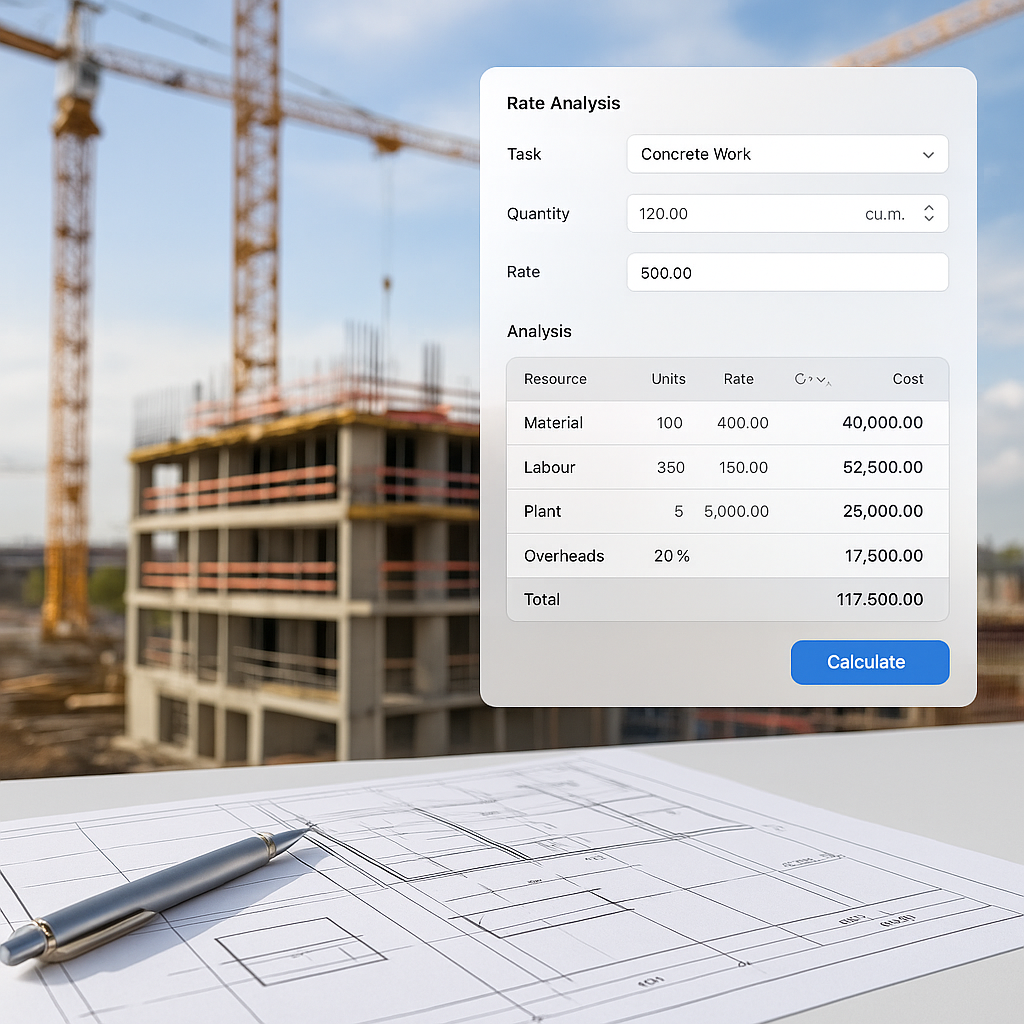
Why Civil Rate Analysis Feels Like a Grind
Let’s be honest: rate analysis isn’t anyone’s favorite part of construction estimation. It’s tedious, error-prone, and requires endless cross-referencing. You’re flipping through rate books, juggling multiple spreadsheets, and trying to adjust for inflation or regional modifiers. A single missed rate can derail the entire estimate.
Take a typical infrastructure project. You might need to price earthworks, pavements, structures, and utilities—all pulling rates from different sources. For example:
- RSMeans for general construction
- CPWD DSR for government projects in India
- Custom vendor quotes for specialized materials like acoustic panels or high-strength concrete
Managing all of this manually is a nightmare—and it only gets worse with larger projects. For instance, one infrastructure firm in Texas spent three full workdays recalculating rates on a $50 million highway expansion project because a single inflation adjustment was misapplied. When bid deadlines are looming, this kind of time sink is a disaster.
The Hidden Cost of Manual Rate Analysis
Manual rate analysis doesn’t just waste time—it costs money. And the numbers are staggering:
Time Sink
- Teams spend an average of 30+ hours per estimate on rate lookup and calculation alone. For a team of estimators billing at $130/hour, that’s $3,900 per bid.
- Multiply that by 10 or 20 bids annually, and you’re looking at $39,000–$78,000 per year just for rate calculations.
Errors
Mistakes are inevitable when humans handle repetitive, detail-heavy tasks. Common errors include:
- Missed adjustments for inflation or regional cost variations.
- Outdated rates, leading to either underpricing (which erodes margins) or overpricing (which risks losing the bid).
Here’s a real-world example: A mid-sized GC lost a $12 million warehouse project because their bid rates were inconsistent. The client flagged discrepancies between labor rates and materials, leading to questions about the estimator’s accuracy. On the flip side, an MEP subcontractor won a project but underestimated labor rates by 15%, resulting in a $200,000 margin loss.
How AI Changes the Game
AI-powered tools like EstimateNext are transforming how rate analysis is done. Instead of flipping through PDFs or juggling Excel tabs, you upload your BOQ (Bill of Quantities), and the system matches rates across 78,000+ items in seconds. Here’s how it works:
Key Features
- Smart BOQ Parser: Upload your BOQ in Excel or CSV format, and the app automatically detects merged cells, section headers, and hierarchies. No more hours wasted cleaning up poorly formatted files.
- AI Rate Matching: The tool searches across catalogs like CPWD DSR, RSMeans, and regional databases to find the best match. It even adjusts for inflation and regional modifiers automatically.
- Audit Trail: Every rate is broken down into components—material, labor, equipment, and overhead costs—with a full audit trail for transparency.
Time Savings
Rate analysis that used to take 30 hours now takes less than 30 minutes. That’s a 90% reduction in time spent. For a team handling five estimates a month, this change frees up 145 hours—time that can be spent refining bid strategies or negotiating with subcontractors.
Real-World Example: Civil Works
Let’s put this into perspective. Imagine you’re estimating costs for a highway extension project. You need rates for:
- Earthworks (cut/fill volumes)
- Pavement slabs
- Retaining walls
- Utilities, like power and drainage systems
Manual Process
With traditional methods, you’d:
- Spend hours flipping through CPWD DSR or RSMeans for rates.
- Manually adjust for inflation using cost indices.
- Cross-check regional variations for labor and material costs.
- Enter everything into Excel, hoping you didn’t miss a decimal point.
If you’re lucky, you’ll finish in a day or two. But any errors mean starting over—or worse, submitting an inaccurate bid.
AI-Powered Process
Using EstimateNext, you:
- Upload your BOQ.
- Let the system pull rates instantly from databases.
- Get alerted to discrepancies, like an earthworks rate that’s outdated compared to recent inflation indices.
- Review a detailed breakdown of each rate, including labor, material, and equipment costs.
The result? Hours saved, fewer errors, and more confidence in your numbers. One consulting firm in the UK used an AI-based tool to complete a complex infrastructure estimate 80% faster, enabling them to submit their bid three days before the deadline—a level of preparation that impressed their client.
Common Objections (And Why They Don’t Hold Up)
Objection 1: “AI can’t handle the complexity of civil works.”
Fair point. Civil projects involve nuanced rates and multiple measurement standards. But that’s exactly where advanced AI tools shine. For example:
- Regional Differences: EstimateNext’s MarketProfile architecture handles country-specific standards like CPWD DSR (India), CESMM3 (UK), and NRM2 (global).
- Specialized Tools: The app includes trade-specific features, such as earth volume calculations, pavement slab pricing, and rebar estimations.
Objection 2: “AI might miss something.”
True for basic tools, but platforms like EstimateNext include a QTO (Quantity Take-Off) review feature. This allows you to:
- Remeasure low-confidence items flagged by the system.
- Override rates manually when needed.
Objection 3: “It’s too expensive.”
Consider the ROI. If the tool saves 90% of your time on rate analysis and reduces errors, the cost of the software becomes negligible compared to the potential savings in time and margin protection.
Why It Matters
Modern construction isn’t slowing down. Infrastructure projects like Chicago’s $14.4 billion construction boom demand faster, more accurate estimation. Manual methods simply can’t keep up.
AI-powered civil rate analysis tools free up your team to focus on strategic decisions—like optimizing bid margins or evaluating subcontractor quotes. And they reduce the risk of costly errors that can derail projects.
Comparison Table: Manual vs. AI-Powered Rate Analysis
| Feature | Manual Process | AI-Powered Process |
|---|---|---|
| Time Required | 30+ hours per estimate | < 30 minutes |
| Error Risk | High (due to human oversight) | Low (automated checks) |
| Inflation Adjustments | Manual calculations | Automatic |
| Regional Cost Modifiers | Manual lookup | Automated |
| BOQ Cleanup | Manual reformatting | Auto-detection |
| Transparency/Audit Trail | Limited | Comprehensive |
Call to Action
If rate analysis is eating up your team’s time and risking your margins, EstimateNext can help. Get started free →
This AI-powered civil rate analysis app slashes hours off your workflow without sacrificing accuracy. It’s time to modernize how you estimate.


