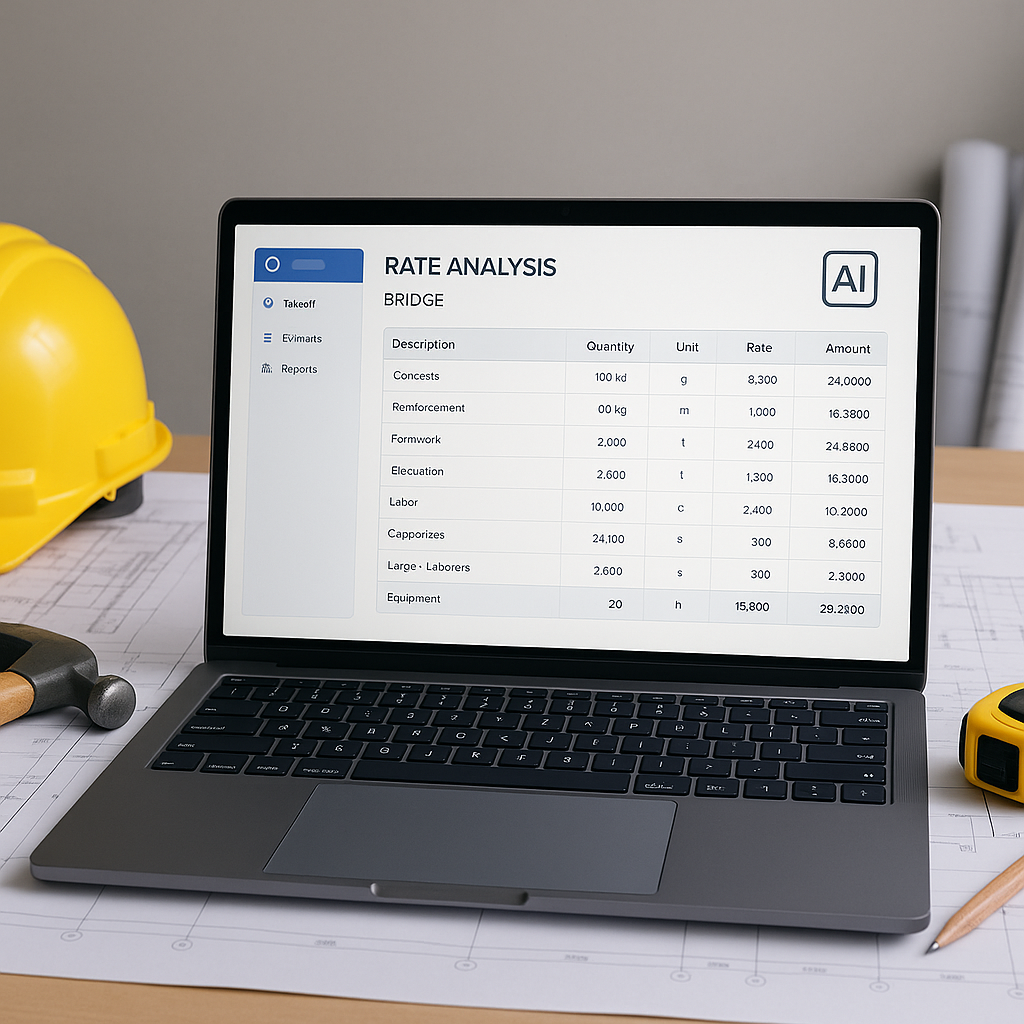
Manual Rate Analysis is Killing Your Productivity
Rate analysis is one of those tasks that sounds straightforward but rarely is. Take material, labor, equipment, overhead, and profit, and calculate the total rate. Easy, right? Not quite.
In reality, it’s a slog. You’re flipping through 2,000-page CPWD DSRs or RSMeans catalogs. You’re cross-referencing rates for materials and labor. You’re adjusting for inflation and regional differences. And then there’s the manual data entry — updating bloated spreadsheets that can break with one wrong formula.
For civil works, this process can take hours, even days. A 2023 study by Construction Executive showed that estimators spend up to 40% of their time on manual rate analysis. That’s tens of thousands of dollars wasted annually on inefficiency.
And mistakes? They’re inevitable. Miss one inflation adjustment or forget a regional labor uplift, and your bid is either overpriced (you lose the job) or underpriced (you bleed margin). For example, a 2021 report from the American Society of Civil Engineers revealed that errors in cost estimation account for nearly 12% of total project budget overruns. The stakes are high.
The AI-Powered Shortcut for Rate Analysis
This is where AI tools like EstimateNext come in. They don’t just speed things up — they make the process smarter and more reliable. Let’s break it down.
1. Automated Rate Matching
Imagine you’re pricing concrete works for a bridge project. You upload your Bill of Quantities (BOQ) into EstimateNext. The platform’s AI scans 78,000+ Standard Schedule of Rates (SOR) items across 135 catalogs, including CPWD and RSMeans, and matches the correct rates instantly.
No more digging through PDFs or outdated spreadsheets. Need a rate for a specific grade of concrete? Just type it in. Matches appear in seconds, not hours.
For example:
- You’re pricing M25 concrete for a highway project.
- The AI instantly identifies the appropriate SOR item from CPWD.
- It provides the rate: ₹6,000/m³, broken into material, labor, and equipment costs.
This eliminates the headache of manual cross-referencing. The time savings compound significantly when dealing with a BOQ that has hundreds or thousands of line items.
2. Detailed Cost Breakdown
AI doesn’t just give you a lump sum. It breaks each rate into material, labor, and equipment costs, complete with a full audit trail. You’ll know exactly what’s driving the cost, which makes it easier to justify to clients or adjust for scope changes.
For example, let’s say your project requires 100 cubic meters of M25-grade concrete. The AI provides:
- Material cost: $70/m³
- Labor cost: $30/m³
- Equipment cost: $20/m³
- Total: $120/m³
This level of transparency becomes critical during negotiations or when clients request cost justifications. It also reduces the risk of overlooking key components that drive up costs.
3. Inflation Adjustments Made Easy
Bidding on a multi-year project? You’ll need to adjust for inflation. EstimateNext auto-suggests the Consumer Price Index (CPI) for your catalog and region, applying compound adjustments to every rate.
Let’s say your CPWD catalog lists a labor rate of ₹500/day. If CPI inflation is 6% annually, the AI will calculate the adjusted rate for the project’s timeline automatically. No manual math required.
Example Use Case:
- Project start: 2023
- Duration: 3 years
- Original labor rate: ₹500/day
- Adjusted rate (2026): ₹500 x (1.06)^3 = ₹595/day
Without AI, you’d need to do this for every line item in your BOQ — an error-prone and time-consuming process.
4. Real-Time Updates for What-If Scenarios
What happens if material prices spike? Or if the client asks for an alternative design? With traditional spreadsheets, you’d have to rebuild your entire workbook. With AI, changes are instant.
Update one rate, and the entire BOQ recalculates in real time, complete with an audit trail. Need to swap out M25 concrete for M30? Done in seconds.
This dynamic capability allows you to handle scope changes or material price fluctuations with ease — a crucial advantage in an industry where uncertainty is the norm.
Real-World Example: Bidding on a Highway Project
Let’s put this into context. Say you’re a contractor bidding on a $50M highway project. The BOQ includes:
- 10,000 cubic meters of M25 concrete
- 15,000 cubic meters of earthwork
- 5,000 tons of asphalt
Here’s how the process looks with and without AI:
| Task | Manual Process | AI-Powered Process |
|---|---|---|
| Rate lookup | 10 hours (catalog searches) | 10 minutes (semantic search) |
| Inflation adjustment | 3 hours (manual CPI calculations) | Automated in seconds |
| Cost breakdown | 2 hours | Instant |
| Scope change updates | 5 hours | 10 minutes |
| Total time | 20 hours | ~20 minutes |
By using AI for rate analysis, you’ve just saved nearly two full workdays on one bid. Multiply that by the 5-8 GMP pursuits you handle annually, and the ROI is obvious.
Why This Matters Now
The construction industry is facing tighter margins, faster timelines, and increasing project complexity. Manual rate analysis isn’t just inefficient — it’s unsustainable. AI tools like EstimateNext are more than a convenience; they’re a necessity for staying competitive.
Take the case of XYZ Construction Co., which adopted EstimateNext in 2022. Over the course of a year, they reduced bid preparation time by 45%, enabling their team to submit 30% more proposals without increasing headcount. This resulted in a 20% increase in revenue from successfully awarded projects.
If you’re still relying on spreadsheets and rate books, you’re leaving money and time on the table. Stop wasting hours on manual processes. Start using AI to perform accurate rate analysis for civil works in a fraction of the time.


