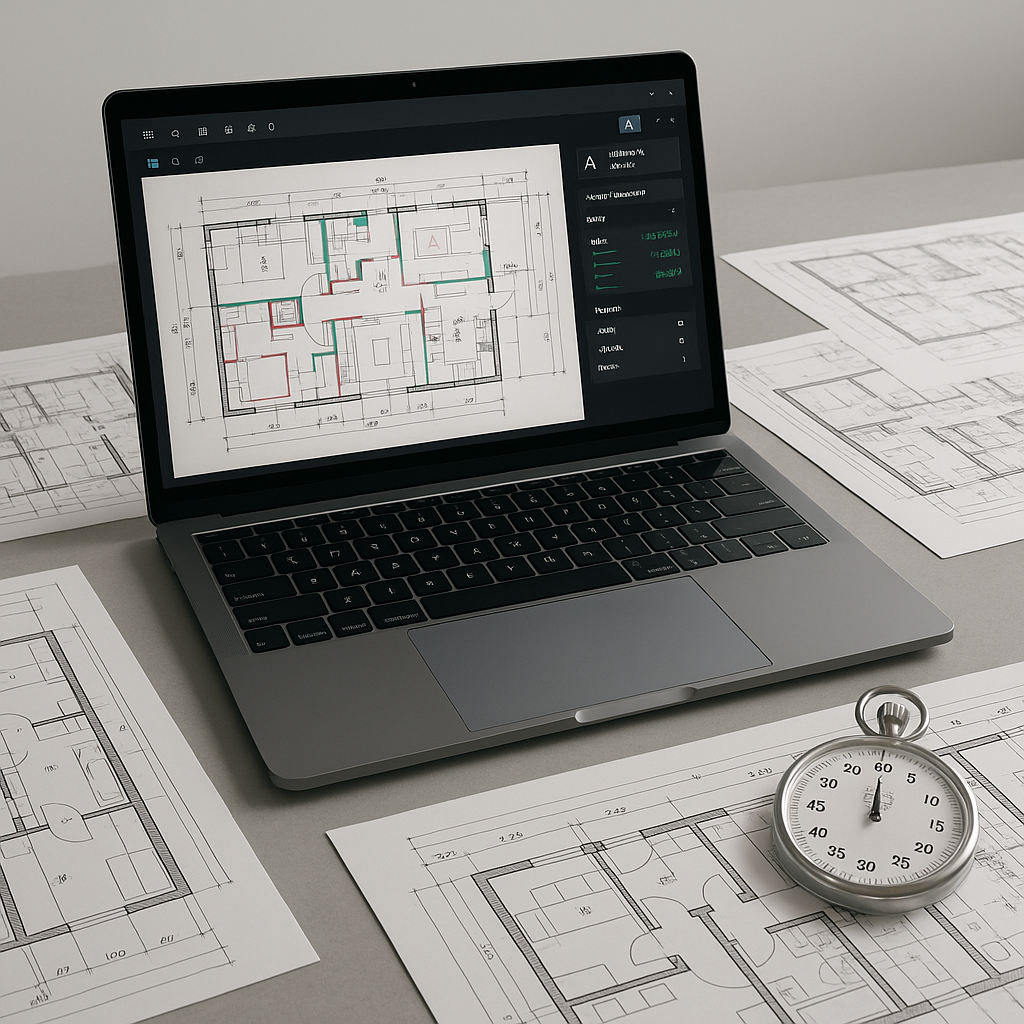
The Brutal Truth: Manual Takeoffs Are Killing Your Margins
Let’s be honest—manual takeoffs are a nightmare. Flipping through drawings, measuring every room and wall, calculating quantities—it’s slow, error-prone, and exhausting. General contractors spend up to 40 hours per bid just on takeoff tasks. That’s two full workdays for two estimators on a single pursuit. Multiply that across five GMP bids a year, and you’ve burned 400 hours. Not ideal.
Now factor in hourly rates. If your estimators cost $130/hour (common for mid-tier GCs), that’s $52,000 in takeoff labor costs annually. And for what? High error rates, missed deadlines, and gut-check revisions. It’s a broken process.
But the damage goes beyond just time and money. Manual takeoffs also limit how many bids your company can pursue, which directly impacts your bottom line. In a highly competitive market, losing out on bids because you’re stuck in an outdated, manual process is a risk you can’t afford.
How AI Cuts Takeoff Time to 10 Minutes
AI-powered tools like EstimateNext Vision AI are flipping the script. Instead of spending 40 hours on manual takeoffs, Vision AI extracts quantities directly from PDF drawings in just 10 minutes. That’s not a typo—10 minutes. The AI scans architectural plans, identifies dimensions (room areas, wall lengths, fixture counts), and outputs a ready-to-use Quantity Takeoff (QTO) file.
Case Study: Mid-Sized GC Saves 120 Hours
A mid-sized general contractor bidding on a 22-story high-rise used Vision AI to complete their takeoff. What would have taken 120 hours manually was completed in just 4 hours end-to-end, including manual review of flagged items. That’s a two-week labor cost saved while still meeting the client’s deadline. They described it as “like hiring a full-time estimator without the overhead.”
Error Reduction is the Game-Changer
The value of AI isn’t just speed—it’s accuracy. Human fatigue often leads to discrepancies: a missed window here, a miscalculated wall length there. Vision AI validates outputs against industry standards like NRM2, CPWD, and CSI, cutting takeoff discrepancies by up to 80%. One flooring subcontractor reported a staggering 25% reduction in material overages after adopting AI-based takeoffs because the tools caught errors they routinely missed manually.
Why Speed Matters More Than Ever
Construction timelines aren’t getting longer; they’re getting tighter. Projects are larger, schedules are compressed, and competition is fiercer than ever. If your bid arrives late—or worse, riddled with errors—you’re handing the job to someone else.
Case Study: The $518M Virginia Floodwater Project
The GC on the $518M Virginia floodwater project was competing against some of the largest firms in the country. By using AI-powered preconstruction tools, they shaved weeks off their manual workflows. This not only allowed them to meet an aggressive submission deadline but also gave them enough time to refine their pricing strategy. The project lead later credited AI tools with keeping them competitive despite being a mid-sized firm.
The Competitive Edge of Fast and Accurate Bids
According to a Dodge Data & Analytics report, contractors who submit bids earlier have a 14% higher likelihood of winning the project. Faster takeoff times enable you to submit polished bids sooner, giving you a significant advantage over competitors still bogged down by manual processes.
Addressing the Obvious Objection: “But AI Can’t Think Like an Estimator”
You might be thinking, “Sure, AI is fast, but it doesn’t understand the nuances of construction.” And you’re right—to a point. AI doesn’t replace your expertise; it amplifies it. You’re still the one making judgment calls, negotiating with subs, and deciding on markup. The AI handles the grunt work—takeoffs, rate matching, what-if recalculations—so you can focus on strategy.
How AI Learns From You
AI tools like Vision AI improve with use. Every project you price feeds into its self-learning model, improving accuracy over time. By the third project, most users report near-perfect rate matching and quantity extraction. For example, a concrete subcontractor who initially reviewed every line item manually found that by their fifth project, AI outputs required only minor adjustments—cutting their review time by 60%.
Why Human Oversight Still Matters
AI tools are incredibly powerful, but they’re not infallible. A flagged low-confidence area might require you to double-check unusual dimensions or infer details not explicitly noted in the drawings. The synergy between human expertise and AI precision is what delivers the best results.
Practical Example: Estimating a $1B Rail Project
Let’s break it down. You’re bidding on a $1B rail project. The drawings arrive: 150 sheets of densely packed data, from bridge elevations to drainage plans. Manual takeoffs would take 56 hours—time you don’t have.
With Vision AI, you upload the PDFs, calibrate the scales, and let the tool extract quantities. In 10 minutes, you’ve got a full QTO, ready for pricing. Plus, the AI flags low-confidence areas for manual review, ensuring nothing gets missed. This hybrid workflow shaves off over 80% of the time, allowing you to focus on refining your pricing strategy and coordinating with subs.
Comparison: Manual vs. AI Takeoff Workflow
| Aspect | Manual Takeoffs | AI-Powered Takeoffs |
|---|---|---|
| Time Per Bid | 40 hours | 10 minutes |
| Error Rate | 15-20% | <5% |
| Labor Cost Per Estimate | $5,200 | $22 |
| Scalability | Limited by manpower | Scales with ease |
The ROI: $5,200 Saved Per Pursuit
Here’s the math: Vision AI saves 40 hours per estimate. At $130/hour, that’s $5,200 in labor costs avoided. Multiply that across five GMP pursuits, and you’re looking at $26,000 annually. All for a tool that costs just $99/month. That’s a 52X ROI.
Subcontractors See Even Better Returns
For subcontractors, the ROI can be even higher. Faster takeoffs mean faster quotes, which translates to responding to more bid packages. One MEP subcontractor reported a 50% increase in bid responses after adopting AI estimation tools. More bids = more wins = more revenue.
Take the Next Step
If manual takeoffs are draining your team’s time and budget, it’s time to rethink your process. EstimateNext Vision AI automates drawing extraction, cuts errors, and delivers ROI you can’t ignore. Get started free →


