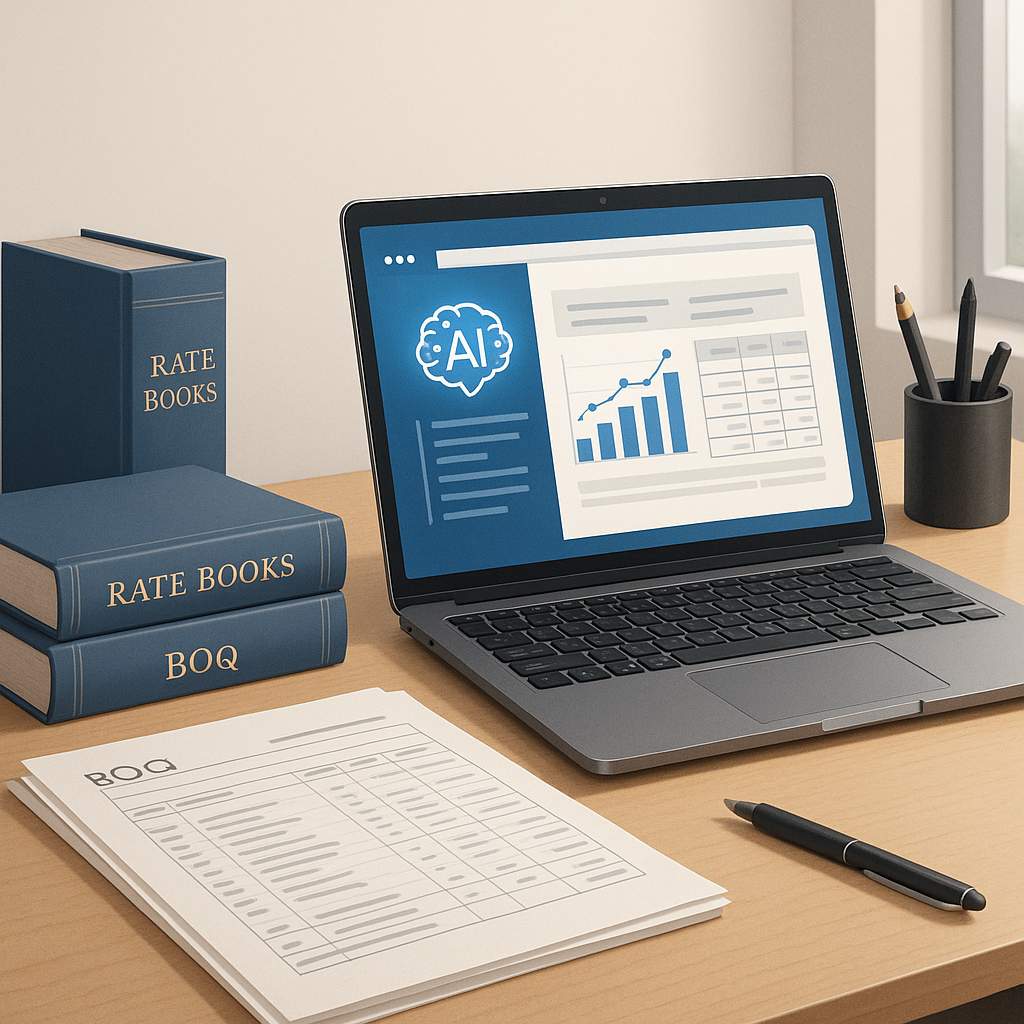
How AI-Powered Rate Matching Improves Preconstruction Estimation
Manual rate lookups are a common challenge in an estimator’s workflow. Whether you’re referencing RSMeans, CPWD DSR, or custom catalogs, the process can be tedious, error-prone, and time-consuming. This inefficiency can add up significantly across multiple projects, creating bottlenecks in the preconstruction phase.
AI-powered rate matching offers a solution by automating these repetitive tasks. It’s faster, smarter, and adapts to your workflow over time. Here’s how it works and why it’s a valuable tool for preconstruction estimation.
The Problem: Manual Rate Matching Eats Time and Accuracy
Manual rate matching involves uploading your Bill of Quantities (BOQ) into a spreadsheet and cross-referencing each line item against rate books or catalogs to find material, labor, and equipment costs. This process can become even more cumbersome if the BOQ contains merged cells, inconsistent headers, or other formatting issues that require additional cleanup.
Errors are common in manual processes. Missing a row can lead to underpricing, while using an incorrect rate can inflate your bid. Even experienced estimators are not immune to these errors, which can ultimately affect the competitiveness of a bid.
This challenge is not limited to small contractors. Large general contractors, MEP subcontractors, and fit-out specialists all face similar inefficiencies when relying on manual methods.
The Solution: AI-Powered Rate Matching
AI-powered tools streamline the rate-matching process by automating repetitive tasks and reducing the likelihood of human error. These tools use advanced algorithms to parse BOQs, identify hierarchies, and match line items to the most relevant rates. Key features often include:
- Tenant History: Leveraging rates used in previous projects.
- User Catalogs: Incorporating custom materials and finishes.
- Regional Rates: Adapting to location-specific rate books.
- Predictive Matching: Offering suggestions for new or ambiguous items.
For example, if you need the labor rate for installing pre-stressed concrete girders, the AI can quickly provide a match without requiring you to manually search through PDFs or spreadsheets. This allows estimators to focus on higher-value tasks rather than repetitive lookups.
Why Feedback Loops Matter
AI rate matching improves over time through feedback loops. When users adjust rates or reject matches, the system learns from these inputs to provide more accurate suggestions in future projects. This adaptability ensures that the tool becomes increasingly aligned with your specific needs, whether you’re working on a small renovation or a large infrastructure project.
Common Objection: “But AI Can’t Think Like an Estimator”
It’s true that AI doesn’t understand the nuances of construction, such as why one grade of steel might be preferred over another or how to negotiate with subcontractors. However, the purpose of AI is not to replace human expertise but to enhance it. By handling repetitive tasks, AI allows estimators to focus on strategic decisions, such as markup and scope definition, where their expertise is most valuable.
What to Watch For
While AI-powered rate matching offers significant advantages, there are a few considerations to keep in mind:
- Data Quality: Ensure that your BOQ is clean and well-structured to maximize the tool’s effectiveness.
- Custom Rates: Upload unique materials or rates into the system beforehand for accurate matching.
- Validation: Always review AI-generated matches, especially for high-cost or critical items.
- Regional Variations: Verify that the AI is using the correct regional catalogs, such as CPWD for India or RSMeans for the US.
FAQ
Q: How accurate are AI-generated rate matches?
A: AI tools are designed to provide high accuracy but include manual override options to ensure precision.
Q: Can I use AI rate matching for custom catalogs?
A: Yes, most platforms allow you to upload custom rates, which are then integrated for future use.
Q: Does AI rate matching work for smaller projects?
A: Yes, the system can scale to accommodate projects of any size, from small fit-outs to large infrastructure developments.
Q: Does AI replace estimators?
A: No, AI is a tool that enhances efficiency while relying on human oversight for final decisions.
Conclusion
AI-powered rate matching simplifies preconstruction estimation by automating tedious tasks, reducing errors, and allowing estimators to focus on higher-value activities. By integrating these tools into your workflow, you can improve both efficiency and accuracy in your bid preparation process.