AI-Powered Preconstruction Estimation: How Rate Matching Works
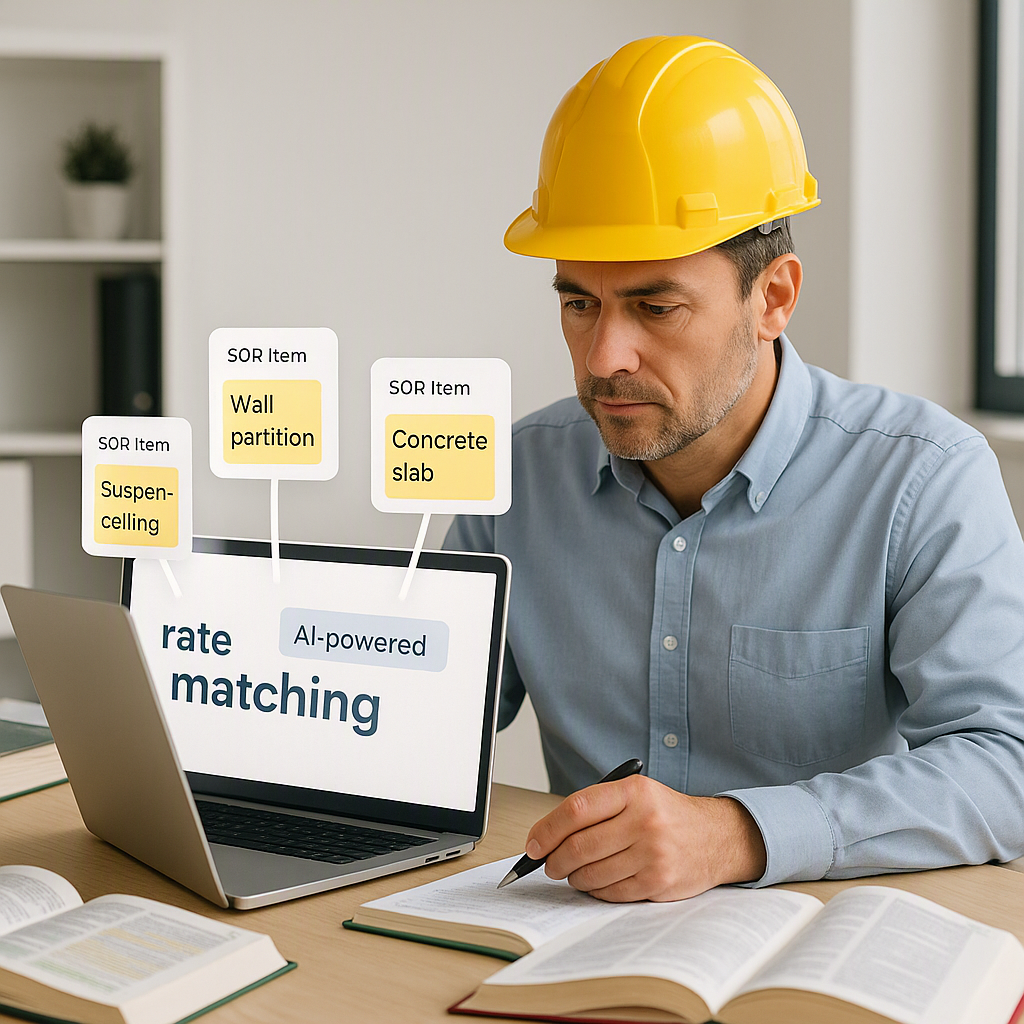
Manual rate lookups aren’t just tedious—they’re a productivity bottleneck. If you’ve ever spent hours flipping through a 2,000-page rate book or scrolling endless PDFs of RSMeans or CPWD SORs, you know how time-consuming it can be. Yet, it’s unavoidable if you want an accurate estimate.
But what if you didn’t have to do it manually? What if AI could match rates for you in seconds?
Let’s break down how AI-powered rate matching works, why it’s a game changer for estimators, and how it can streamline your workflow.
The Pain of Manual Rate Lookups
Finding the right rate for a specific item is often a bottleneck in preconstruction. For example, when pricing a large commercial project, you might have a lengthy bill of quantities (BOQ), and each line item needs a rate. For every item, you might:
- Check historical rates in your company’s database.
- Look up market rates in RSMeans, CPWD DSR, or another catalog.
- Factor in location-specific adjustments, inflation, or custom specifications.
This process can take significant time per estimate. And it’s not just about time—it’s about accuracy. Misreading a rate or applying the wrong adjustment can skew your entire estimate. Small mistakes compound, especially on larger projects.
How AI-Powered Rate Matching Works
AI tools automate this process by using semantic search and machine learning. Here’s how it works:
- Upload Your BOQ: You start by uploading your bill of quantities in Excel, CSV, or even PDF format.
- Semantic Search: The AI scans your BOQ line items and searches across a database of standard rates. Instead of relying on exact matches, it uses context to find the closest rates. For example, if your item says “Polished Concrete Flooring,” the AI searches for related terms like “Concrete Flooring—Polished Finish” or “High-Gloss Concrete.”
- Layered Matching: The system applies a multi-step approach:
- Matches rates from your company’s previous projects.
- Checks any custom catalogs you’ve uploaded.
- Expands the search to national or regional rate books (e.g., CPWD DSR for India, RSMeans for the US).
- Uses machine learning to suggest matches when no exact rate exists.
- Adjustments: It applies location factors, inflation percentages, and other cost variables automatically.
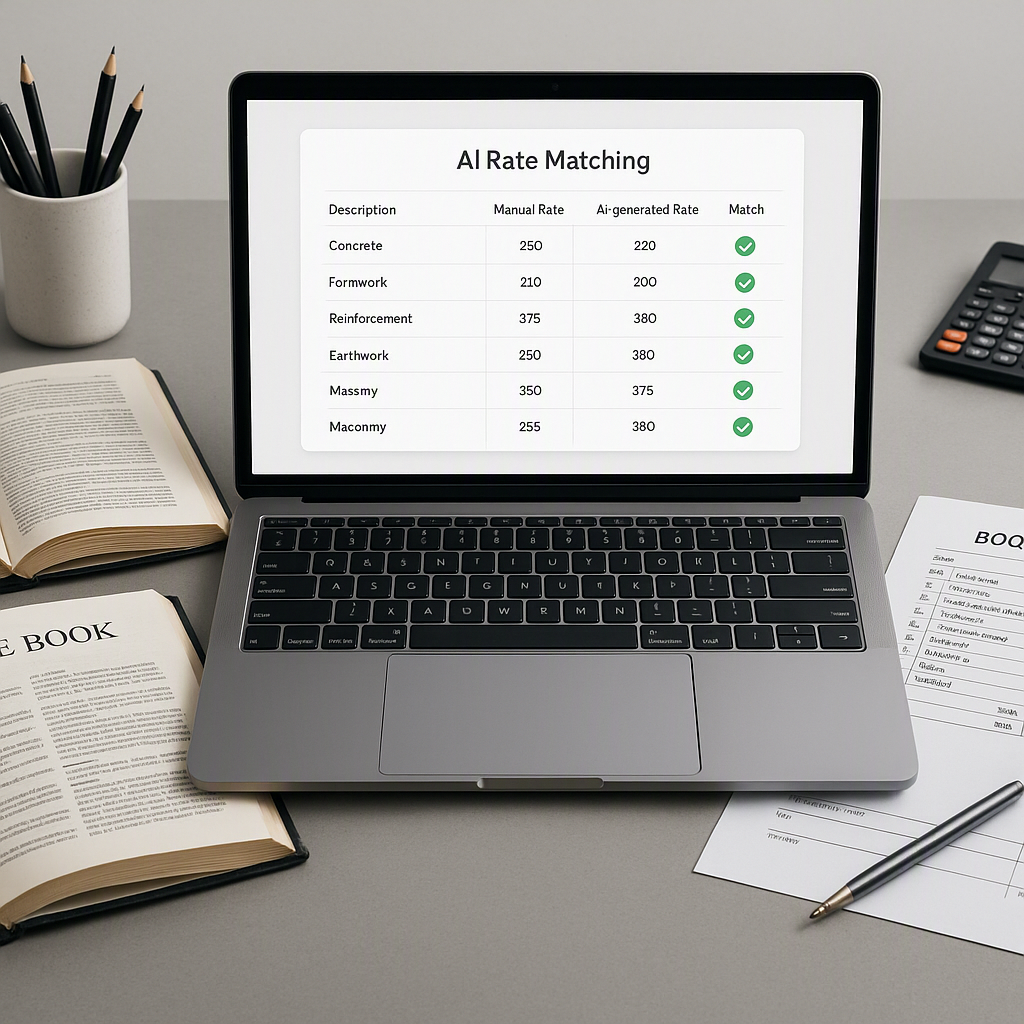
In a short time, you’ve got a fully populated BOQ with rates—no flipping pages, no guessing.
Benefits of AI Rate Matching
AI-powered rate matching offers several advantages:
- Time Savings: Automating rate lookups frees up significant time for estimators to focus on higher-value tasks.
- Improved Accuracy: By standardizing the process, AI reduces the likelihood of human errors, such as misreading rates or applying incorrect adjustments.
- Scalability: Faster rate matching allows teams to handle more estimates, increasing their capacity to bid on projects.
Common Questions About AI Rate Matching
1. Is AI accurate enough for high-value projects?
Accuracy depends on the quality of your input data. If your BOQ is clean and detailed, AI tools can deliver highly accurate matches. However, human oversight remains critical for final checks.
2. What if my rates are custom or project-specific?
Most AI tools allow you to upload custom rate catalogs. The system integrates these seamlessly, ensuring your estimates reflect your actual costs.
3. Does AI integrate with existing preconstruction tools?
Yes, many platforms integrate with common tools like Bluebeam, Procore, and Excel, enabling you to export AI-driven estimates directly into your workflows.
4. How long does it take to train a team to use AI tools?
Most platforms are designed to be intuitive, with training typically taking a short amount of time, even for teams new to AI.
What to Watch For
AI-powered rate matching isn’t perfect. Here are a few considerations:
- Input Quality is Key: If your BOQ is incomplete or vague, the AI won’t perform as well.
- Edge Cases: Highly specialized items or materials may not have a direct match, requiring manual intervention.
- Feedback Loops: Good AI tools improve over time. Providing feedback helps the system learn and become more accurate.
Why This Matters
AI isn’t here to replace estimators—it’s here to make their jobs easier. Rate matching is a prime example of how AI can take a repetitive, low-value task off your plate so you can focus on what actually matters: refining your bid strategy, negotiating with subcontractors, and winning more work.
If you’re still doing rate lookups manually, you’re leaving time and efficiency on the table. AI-powered tools offer a way to modernize your process without the steep learning curve of traditional estimation software.