Takeoffs Are Killing Your Preconstruction Workflow
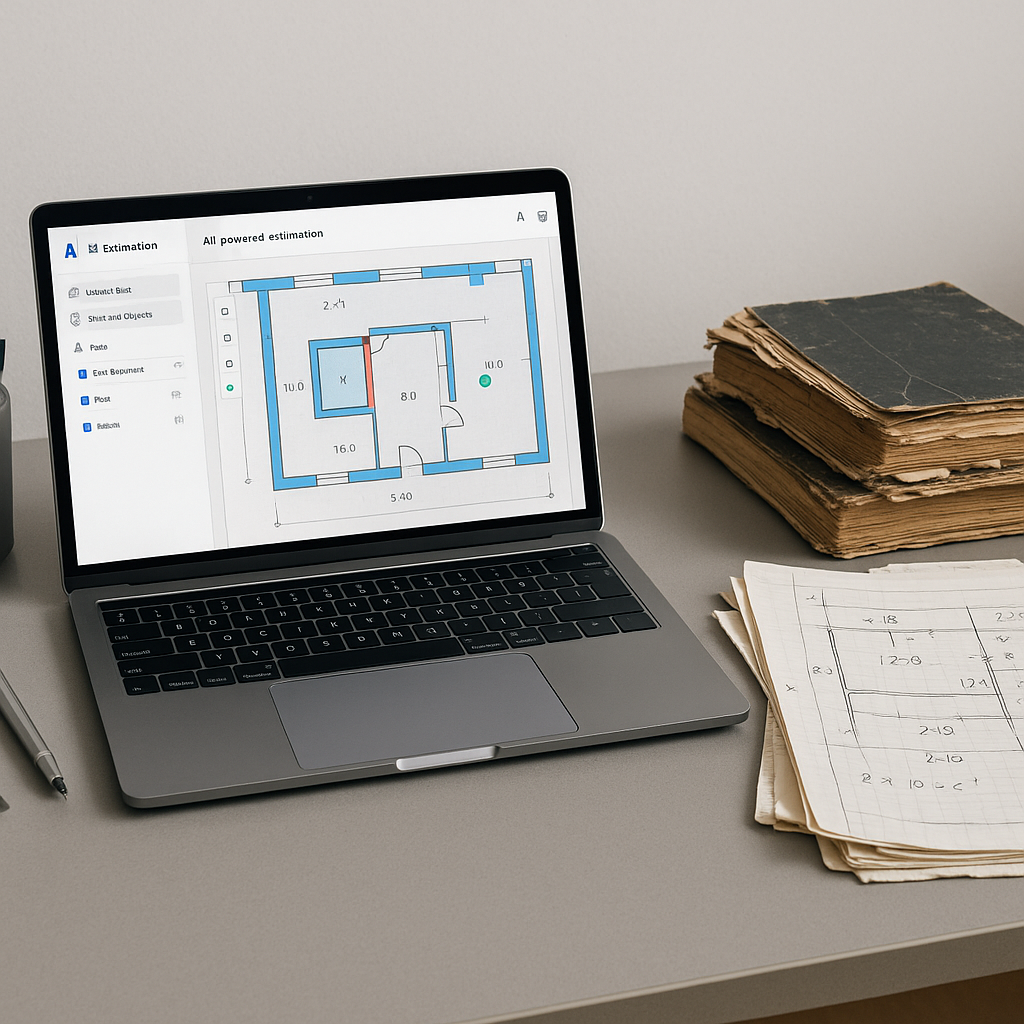
Every estimator knows the pain: staring at drawings for hours, manually measuring lengths, areas, and counts. It’s slow, tedious, and prone to errors. On average, manual takeoffs consume 40 hours per project—that’s two full workweeks just pulling quantities. Multiply that across multiple bids, and you’re burning time you don’t have.
But what if you could cut that down to 10 minutes? That’s not an exaggeration. AI-powered tools like EstimateNext deliver exactly this kind of speed boost. Let’s dive deeper into why manual takeoffs are holding you back and how AI can drastically improve your workflow.
Why Manual Takeoffs Don’t Cut It Anymore
Let’s be real—manual takeoffs are outdated. They worked when project scopes were simpler, and deadlines were longer. But today? Projects are more complex, and bid timelines have shrunk dramatically. You can’t afford to spend days on measurements while your competitors are already pricing their bids.
The Hidden Costs of Manual Takeoffs
Here’s what makes manual takeoffs such a bottleneck:
- Human Errors: Misread dimensions, missed details, or incorrect scaling. These errors can cost you the bid—or worse, your profit margin. For instance, a small miscalculation on a $10M commercial project led one contractor to underbid by $50,000—wiping out their expected profit.
- Rework: Revisions to drawings mean starting over from scratch. You lose hours rebuilding your quantities. Imagine having to redo measurements because of a single updated CAD file.
- Resource Strain: Senior estimators could spend their time on high-value tasks like bid strategy but are stuck doing grunt work. A seasoned estimator earning $100,000 a year might spend 20% of their time on repetitive tasks, effectively wasting $20,000 annually.
The Industry Shift
The construction industry is evolving rapidly. According to a study by McKinsey, construction productivity has only grown by 1% annually over the past two decades, significantly lagging behind other industries. To stay competitive, firms must adopt tools that optimize workflows and eliminate inefficiencies. Manual takeoffs are a prime example of low-hanging fruit for improvement.
How AI Revolutionizes Takeoffs
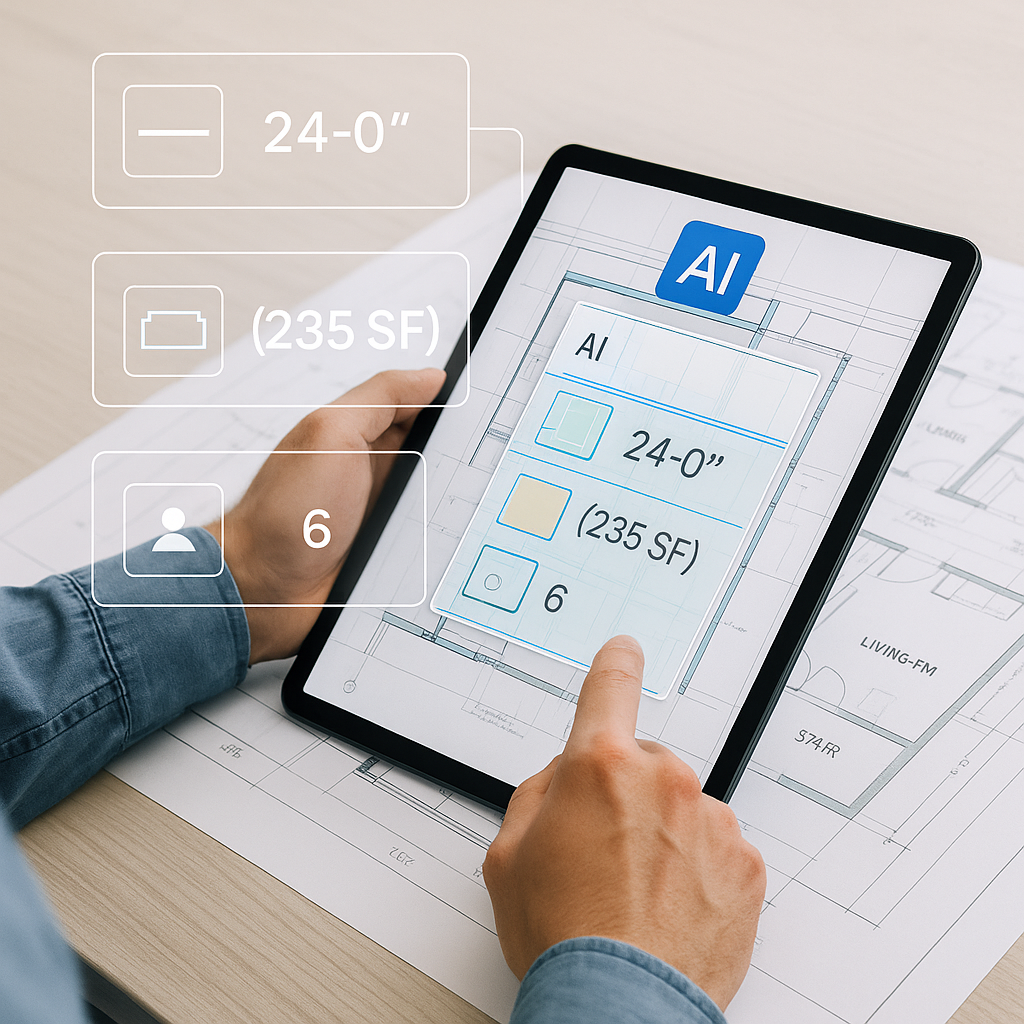
AI-powered takeoff tools flip the script. Instead of manually tracing drawings, you upload a PDF or CAD file, and the software extracts quantities automatically. No rulers, no guesswork.
How It Works
- Upload Your Drawings: Drop in your PDF or CAD files—no manual setup required.
- AI Scans for Quantities: The tool identifies walls, doors, windows, and more, calculating areas, lengths, and counts in seconds.
- Review Low-Confidence Areas: If the AI isn’t sure about a detail, it flags it for your review. You can adjust and finalize with just a few clicks.
For example, a mid-sized general contractor recently used EstimateNext’s Vision AI on a high-rise bid. They saved 120 hours of labor—two full weeks of work—just on quantity takeoffs. That’s time they reinvested into refining their bid strategy and negotiating better subcontracts.
Key Benefits
- Speed: A process that used to take 40 hours can now be completed in just 10 minutes.
- Accuracy: AI reduces human error by up to 80%, ensuring more reliable estimates.
- Scalability: Whether you’re bidding on a $1M project or a $1B infrastructure job, AI adapts to the scope and complexity.
Real-World Success Story
Take the case of Johnson & Co., a regional general contractor specializing in healthcare facilities. Before adopting AI, they struggled to juggle 15 bids a month, often stretching their small estimating team to the breaking point. After switching to an AI-powered takeoff tool, they:
- Reduced time spent on takeoffs by 85%.
- Increased their bid throughput by 30%, allowing them to pursue more opportunities.
- Improved bid accuracy, which directly contributed to a 10% higher win rate.
The Numbers Don’t Lie
A typical estimator spends 40 hours on manual takeoffs. With AI tools, that drops to 10 minutes. Let’s break that down:
| Metric | Manual Workflow | AI Workflow |
|---|---|---|
| Time per estimate | 40 hours | 10 minutes |
| Labor cost per bid | $2,000 ($50/hour) | $8.33 ($50/hour) |
| Annual cost (10 bids) | $20,000 | $83.30 |
Multiply that difference across 10 bids per year, and you’re looking at $19,917 saved annually per estimator. For a team of 4 estimators, that’s nearly $80,000 in savings.
And it’s not just about the money. Faster takeoffs mean:
- More time for strategic tasks.
- Improved accuracy, reducing the risk of costly errors.
- The ability to respond to more bids, increasing your win rate.
ROI Breakdown
Let’s run the math for a General Contractor (GC):
- Project Scale: $200M/year revenue.
- Estimating Team: 4 estimators.
- Bids Per Year: 10 GMP pursuits.
- Time Savings: 40 hours saved per bid x 10 bids = 400 hours/year.
- Labor Cost Savings: 400 hours x $50/hour = $20,000/year.
Now, compare that to the cost of an AI tool like EstimateNext, which starts at $99/month per seat. For a team of 4, that’s $4,752/year. The ROI? 420% annually.
Common Objections to AI Takeoff Tools
“AI can’t do what I do.”
I hear this a lot. And it’s true—AI isn’t replacing your expertise. But it can handle the repetitive, time-consuming tasks, leaving you free to focus on the parts of estimation that require judgment and experience.
“What if the AI makes mistakes?”
AI isn’t perfect, but tools like EstimateNext include confidence scoring and manual override features. You review flagged areas and make adjustments as needed. Think of it as an assistant—not a replacement.
“We’re a small firm. Do we really need this?”
Absolutely. AI scales to any project size. Whether you’re estimating a $1M renovation or a $1B infrastructure project, the time savings are the same. For smaller teams, it’s like adding an extra estimator without the payroll expense.
FAQ
Q: How accurate are AI-powered takeoffs?
AI tools like EstimateNext are highly accurate, often reducing discrepancies by up to 80%. Human oversight ensures final precision.
Q: Can I use AI tools with existing software?
Yes! EstimateNext integrates seamlessly with platforms like Bluebeam, Procore, and Excel.
Q: What if my project uses custom rates?
You can upload your own rate catalogs, ensuring every estimate reflects your actual costs.
Q: How long does it take to implement AI tools?
Most teams are up and running in under two weeks, with minimal training required.
Q: Is this only for large firms?
Not at all. AI tools scale to any project size and budget, making them ideal for small firms too.
Call to Action
If you’re tired of losing hours to manual takeoffs, it’s time to make a change. EstimateNext can cut your takeoff time from 40 hours to just 10 minutes. Get started free →