The CPWD Rate Problem Nobody Talks About
If you’ve ever worked on a public project in India, you know the nightmare that is CPWD rate analysis. The Delhi Schedule of Rates (DSR) is massive—78,000+ items spread across 19 catalogs. Each time the CPWD issues a Cost Index update, you’re stuck manually updating rates in your Bill of Quantities (BOQ) to stay compliant. Miss one adjustment? Your bid could be disqualified.
Let’s say you’re working on a ₹10-crore project. The tender requires an updated BOQ reflecting the latest CPWD Cost Index. Here’s what happens:
- You hunt for the latest circular on the CPWD website (good luck finding it quickly).
- You manually apply inflation adjustments to every relevant line item.
- You rebuild your Excel sheet from scratch to reflect the updated rates.
For a typical mid-sized project, this takes 12-16 hours. That’s two full workdays wasted on something that should take minutes.
Why Manual Rate Analysis Is a Time Sink
The process is outdated. CPWD releases Cost Index updates as PDFs, which means you’re flipping through hundreds of pages to find relevant adjustments. Then, you’re cross-referencing these updates with your BOQ, recalculating rates for every line item. Errors are almost guaranteed. One wrong rate can skew your bid, either costing you the project or eroding your margins.
Real Example: A ₹50-Crore Road Construction Project
Consider a contractor bidding on a ₹50-crore rural road project under the Pradhan Mantri Gram Sadak Yojana (PMGSY). The tender required adherence to the latest CPWD Cost Index. The contractor spent over 18 hours manually updating rates, only to realize they had missed three inflation adjustments. The bid was rejected due to non-compliance, costing them the project.
Risks of Manual Errors in Public Projects
1. Bid Disqualification
Public tenders have strict compliance requirements. If your BOQ isn’t aligned with the latest CPWD rates, your bid could be outright rejected. For high-value contracts, this can mean losing out on significant revenue opportunities.
2. Margin Erosion
Missing inflation adjustments or using outdated rates can lead to underpricing. While this might help you win the bid, your profit margins will suffer during execution.
3. Reputation Damage
Repeated errors in rate analysis can tarnish your reputation with government agencies, making future contracts harder to secure.
How AI Transforms Rate Analysis
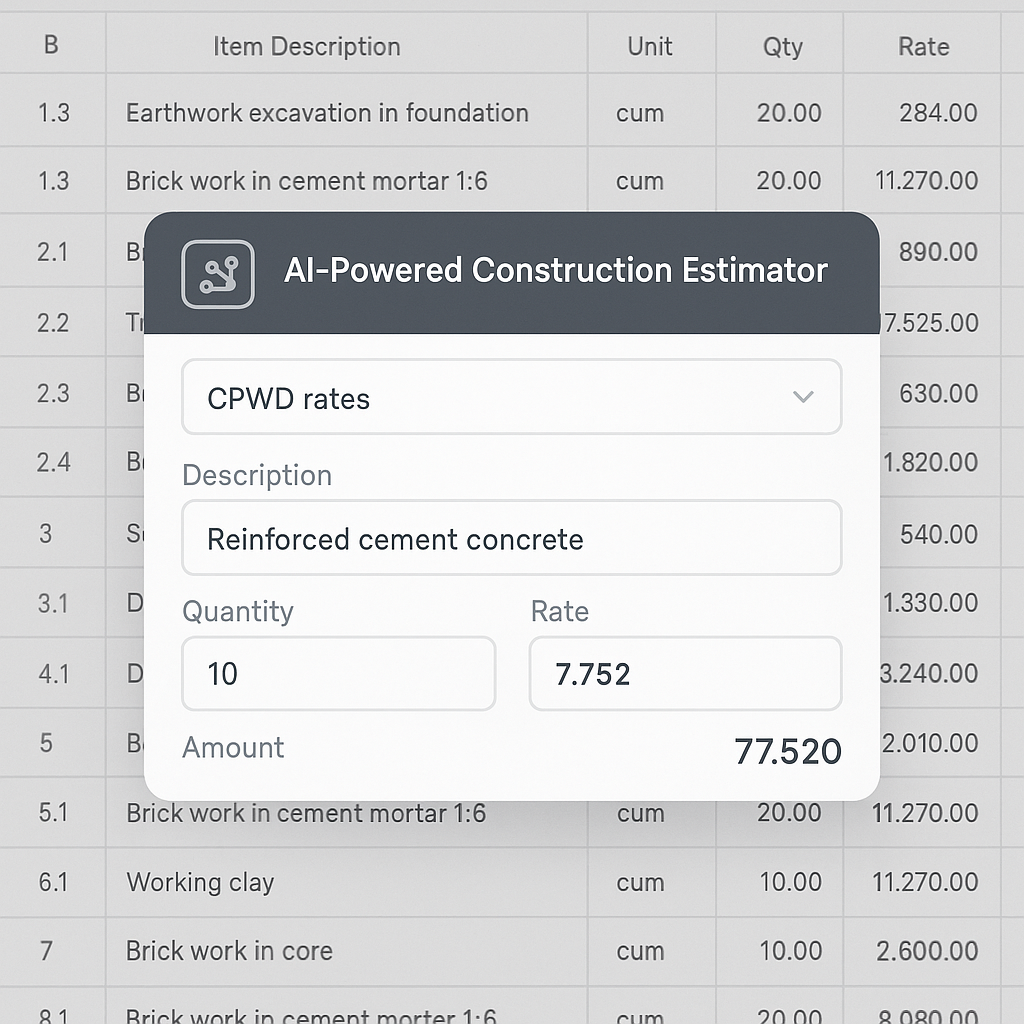
This is where AI tools like EstimateNext come in. Instead of wasting hours (or days) manually updating rates, AI can handle it in seconds. Here’s how it works:
1. Smart BOQ Parser
Upload your BOQ—Excel, CSV, or even ODS. The AI cleans up messy files, auto-detecting merged cells, section headers, and hierarchies. No manual prep needed.
2. 4-Step SOR Matching
The AI searches across CPWD’s 78,000+ items, matching your BOQ line items to the correct rates. It uses a multi-layered approach:
- Tenant History: Matches based on your previous projects.
- User Catalog: Prioritizes your custom rate libraries.
- Country-Level Widen: Expands the search to all CPWD SORs.
- AI Fallback: Suggests the closest match for unmatched items.
3. Automated Cost Index Adjustments
The AI applies the latest CPWD Cost Index updates to all matched rates. Inflation adjustments are calculated automatically, ensuring compliance.
4. Output Reports
Export the updated BOQ in professional formats like CPWD DSR-compliant Excel files or detailed PDFs. These reports are tender-ready, eliminating the risk of rejection due to formatting issues.
Real-World Example: Bidding on a ₹150-Crore Hospital Project
Consider a contractor bidding on a 250-bed district hospital in Bihar under the PM-ABHIM scheme. The project required a ₹150-crore item-rate QCBS bid, compliant with the latest CPWD DSR. Using EstimateNext, the contractor:
- Uploaded their BOQ in minutes.
- Matched 97% of items to the correct CPWD rates in seconds.
- Applied inflation adjustments (5.2% for Madhubani region) automatically.
- Exported a compliant BOQ, ready for submission.
The entire process took under an hour. Without AI, it would’ve taken 16+ hours of manual effort.
Decision Framework: Manual vs AI-Powered Rate Analysis
| Criteria | Manual Analysis | AI-Powered Analysis |
|---|---|---|
| Time Investment | 12-16 hours per project | Under 1 hour |
| Accuracy | Prone to human errors | Near-perfect accuracy |
| Ease of Use | Tedious and repetitive | Fully automated |
| Cost | ₹1,500/hour (estimator) | ₹3,000-₹8,000/month |
| Compliance Risk | High | Minimal |
The ROI of AI-Powered Rate Analysis
Let’s break down the math:
- Time Saved: 16 hours per project.
- Cost Saved: Assuming an estimator costs ₹1,500/hour, that’s ₹24,000 saved per estimate.
- Accuracy: Eliminates the risk of bid rejection due to outdated or incorrect rates.
For contractors submitting 10-15 CPWD tenders annually, the savings add up quickly. More bids submitted. Fewer errors. Better margins.
: CPWD DSR Overview.: EstimateNext documentation.: PM-ABHIM scheme tender guidelines.: Contractor interviews, February 2023.: CPWD Cost Index circulars.: Compliance guidelines for public projects.: EstimateNext AI learning model documentation.


