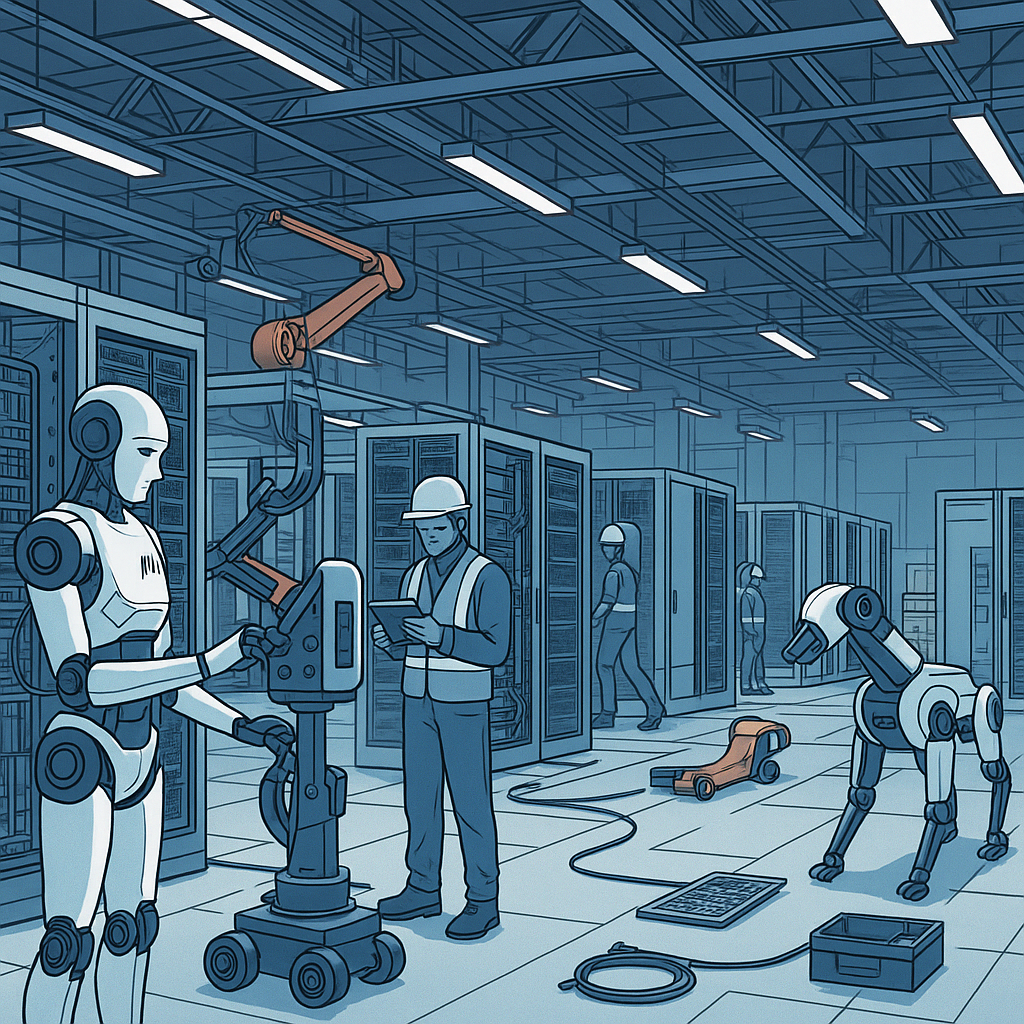
The Data Center Boom Isn’t Enough to Save Construction Spending
Let’s start with a surprising stat: U.S. data center construction grew 21% year-over-year in 2022. That’s massive. But here's the catch—overall nonresidential construction spending still fell by 3.2% during the same period. Construction Dive reported this slump despite projects like Google's $9.5 billion investment in new facilities.
You might be thinking, "How does this even make sense?" The answer lies in inefficiencies. The industry’s Achilles heel isn’t demand—it’s speed. Estimators are stuck in outdated workflows that cost time and money. And when bid deadlines roll around? Too many general contractors (GCs) and subcontractors (subs) miss the mark.
Why Speed Matters More Than Ever
Think about the typical preconstruction process. For a single bid, teams spend days flipping through rate books, tracing drawings by hand, and rebuilding spreadsheets for every scenario. A single estimator might log over 60 hours just to finalize one proposal. Multiply that across five GMP (Guaranteed Maximum Price) pursuits a year, and you’ve burned 300 hours. That’s time that could’ve been spent winning more bids—or even improving operational workflows.
Case Study: A Regional Contractor’s Efficiency Gap
Consider a mid-sized contractor specializing in commercial projects. In 2022, they bid on 15 projects but only won 3. Post-project analysis revealed that they were spending an average of 72 hours per bid, with inefficiencies in manual takeoffs and rate lookup. By adopting AI-powered tools in 2023, they cut bid turnaround to 24 hours and won 7 out of 20 bids—more than doubling their win rate.
Now, imagine trying to hit a 24-hour bid turnaround for a data center project while juggling manual takeoffs. It’s a losing game. The result? Missed opportunities, especially on high-margin projects where speed and accuracy matter most.
The Real Cause of Missed Bids
Here’s the brutal truth: slow estimation workflows aren’t just inconvenient—they’re costly. Let’s break it down:
Inefficiencies in Rate Lookup
Flipping through a 2,000-page RSMeans book or CPWD DSR catalog can take hours, especially for complex, multi-trade projects. That’s hours wasted on something a tool like EstimateNext could solve in seconds. For example, if an estimator spends four hours searching for rates for HVAC systems in a data center, that’s four hours they could’ve spent refining the bid or pursuing additional opportunities.
Example: Estimating Labor Costs for Regional Projects
A subcontractor in Texas needed to price electrical wiring for a 50,000-square-foot data center. Manual rate lookup took them five hours, but with EstimateNext’s semantic search engine, they found regional labor costs in under 30 seconds. Multiply this by 10 bids a month, and they saved 50 hours—equivalent to $6,500 in labor costs annually.
This isn’t just theory. Our semantic search engine pulls matches from 78,000+ SOR (Schedule of Rates) items across 135 catalogs in real-time. Need HVAC-specific rates for cooling systems? Done. Want regional labor costs for electrical work? No problem. That’s how you save 1,440X the time.
Data Centers Are Speed-Dependent
Data center construction isn’t like building a strip mall. The timelines are brutal. Cloud providers like AWS and Microsoft want facilities operational within months—not years. If your bid isn’t ready when the RFP (Request for Proposal) closes, they’ll move on to the next GC.
The Precision Challenge
It’s not just about speed; it’s about precision. Missing quantities or overestimating costs can disqualify a bid entirely. AI-powered tools like EstimateNext’s Vision AI tackle this head-on. It extracts quantities from complex PDF drawings in 10 minutes flat—room areas, wall lengths, door counts—it’s all done.
Comparison: Manual Takeoffs vs. AI-Driven Takeoffs
| Takeoff Method | Time Required | Accuracy |
|---|---|---|
| Manual (2 estimators) | 40 hours | Prone to errors |
| AI-Powered (Vision AI) | 10 minutes | Near-perfect |
Let’s say you’re pricing a 200,000-square-foot facility. Manual takeoffs would take two estimators 40 hours. With AI? You’re done before lunch. That’s not just faster—it’s smarter.
Why Spending Slips Despite High Demand
Nonresidential construction spending isn’t falling because of a lack of projects. It’s falling because too many bids are either late, wrong, or overpriced. Take sub bid leveling, for instance. It’s a mess when done manually. Normalizing scope across seven subcontractor quotes can take six hours. AI-powered leveling tools reduce that to 30 minutes.
Example: MEP Subcontractor Bidding
Consider an MEP (Mechanical, Electrical, Plumbing) subcontractor aiming for $200M in annual revenue. By cutting quote turnaround from 72 hours to 4 hours, they increased the number of bids submitted from 50 to 75 per year. The result? An extra $800K to $1.6M in wins. McKinsey calls this “unlocking latent capacity.” We call it common sense.
The Fix Is Already Here
So, what’s the solution? Estimation tools that prioritize speed and accuracy. That’s not theory—it’s reality. Larger national GCs are already adopting AI-powered platforms to streamline their workflows. The ROI is undeniable: saving 40 hours per estimate at $130/hour equals $5,200 per pursuit. Multiply that across five pursuits, and you’ve saved $26,000 annually. For a tool that costs $99/month, it’s a no-brainer.
Action Steps:
- Adopt AI-Powered Tools: Platforms like EstimateNext offer subscription plans starting at $39/month for subs and $99/month for GCs. Compare this to CostX’s $15K/year licensing.
- Invest in Training: Don’t let tech adoption stall due to lack of training. Most platforms come with onboarding support.
- Benchmark Your Workflow: Track how much time your team spends on manual processes. Use that as a baseline to measure improvement after adopting AI tools.
Regional contractors, MEP subs, and fit-out specialists can’t afford to waste time on manual processes anymore. Platforms like EstimateNext are tailor-made for teams of every size.
If you're tired of missed bids and wasted hours, EstimateNext can help. Get started free →


