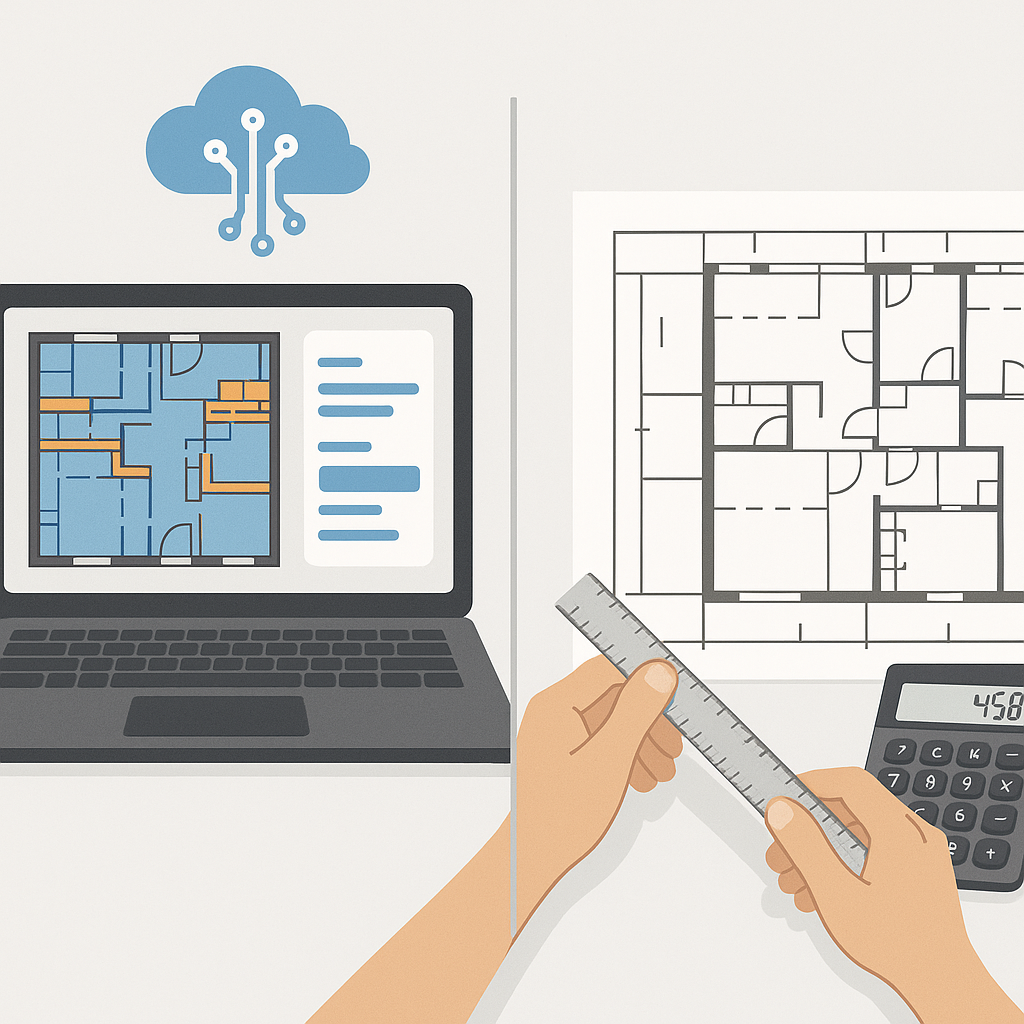
Manual Takeoffs Are Bleeding Time and Money
Let’s start with some brutal math. The average preconstruction team spends 40 hours on manual takeoffs for a single project. That’s two estimators grinding through drawings, PDFs, and Excel sheets for two full days. At $130/hour (a typical US estimator’s rate), that’s $5,200 per project in labor costs alone.
Now multiply this by five GMP pursuits a year. Or 30 bid packages for MEP subcontractors. Or 60 if you’re in regions like the GCC (Gulf Cooperation Council). Suddenly, you’re staring at $250,000 to $3 million annually, just on manual quantity takeoffs. And for what? A process riddled with errors, rework, and missed deadlines.
Why Manual Takeoffs Don’t Cut It
Here’s the problem: manual takeoffs are painfully slow and error-prone. You’re tracing lines on Bluebeam, flipping between sheets, and squinting at specs. One missed annotation? That’s a $50K mistake on bid day. And revisions? Good luck. Every change means starting over.
Even worse, manual workflows choke your bid pipeline. How many bids have you skipped because there wasn’t enough time? Or rushed and overpriced because you couldn’t verify quantities? In today’s market, speed wins. Accuracy wins. Manual takeoffs? They lose.
Real-World Example: Missed Opportunities
A mid-sized general contractor (GC) in Florida recently shared their struggles with manual takeoffs. On average, they spend 50 hours per project, but still missed 15-20% of potential bids due to time constraints. Worse, they discovered after losing bids that competitors were submitting tighter, more accurate numbers. In a single year, they estimated $1.2 million in lost revenue from missed opportunities alone—revenue that could have been reclaimed with faster workflows.
Digital Takeoffs: 10x Faster, 100x Smarter
This is where AI-powered tools like EstimateNext come in. Instead of spending 40 hours on takeoffs, you can do it in 10 minutes. Yes, 10 minutes. Here’s how:
1. Vision AI Extraction
Upload your PDF drawings, and the AI reads them for you. Room areas, wall lengths, door counts—it extracts it all. No tracing. No guesswork.
- Example: A mid-size GC in Texas shaved 38 hours off a school renovation bid. That saved $4,940 in labor costs, and they submitted two extra bids that month—securing one of them worth $500,000.
2. Revisions Made Easy
Got updated drawings? Just upload them. The AI compares revisions, highlights changes, and updates quantities automatically.
- Practical win: No more “version control” nightmares. Instead of redoing the entire takeoff, teams can focus on pricing and strategy.
3. Accuracy You Can Trust
The tool flags low-confidence measurements for manual review. If it’s unsure, it asks. You’re not flying blind.
- Case Study: A Chicago-based MEP subcontractor reduced their bid errors by 60% in the first six months of using EstimateNext. The flagged discrepancies helped avoid underbidding by $80,000 on a single high-rise project.
Real Numbers, Real Savings
Let’s run the numbers. Say your team handles 10 projects a year, each requiring 40 hours of manual takeoffs. That’s 400 hours annually. Switch to AI-powered takeoffs, and you’re down to 100 hours. You just freed up 300 hours.
At $130/hour, that’s $39,000 in labor savings alone. Add the revenue from the extra bids you can take on (say, 2-3 more wins at $200K each), and the ROI skyrockets.
For larger teams or subcontractors responding to dozens of packages, the impact compounds:
- One MEP firm in Chicago used EstimateNext to cut their quote cycle from 72 hours to 4. The result? 50% more bids responded to, and 8 additional wins that year. That’s $1.6 million in incremental revenue.
- A GC in California saved 600 hours annually across their estimating team, reinvesting that time into more competitive bids. Their win rate improved by 20% within the first year.
The Obvious Objection: “What About Accuracy?”
You might be thinking, “Sure, AI is fast, but can I trust it?” Fair point. Here’s the thing: AI doesn’t replace you. It augments you. Think of it as a supercharged assistant.
It handles the grunt work—extracting quantities, matching rates, flagging inconsistencies—so you can focus on the big stuff. Like refining your margins or value-engineering the bid. And because the tool learns from every project, it gets smarter over time. Your takeoffs today will be even better tomorrow.
Side-by-Side Comparison:
| Feature | Manual Takeoffs | AI-Powered Takeoffs |
|---|---|---|
| Time per Project | 40 hours | 10 minutes |
| Error Rate | High (human fatigue) | Low (AI validation) |
| Revision Handling | Labor-intensive | Automated |
| Scalability | Limited | Unlimited |
| Cost per Project | $5,200 | <$500 |
Why Speed Matters More Than Ever
The construction industry isn’t slowing down. Projects are getting bigger, timelines tighter, and competition fiercer. If your takeoff process is still stuck in 2003, you’re already behind.
AI tools like EstimateNext don’t just save time. They let you bid faster, more accurately, and more competitively. That’s the difference between winning a project and watching it go to your competitor.
Industry Trends That Demand Change:
- Rising Material Costs: Accurate takeoffs ensure you’re not underbidding in a volatile market.
- Tighter Timelines: Owners and GCs are demanding shorter bid turnaround times—manual processes can’t keep up.
- Increased Competition: More firms are adopting tech to gain an edge. Staying manual puts you at a disadvantage.
Ready to Leave Manual Behind?
If you’re still spending 40 hours per takeoff, it’s time to rethink your workflow. AI-powered solutions like EstimateNext can cut that to 10 minutes. Less time on takeoffs means more bids, more wins, and more profit.


