Why Are We Still Doing Takeoffs Like It's 1995?
Let’s get straight to the point: manual quantity takeoffs are a colossal time-waster. Two estimators can easily spend 40 hours tracing drawings, measuring wall lengths, and counting fixtures. That’s five full workdays. And if you’ve got tight deadlines or multiple bids overlapping, guess what? Corners get cut. Errors creep in. Bids are lost.
It doesn’t have to be this way.
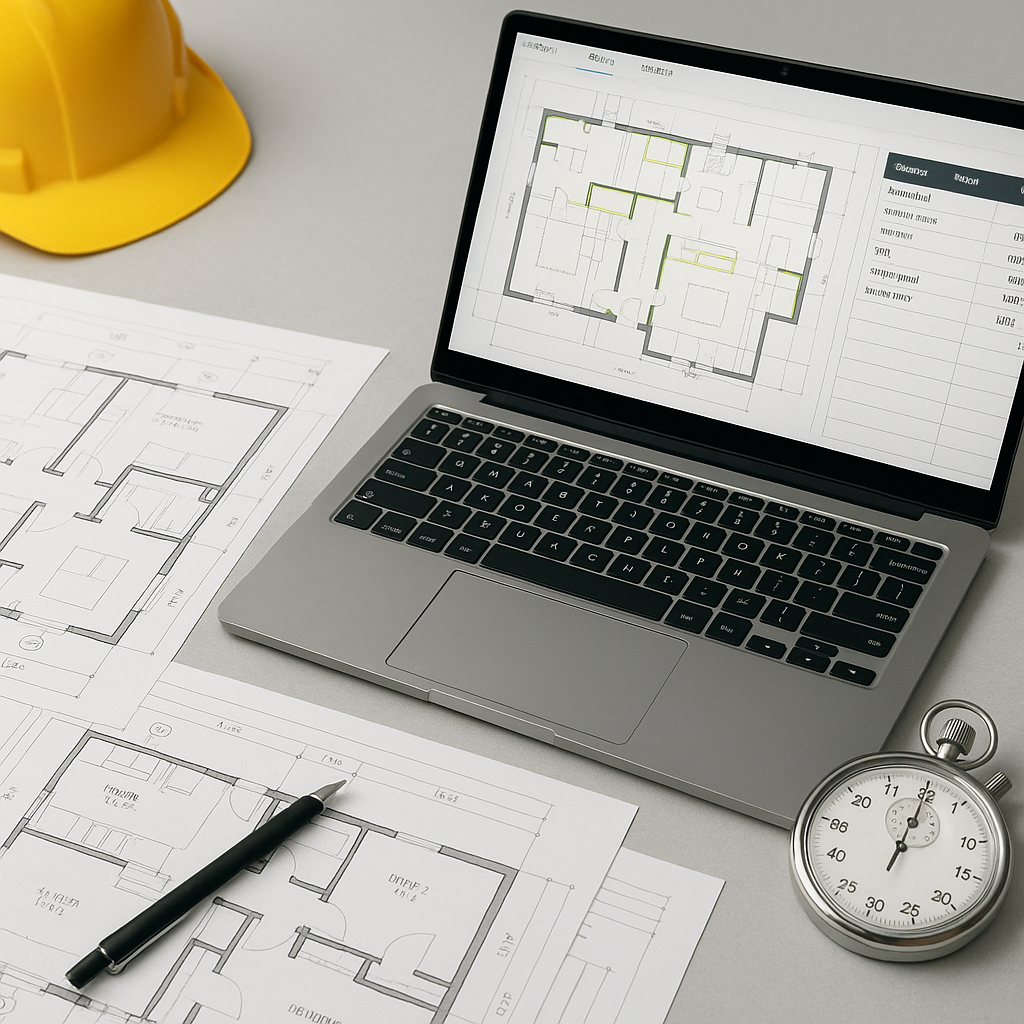
AI-powered tools are flipping the script. Instead of slogging through drawings with a scale and highlighter, platforms like EstimateNext use Vision AI to extract quantities in minutes. Yes, minutes. Upload a PDF set, and the system spits out room areas, wall lengths, door counts—everything you’d otherwise measure manually.
Still skeptical? Let’s break it down with a real example.
The $1B Rail Project That Changed My Mind
One of our mid-sized clients—let’s call them “Able Contractors”—recently bid on a $1 billion rail project. Their team used to spend 56 hours per bid on takeoffs. But with EstimateNext, that time dropped to just 10 minutes. They uploaded the drawings, reviewed the AI’s output, made minor adjustments, and were done before lunch.
What’s more important? They didn’t just save time—they avoided burnout. Estimators weren’t stuck in the weeds of tedious measurements. Instead, they focused on refining rates, negotiating with subs, and fine-tuning their bid strategy. The result? A polished, competitive proposal delivered on time.
Here’s the kicker: the AI wasn’t just faster—it was more accurate. In their words, “It’s like hiring a full-time estimator without the payroll.”
Another Example: A Small Subcontractor’s Experience
Consider a small electrical subcontractor bidding on a $750,000 hospital renovation project. Before adopting AI, their two-person estimating team would spend 24 hours manually measuring conduit lengths, fixture counts, and cable runs. With EstimateNext, the same scope was completed in under 2 hours, including a detailed review.
This wasn’t just a time-saver—it was a competitive edge. They submitted their bid ahead of schedule, which impressed the general contractor. The result? They landed the job and were asked to price additional packages for future phases.
Why Speed Alone Isn’t Enough
You might think, Great, it’s faster. But is it reliable? Fair question. AI isn’t perfect, and no one’s pretending otherwise. That’s why EstimateNext includes a confidence scoring feature. If the AI isn’t 100% sure about a quantity, it flags it for human review. You can override it, tweak it, or remeasure as needed—but you’re still saving hours.
Case Study: Handling Complex Revisions
Let’s talk about revisions—a common pain point for contractors. Architects issue updated drawings, and the estimator has to start over. This can double the time spent on takeoffs. With AI, reprocessing updated drawings is seamless. For example, during a retail build-out project, a contractor using EstimateNext processed revised drawings in under 15 minutes. The system flagged changes like resized rooms and relocated fixtures, allowing the team to adjust quantities without redoing the entire takeoff.
This feature isn’t just convenient—it eliminates the risk of missing critical changes, which can lead to underbidding or costly rework.
The Real ROI of AI Takeoffs
Time is money. Let’s do the math:
- A general contractor typically spends 40 hours on manual takeoffs per bid.
- Average estimator labor cost: $130/hour.
- Total cost per manual takeoff: $5,200.
Now compare that to an AI-powered workflow:
- 10 minutes of AI processing + 2 hours for review.
- Total cost per AI takeoff: ~$300 (including software).
That’s a 95% cost reduction. Multiply it across 5-8 GMP pursuits per year, and you’re looking at $25K-$40K in annual savings—per estimator. For larger firms, the ROI scales even higher.
Hidden Costs of Manual Takeoffs
It’s not just about direct labor costs. Consider these hidden costs:
- Missed Opportunities: Spending 40 hours on one bid means you might not have time to pursue another.
- Error Corrections: Mistakes in manual estimates can lead to change orders, which strain client relationships and erode profits.
- Burnout: Overworked estimators are more likely to make errors or leave your company, increasing turnover costs.
AI takeoffs address all of these issues by reducing workload, improving accuracy, and freeing up time to pursue more opportunities.
What About Small Contractors?
You might be thinking, This sounds great for big firms, but what if I’m a smaller sub bidding on $200K-$1M projects? AI tools scale. Whether you’re handling a $1 billion rail bridge or a $500K office fit-out, the process is the same. In fact, smaller teams benefit even more because they don’t have the luxury of dedicated takeoff staff.
Take MEP subcontractors as an example. They’re often juggling 30-60 bid packages a year, with just a handful of estimators. AI-powered takeoffs can turn a 3-day quote cycle into a 4-hour process. That’s the difference between meeting a deadline and missing it.
Comparison: Manual vs. AI Takeoffs for Small Teams
| Metric | Manual Takeoffs | AI-Powered Takeoffs |
|---|---|---|
| Time per Takeoff | 10-40 hours | 1-2 hours (including review) |
| Error Rate | Moderate to High | Low (with manual review) |
| Cost per Takeoff | $1,300-$5,200 | ~$300 |
| Scalability | Limited by manpower | High |
The Obvious Objection: “But AI Can’t Think Like an Estimator”
This pushback comes up a lot. And it’s valid—to a point. AI doesn’t replace human judgment. It doesn’t know your preferred markup or which sub you trust to handle tricky scope. But it doesn’t have to.
Think of AI as an apprentice. It handles the grunt work, freeing you up to focus on high-value tasks. You’re still the one making judgment calls, negotiating, and deciding on final pricing. The AI just makes sure you’re not wasting time drawing lines on a PDF.
Real-World Feedback From Estimators
“A lot of people think AI will take their jobs. That’s not true. It’s more like hiring a junior estimator who never sleeps. I still make all the big decisions—it just gets me there faster.”
How to Get Started
If you’ve never used AI tools before, start small. Test them on a mid-sized project where you can compare the AI’s output to your usual process. Most platforms, including EstimateNext, let you review and adjust quantities manually, so you’re never flying blind.
Actionable Steps:
- Pick a Pilot Project: Choose a project with a manageable scope for testing.
- Set a Baseline: Complete the takeoff manually first to compare results.
- Review AI Outputs: Use the platform’s confidence scoring to focus on flagged items.
- Integrate Gradually: Export AI data into your current tools (e.g., Excel, Procore).
- Train Your Team: Most platforms offer training resources to get your team up to speed quickly.
Final Thoughts
AI isn’t a magic bullet, but it’s a game-changing tool for preconstruction professionals. By automating the most tedious parts of the job, you can focus on what really matters—building better bids, winning more projects, and delivering value to your clients.
If you’re tired of wasting time on manual takeoffs, EstimateNext can help. Get started free →


