The Problem: Sub Bid Leveling Is a Time Sink
If you’ve ever had to compare multiple subcontractor bids, you know how tedious and time-consuming it can be. For a typical mid-size project, you might receive quotes from 3-7 subcontractors per trade. Each quote comes in a different format, with varying levels of detail. From there, the manual grind begins: normalizing scope exclusions, comparing quantities, flagging deviations, and ranking the bids. This process can take 6+ hours per trade. Multiply that across multiple trades, and you’re easily looking at days—if not weeks—of work.
And it’s not just about the time. The manual nature of this process introduces significant room for error. Forget to catch a missing scope exclusion, or misinterpret a labor rate, and you could end up either overbidding and losing the job or underbidding and jeopardizing your project’s profitability.
This inefficiency drains resources and puts contractors at risk, particularly in an industry where speed and precision are critical to winning bids and maintaining margins.
The AI Solution: Sub Bid Leveling in 30 Minutes
AI tools like EstimateNext are revolutionizing the sub bid leveling process. Instead of manually poring over PDFs, Excel sheets, and handwritten notes, you simply upload your subcontractor quotes into the platform. The AI does the heavy lifting for you. Here’s how it works:
1. Scope Normalization
Every subcontractor formats their bid differently. One might include firestopping in their scope, while another excludes it. Some might itemize their estimates, while others bundle costs together. AI-powered tools analyze these bids line by line, identifying and normalizing discrepancies. For example:
- If one bid excludes duct insulation, the AI will flag it as a missing scope.
- If another bid includes an ambiguous term like “miscellaneous materials,” the AI can prompt you to clarify it.
By ensuring that all bids are evaluated on an apples-to-apples basis, the tool eliminates confusion and ensures that you’re comparing equivalent scopes.
2. Quantity Matching
Quantity mismatches are a common issue in subcontractor bids. For example, one contractor might price materials for 10,000 square feet, while another prices for 9,800 square feet. The AI highlights these differences and adjusts the bids so you can make a fair comparison. This step eliminates the manual effort of combing through quantities and trying to reconcile discrepancies.
3. Rate Analysis
AI tools don’t just compare prices; they analyze labor and material rates against historical data, industry benchmarks, and even regional averages. This helps identify outliers, such as:
- A labor rate that’s significantly lower than the market standard (which might suggest they’re underestimating hours or hiring unqualified workers).
- Material costs that are unusually high, perhaps due to an error in the bid or an attempt to pad margins.
4. Ranking and Reporting
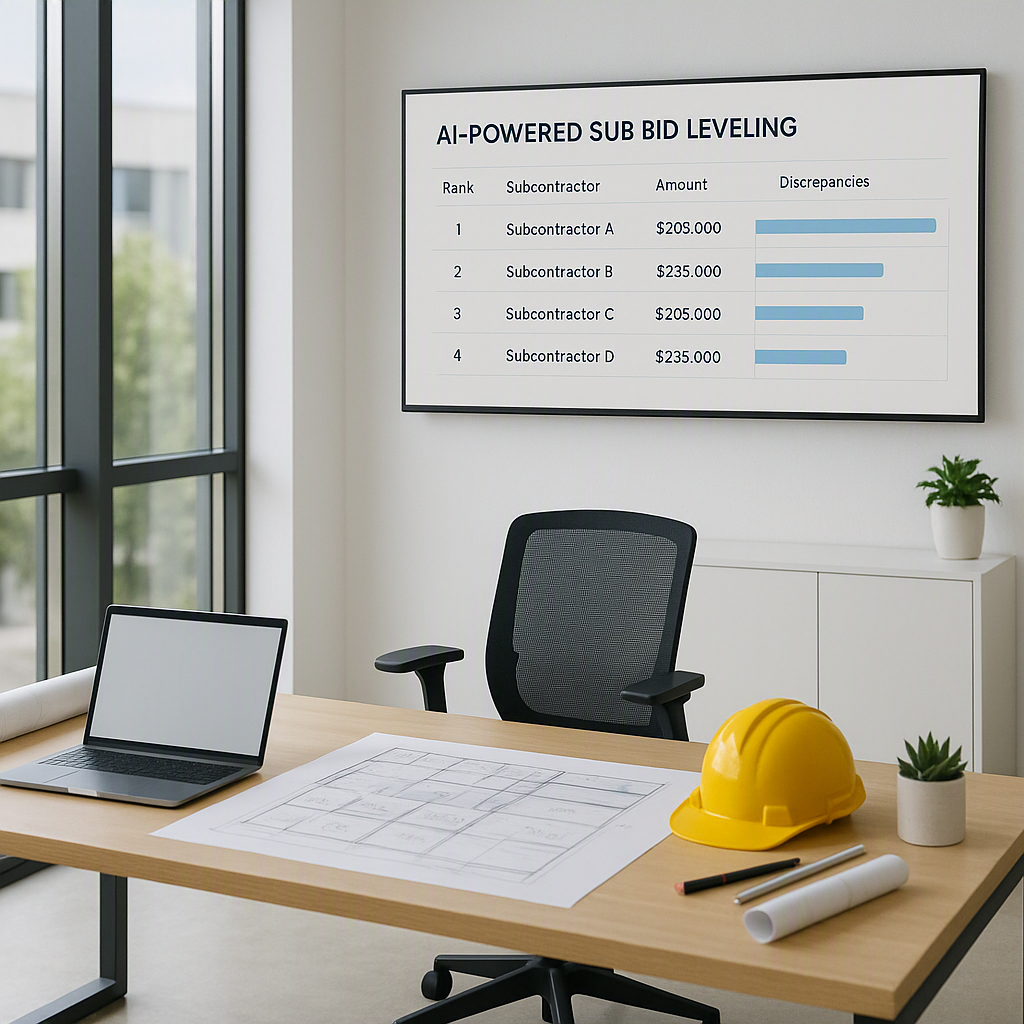
Once the AI processes the bids, it generates a ranked list of subcontractors (e.g., L1, L2, L3) based on criteria like price, scope completeness, and historical performance. The platform also provides a detailed audit trail, so you can see exactly how each bid was evaluated and why specific adjustments were made.
By automating these steps, AI reduces the sub bid leveling process from an all-day marathon to a 30-minute task. And because the process is data-driven and transparent, you can trust the results.
Why Speed and Accuracy Matter
Saving time isn’t just about convenience—it’s about opportunity. In the construction industry, speed and accuracy are critical competitive advantages. The faster you can turn around bids, the more projects you can pursue. Here’s why this matters:
-
Increased Capacity: With the time saved using AI, your team can handle more bids simultaneously. This not only increases your chances of winning more projects but also enables you to focus on higher-value tasks like strategy and relationship-building.
-
Reduced Risk: Errors in bid leveling can have serious consequences, from losing the bid due to overpricing to ruining your margin by missing critical exclusions. AI minimizes these risks by flagging issues early in the process.
-
Competitive Edge: According to Construction Dive, general contractors are increasingly competing on speed and accuracy. Being able to submit accurate bids faster can mean the difference between winning a contract and losing out.
Actionable Steps to Get Started with AI for Sub Bid Leveling
If you’re ready to move past the inefficiencies of manual bid leveling, here are some steps to get started:
-
Evaluate Your Current Process: Identify areas where your current process is causing delays or errors. Are you spending too much time normalizing scopes? Are discrepancies between bids frequently overlooked?
-
Choose the Right AI Tool: Not all AI tools are created equal. Look for one that includes:
- Scope normalization
- Quantity matching
- Rate analysis with benchmarking
- Customization options
- Integration with your existing workflows
-
Start Small: Test the tool on a single trade or project. This will give you a sense of how it fits into your process and whether it delivers the promised time savings and accuracy.
-
Train Your Team: While AI tools are designed to be user-friendly, some training may be required to maximize their potential. Ensure your team understands how to upload bids, interpret results, and make adjustments.
-
Measure Results: Track how much time and effort you save using the tool. Use these metrics to assess whether the investment is delivering ROI.
Comparison: Manual Bid Leveling vs. AI-Powered Bid Leveling
| Feature | Manual Bid Leveling | AI-Powered Bid Leveling |
|---|---|---|
| Time Required | 6+ hours per trade | ~30 minutes per trade |
| Error Risk | High (human error) | Low (data-driven analysis) |
| Scalability | Limited by team capacity | High scalability |
| Customizability | Manual adjustments required | AI learns and adapts |
| Audit Trail | Requires meticulous notes | Automatically generated |
| Overall Efficiency | Low | High |
Key Takeaways
- Save Time: Leverage AI to cut bid review time from hours or days to mere minutes.
- Improve Accuracy: Automated flagging and benchmarking reduce costly errors and improve confidence in your decisions.
- Scale Your Operations: Free up your team to handle more bids and focus on strategic tasks.
- Stay Competitive: Faster, more accurate bids give you an edge in winning projects in a competitive market.
Get Started
If you’re tired of wasting hours on manual bid comparisons, it’s time to adopt a smarter and more efficient approach. Tools like EstimateNext can help you streamline sub bid leveling, improve accuracy, and refocus your team on high-value activities. Don’t let manual processes hold you back—embrace AI and stay ahead of the competition.


