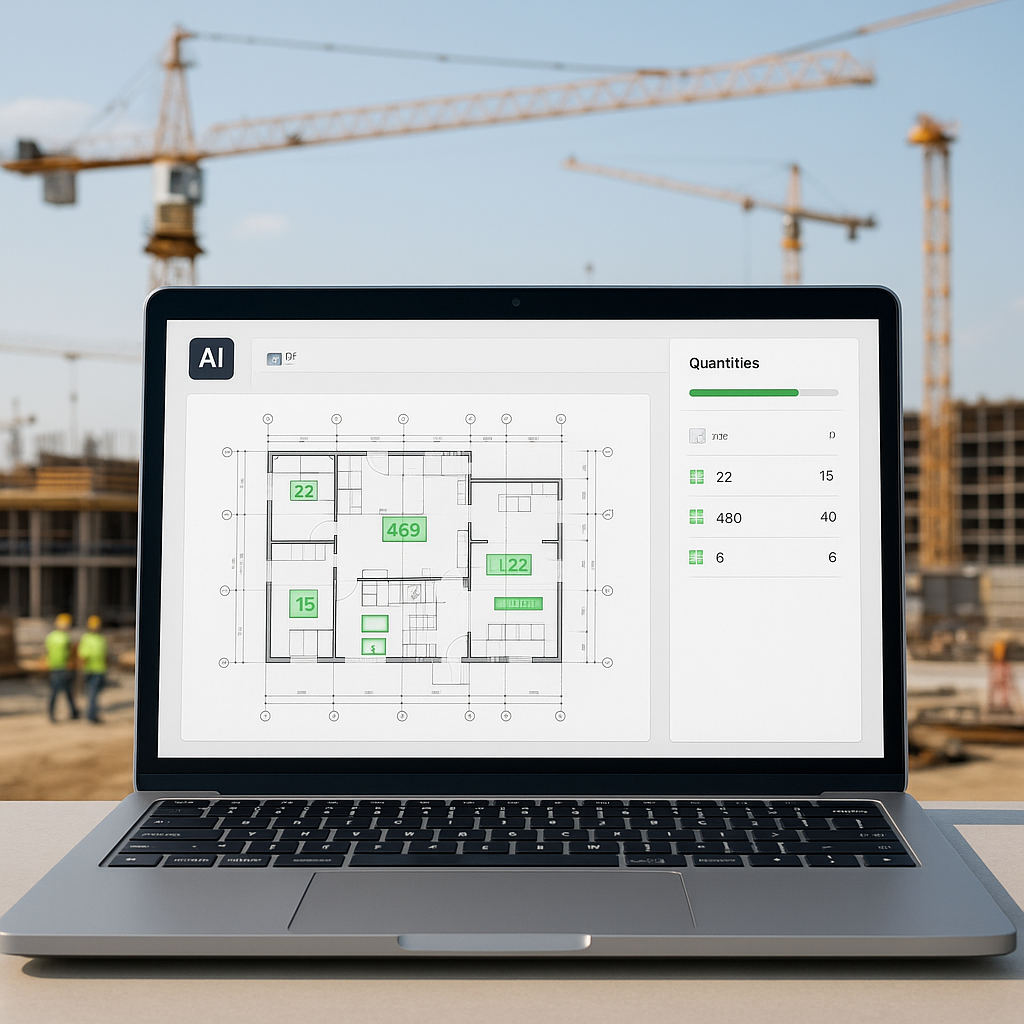
Why Manual Takeoffs Are Killing Your Team’s Bandwidth
Imagine this: two estimators spending two full days tracing drawings and manually calculating quantities for a $50M hospital bid. It’s mind-numbing work—40 hours of squinting at PDFs, measuring wall lengths, and double-checking numbers. And let’s be honest, errors slip through. A missed dimension here, an overestimated volume there—it all adds up to risk. You might win the bid, but at what cost?
This isn’t rare. For most general contractors (GCs), manual takeoffs are the norm. Bluebeam, Excel, and a lot of caffeine keep the wheels turning. But this process doesn’t scale. When you’re juggling 5-8 GMP pursuits a year, every minute counts. So why are we still doing this the hard way?
Enter AI-Powered Takeoffs
AI takeoff tools like EstimateNext are flipping this script. Instead of spending 40 hours on manual takeoffs, you can upload a PDF or drawing set and let AI extract quantities in 10 minutes. Yes, 10 minutes. That’s a 10X speed boost.
How It Works
Platforms like EstimateNext use Vision AI—a machine learning model trained to interpret construction drawings. Here’s what the process looks like:
- Upload Plans: Whether it’s PDFs or CAD files, the system takes any standard format.
- Calibrate Scales: You set the scale once, ensuring measurements are accurate.
- Automated Quantity Extraction: The AI identifies and measures quantities for materials, such as concrete, drywall, steel, etc.
- Confidence Scoring: Low-confidence areas—where the AI isn’t 100% sure—are flagged for manual review.
One mid-sized contractor shared their experience: “We saved 120 hours on a high-rise bid. That’s two full weeks of labor costs avoided. And we still met the deadline.”
Case Study: A Real-Life Win
Take Smith Brothers Construction, a mid-sized GC based in California. They adopted AI-powered takeoffs after struggling to meet deadlines on larger projects. On a recent office tower bid, their team saved 136 hours, reduced takeoff errors by 85%, and submitted a more competitive proposal. The kicker? They won the project.
But What About Accuracy?
The obvious objection is, “Can AI really be as accurate as a human?” Short answer: almost. AI tools are highly accurate, often reducing takeoff discrepancies by up to 80%, according to McKinsey.
Actionable Accuracy Tips
Accuracy depends on input quality. Here’s how to ensure reliable results:
- Check Your Drawings: Messy or incomplete drawings lead to errors, regardless of the tool.
- Leverage Confidence Scores: AI platforms like EstimateNext flag areas needing manual review—use this feature.
- Combine AI with Human Oversight: Treat AI as an assistant, not a replacement for experienced estimators.
Example Comparison
| Manual Takeoffs | AI-Powered Takeoffs |
|---|---|
| Time: 40+ hours per estimate | Time: 10 minutes per estimate |
| Accuracy: Prone to human error | Accuracy: 80% fewer discrepancies |
| Scalability: Limited by manpower | Scalability: Expand without headcount |
| Cost: $130/hour labor cost | Cost: $99/month subscription |
The ROI Math Is Brutal (In a Good Way)
Let’s talk numbers. For a GC Director running 6 GMP pursuits annually, here’s the math:
- 40 hours saved per estimate × $130/hr (fully loaded estimator cost) = $5,200 saved per bid
- Multiply that by 6 bids/year = $31,200 saved annually
- Cost of an AI tool like EstimateNext? $99/month or $1,188/year
That’s a 26X ROI. And this is just from takeoff speed. Add in time saved on rate matching, bid leveling, and what-if scenarios, and the ROI climbs even higher.
Expanded ROI Example
Imagine a subcontractor specializing in drywall, bidding on 30 projects annually. By reducing takeoff time from 10 hours to 1 hour per project, they free up 270 hours a year. That’s nearly 7 full workweeks saved—time they can use to bid on more jobs or refine pricing strategies.
What Happens to the Saved Time?
This is the real game-changer. Time saved on takeoffs isn’t just “extra”—it’s time you can reinvest. Here’s how savvy GCs use it:
1. Bid More Projects
Respond to 20% more RFPs without increasing headcount. More bids = more chances to win.
2. Improve Bid Quality
Spend more time refining costs, analyzing subcontractor bids, and tightening margins. Higher-quality bids often lead to better hit rates.
3. Win More
Faster, more accurate estimates improve your hit rate. Period.
Subcontractor Advantage
For MEP subcontractors, AI takeoffs mean faster quote turnarounds. Let’s say you’re bidding on 50 projects a year. A typical quote takes 3 days to prepare. With AI, you’re down to 4 hours. That’s 46 extra days annually to respond to more bids—or just to catch your breath.
One HVAC contractor shared, “We’ve gone from 50% to 75% quote response rates. That’s made a direct impact on our bottom line.”
The Bottom Line
Manual takeoffs are a bottleneck. They waste time, introduce errors, and limit how many bids you can tackle. AI-powered tools like EstimateNext cut through the noise, delivering speed and precision when you need it most.
But remember: AI isn’t perfect. It’s a tool, not a magic wand. You still need skilled estimators to interpret results, adjust for project nuances, and make judgment calls. In my view, the real power of AI is in partnership. It handles the grunt work, so your team can focus on what they do best—winning bids and delivering great projects.
Ready to Save 40 Hours Per Bid?
If you’re tired of losing days on manual takeoffs, EstimateNext can help. Upload your first BOQ today and see the difference AI makes. Get started free →


