The Takeoff Time Sink No One Talks About
Let’s be real: manual quantity takeoffs are a slog. Whether you’re a GC chasing a $300M high-rise or a Sub looking at a 40,000 sq. ft. office fit-out, the process is the same: upload the plans, trace the drawings, double-check your measurements, rinse, and repeat. It’s not fun, and it’s definitely not fast.
On average, estimators spend 40 hours per bid just on takeoffs. That’s 40 hours you could spend refining your pricing, negotiating with subs, or, I don’t know, maybe going home on time for once. But we keep doing it because we’ve always done it this way.
The obvious objection? “Accuracy matters. If I rely on AI, I’ll lose control of the numbers.” I used to think the same thing. But here’s the hard truth: humans aren’t perfect either. We miss things. We transpose digits. We get tired. And when you’re up against tight deadlines, even small mistakes can snowball into giant cost overruns.
That’s where AI-powered tools like EstimateNext come in. They don’t just speed up the takeoff process — they change the entire game.
How Vision AI Cuts Takeoff Time by 96%
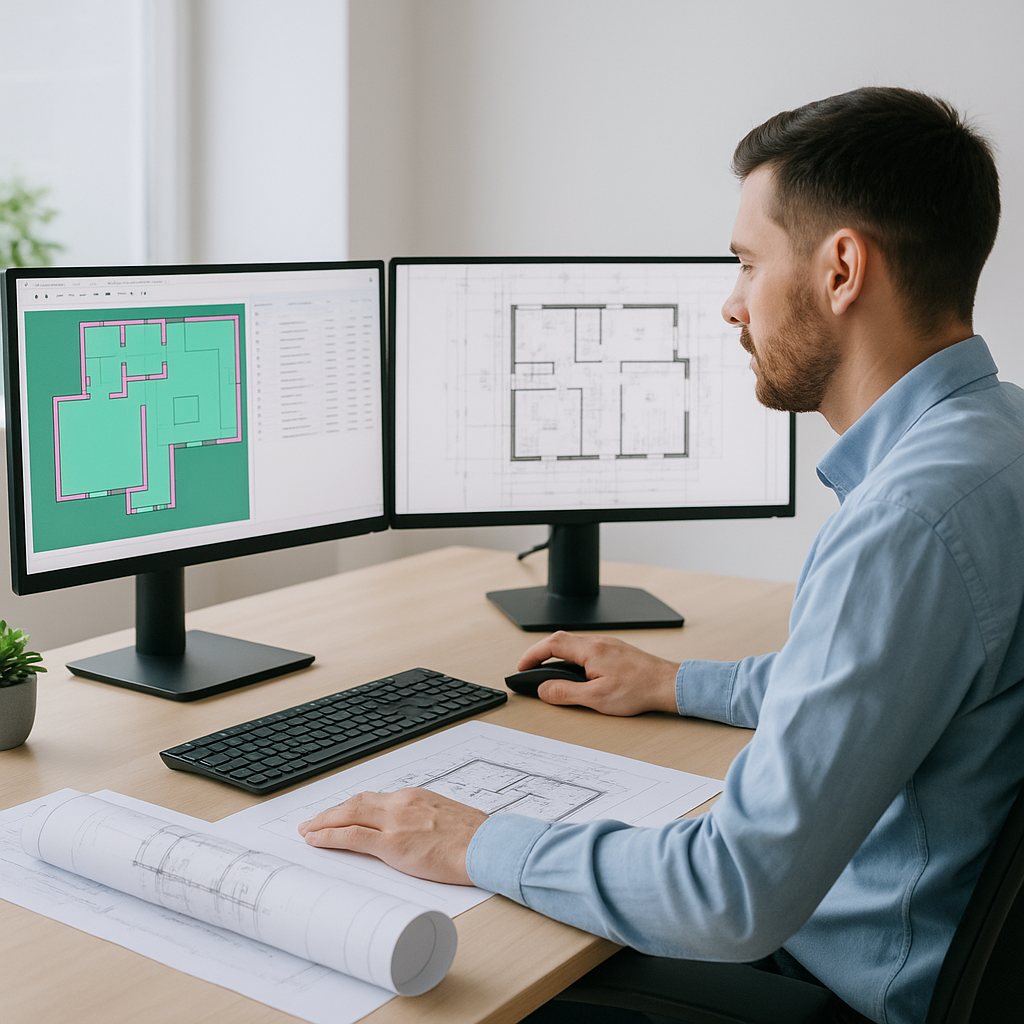
EstimateNext’s Vision AI doesn’t replace you; it accelerates you. Upload a set of PDF drawings, and the system extracts quantities for walls, doors, windows, and even floor finishes in 10 minutes. It’s not magic — it’s machine learning trained on thousands of projects.
Real-World Case Study: How a Mid-Sized GC Saved 120 Hours
Here’s one example: A mid-sized general contractor (GC) bidding on a $40M high-rise project saved 120 hours on a single bid by switching to Vision AI. That’s the equivalent of three full workweeks for one estimator. To put it in perspective, those 120 hours could’ve been used to price out six additional bids, respond to RFIs, or refine cost models for value engineering.
As the GC’s lead estimator described it, “It felt like hiring another full-time team member without the payroll hit.”
Actionable Steps to Implement AI Faster
- Start Small: Begin with one AI-powered tool for a single project. Compare its results to your manual takeoff to understand its accuracy and ROI.
- Customize Training: Many platforms, including EstimateNext, allow for customization. Upload your own project data to fine-tune the AI for your specific workflows.
- Review and Learn: Use the flagged low-confidence measurements as a training opportunity for both the AI system and your team.
Why Manual Takeoffs Are Costing You More Than Time
Speed is great, but let’s talk dollars. Every hour your team spends on takeoffs is an hour not spent on higher-value tasks. If your average estimator costs $130/hour, those 40 hours per bid add up fast. For a GC chasing 8 GMP pursuits a year, that’s $41,600 in labor costs — just for takeoffs.
Now, imagine cutting that to 4 hours per bid. You’re looking at a savings of $36,400/year for just one estimator. Multiply that by a team of four, and the math gets ridiculous.
Opportunity Cost: The Real Killer
But it’s not just about saving time and labor costs. Faster takeoffs mean you can bid on more projects and respond to more RFIs. For example, let’s say you can increase your bidding capacity by 30% annually. If your average win rate is 15% and your typical project margin is $500K, that could translate to an additional $2.25M in profit per year.
Comparison Table: Manual vs. AI Takeoffs
| Metric | Manual Takeoffs | AI-Powered Takeoffs |
|---|---|---|
| Time per bid (40,000 sq. ft.) | 40 hours | 4 hours |
| Average labor cost per bid | $5,200 | $520 |
| Capacity for bids per year | ~8 | ~30 |
| Error rate | 5-10% | <2% (with oversight) |
What About Smaller Firms?
You might be thinking, “This sounds great for big GCs, but I’m just a regional contractor. Do I really need AI?” Short answer: Yes. AI tools scale to any project size, whether you’re pricing a $1M renovation or a $150M mixed-use development.
Example: Small MEP Sub Wins Big
Take the case of a 10-person mechanical, electrical, and plumbing (MEP) subcontractor. By using EstimateNext’s trade-specific tools, they shaved 68 hours off their monthly workload. With the extra time, the firm was able to pursue five additional bids per month, landing two new contracts valued at $850K combined. For a small firm, that’s a game-changer.
Action Steps for Small Firms
- Evaluate Your Workload: Identify repetitive, time-consuming tasks in your current estimating process.
- Look for Specialized Tools: Many AI platforms offer trade-specific features, such as ductwork or piping takeoffs for MEP contractors.
- Leverage Free Trials: Most AI tools offer free trials or demo periods. Use this time to test the system on a real project.
The Skeptic’s Question: Does AI Replace Estimators?
Nope. AI doesn’t replace your expertise; it amplifies it. You’re still the one making judgment calls, negotiating with subs, and deciding on margins. The AI just handles the grunt work — like tracing 400 wall sections or recalculating a BOQ after the client swaps gypsum for Armstrong ceilings (again).
In my view, the real power of AI isn’t automation; it’s augmentation. It frees you up to focus on the big picture instead of getting bogged down in the details.
Key Tasks AI Handles Well
- Automated measurements: walls, doors, windows, finishes
- Rapid recalculations after design changes
- Confidence scoring for flagged measurements
The Bottom Line
Manual takeoffs are a relic of the past. AI-powered tools like EstimateNext aren’t just faster — they’re smarter, more accurate, and better for your bottom line.
If you’re tired of burning hours on takeoffs, it’s time to make the switch. Get started free →


