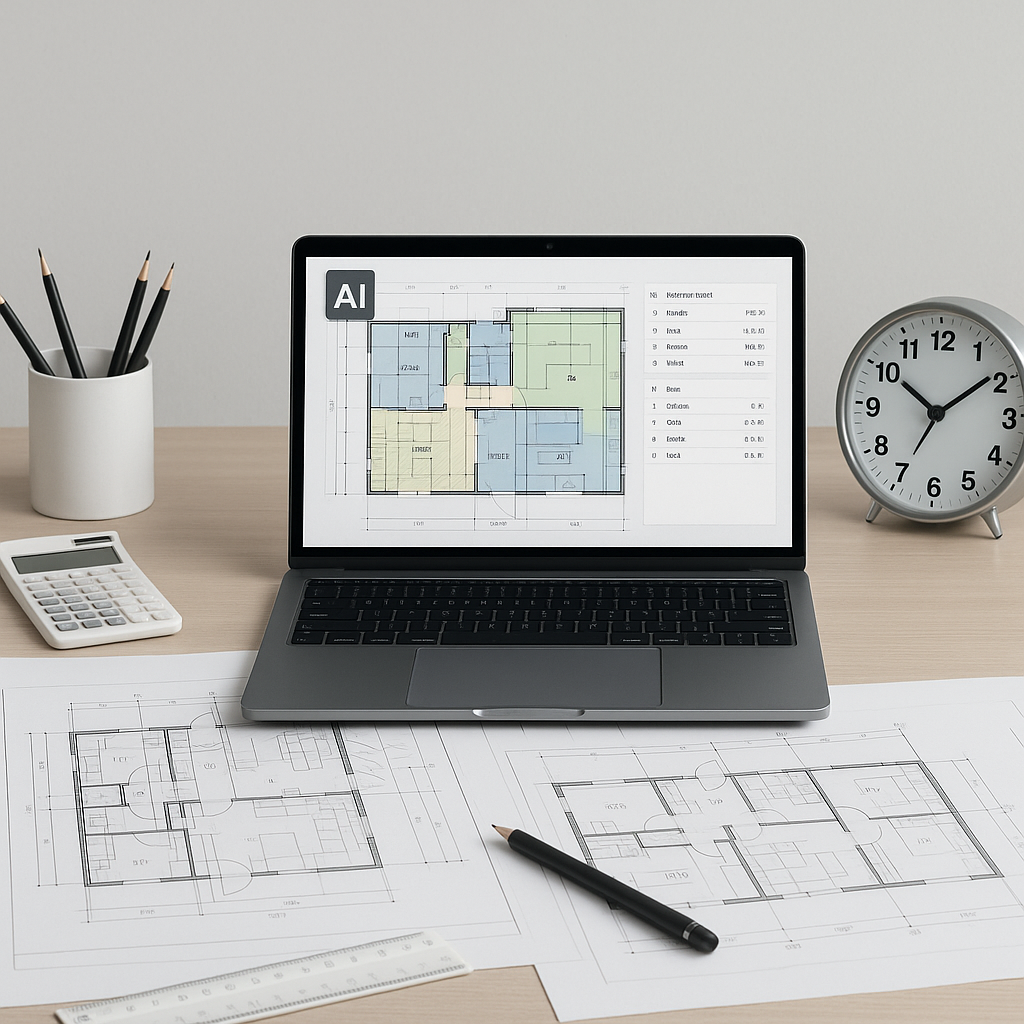
Stop Spending 40 Hours on Takeoffs — It's 2026, Not 2006
Let’s get real: manual takeoffs are a productivity killer. If you’re still spending 40 hours measuring drawings, you’re not just wasting time—you’re losing money. Technology has advanced, yet many construction professionals are stuck in the past, relying on outdated methods that drain resources and slow down bidding processes.
Take a typical mid-sized general contractor bidding on a $25M office project. Two estimators spend two full days (that’s 40 hours) manually measuring, cross-checking, and recalculating quantities. At $130/hour, that’s $5,200 in labor costs before you’ve even priced a single item. Now multiply that across 8-10 GMP pursuits a year. You’re burning $50,000+ annually just on takeoff labor. And this doesn’t account for errors or delays caused by fatigue and human oversight.
Here’s the kicker: you don’t need to. AI-powered tools like EstimateNext can handle the same task in 10 minutes. Yes, minutes—not days.
How AI Takeoff Works (In Plain English)
The idea of AI for takeoffs might sound complicated, but the process is surprisingly straightforward. Here’s how it works:
- Upload Your Drawings: Drop your PDFs into the platform. No need to pre-label or organize files; the software handles it.
- Vision AI Reads the Plans: The system auto-detects room areas, wall lengths, door/window counts, and other quantities from the drawings. It uses advanced technology like GPT-4o to recognize even poorly scanned documents or non-standard formats.
- Confidence Scoring: Not sure if the AI got it right? It flags low-confidence measurements for manual review, allowing you to double-check critical items.
- Export Results: Quantities are output directly into your preferred BOQ format (Excel, CSI MasterFormat, or even CPWD DSR).
Imagine replacing hours of manual labor with a drag-and-drop process that takes minutes. AI doesn’t get tired, distracted, or make math errors. And if there’s a mistake, you can override it with an audit trail that tracks changes.
Real-World Example: $1B Rail Project
Let’s talk about hard numbers. In a case study shared by EstimateNext, a contractor working on a $1B rail bridge project saved 56 hours per bid using AI for takeoffs. That’s a week and a half of estimator labor freed up for more strategic tasks—like negotiating with subcontractors or refining profit margins.
Here’s a breakdown of the impact:
- Before AI: Takeoffs required two estimators working 3-4 days per bid. Errors in quantity calculations led to RFIs and costly change orders downstream.
- After AI: AI completed the takeoffs in under 2 hours, with discrepancies dropping by 80%. Estimators could focus on value engineering and client communication.
The result? Faster bid turnarounds, fewer errors, and a more competitive edge in securing large-scale projects. Read more about their case study here.
Common Pushbacks (And Why They Don’t Hold Up)
Despite the clear advantages, many contractors hesitate to adopt AI tools for takeoffs. Let’s address the most common objections:
“AI can’t think like an estimator.”
No, it can’t. But it doesn’t need to. The AI handles the grunt work—reading blueprints, measuring quantities, and matching rates. You’re still in charge of judgment calls, scope negotiations, and pricing strategy. Think of it as hiring a supercharged intern who works 24/7 and never makes a math error.
“What if the AI misses something?”
It might—but so do humans. The difference is that tools like EstimateNext include confidence scoring and manual override options. You can review flagged items before finalizing your BOQ. It’s a safety net, not a blindfold.
“We’ve always done it manually.”
Sure. And people used to balance checkbooks by hand too. Just because something worked in 1995 doesn’t mean it’s the best approach now. AI isn’t a trend—it’s a tool. And it’s already saving contractors millions every year.
“What’s the upfront cost?”
AI tools like EstimateNext are subscription-based, typically costing less than $100/month. Compare that to the $5,000+ per month you’re likely spending on manual takeoff labor.
The ROI of Switching to AI Takeoffs
Let’s break down the math. For a mid-sized general contractor with 8 GMP bids per year:
| Metric | Manual Takeoffs | AI Takeoffs |
|---|---|---|
| Labor Hours per Bid | 40 | 2 |
| Hourly Rate | $130 | $0 (AI license fee only) |
| Total Annual Cost | $41,600 | $1,188 |
That’s a 35X ROI—without factoring in the value of faster bid turnarounds, improved accuracy, and fewer change orders. For subcontractors responding to 50+ bid packages annually, the ROI is even higher.
Beyond cost savings, consider the intangibles: less stress on your team, fewer missed deadlines, and a reputation for reliability in the competitive bidding market.
Actionable Steps to Get Started
- Pilot AI on a Small Project: Test the tool on a $1M-$5M job to evaluate its accuracy and integration with your existing workflow.
- Train Your Team: Most AI platforms, including EstimateNext, are designed to be intuitive. A 1-2 week training period is usually sufficient to get your team up to speed.
- Set Benchmarks: Track key metrics like time saved, error rates, and bid success rates to measure the ROI of the tool.
- Iterate and Scale: Use feedback from your pilot project to refine processes, then roll out AI broadly across your preconstruction team.
- Integrate with Your Tech Stack: Leverage APIs to connect the AI tool with software like Bluebeam, Procore, and Excel for a seamless workflow.


