Why Manual Takeoffs Are Killing Your Preconstruction Workflow
Let’s be honest—manual takeoffs are brutal. Not just time-consuming, but mentally draining. Flipping through PDF drawings, recalibrating measurements, and double-checking quantities? It’s the definition of tedious. And if you’re working on a $1 billion rail project or even a $1 million renovation, that inefficiency compounds quickly.
Here’s a stat that might make you cringe: Manual takeoffs typically take two estimators about 40 hours per bid. Over a year, that’s over 2,000 hours of labor per estimator. Can your team really afford that?
Beyond the hours lost, manual takeoffs introduce human error into the equation. Misreading scales, missing details, or incorrectly calculating quantities can lead to underpricing or overpricing—a mistake that can cost your company thousands, if not millions, of dollars.
Enter AI-Powered Takeoffs
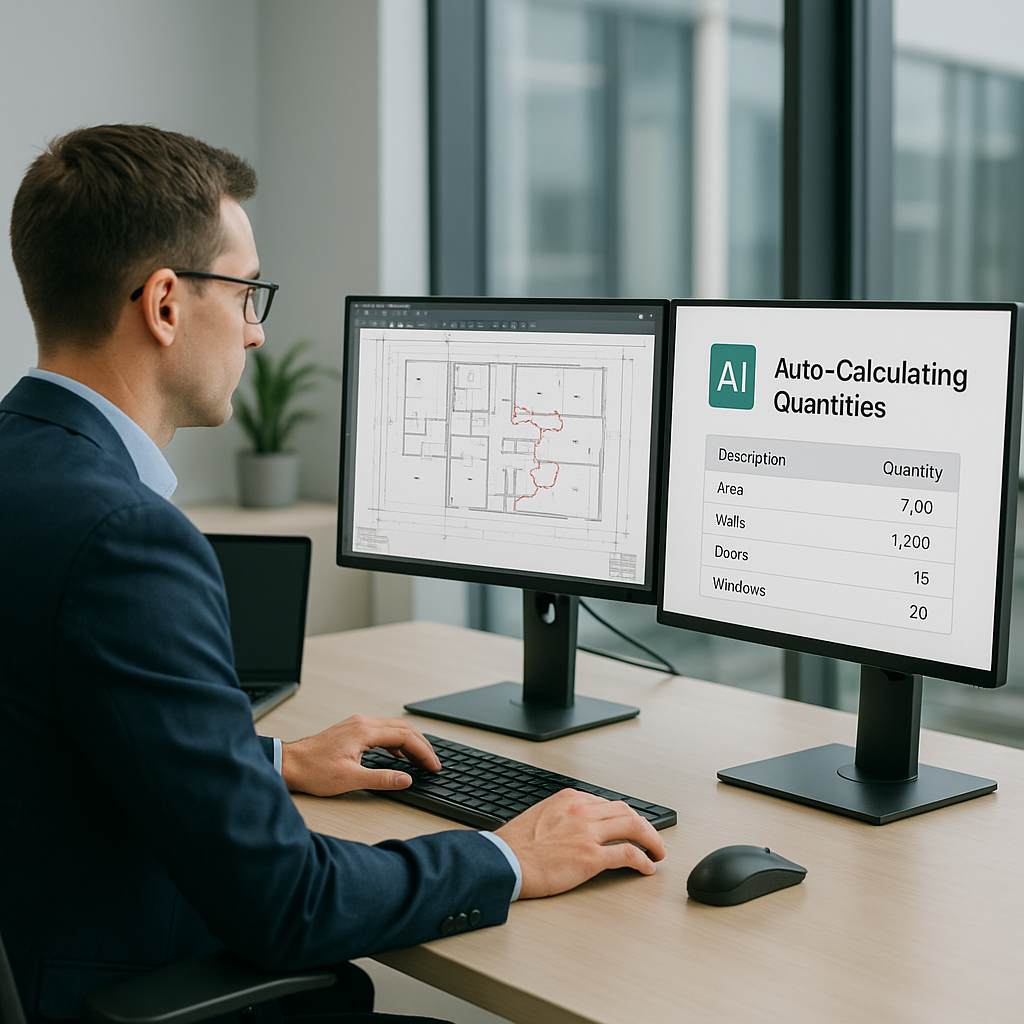
AI tools like EstimateNext’s Vision AI have completely flipped the script. Instead of spending 40 hours marking up drawings, you upload your PDFs, and in 10 minutes, the system spits out quantities. Room areas, wall lengths, door/window counts—it’s all there.
Real-World Example: A Mid-Sized GC
For example, a mid-sized general contractor (GC) recently saved 120 hours on a high-rise bid by using Vision AI. That’s two full weeks of labor costs avoided. What’s more, they met a tight deadline without needing to hire extra hands.
The team was able to focus their energy on refining the pricing strategy and ensuring competitive rates—tasks that truly require human expertise. The result? They won the bid and came in under budget during execution.
But here’s the key: AI doesn’t replace your expertise. It amplifies it. You’re still the one making judgment calls on scope gaps and verifying low-confidence lines. AI just handles the grunt work.
Actionable Steps to Get Started:
- Audit Your Current Process: Review how long your team spends on manual takeoffs and identify specific bottlenecks.
- Test AI Platforms: Start with a free trial or demo of tools like EstimateNext to see how they handle your projects.
- Pilot on a Small Project: Use AI for a smaller bid to familiarize your team without overwhelming them.
- Integrate Gradually: Combine AI with your current workflow, using it for repetitive tasks while maintaining manual oversight initially.
How Does It Work?
The magic lies in two things: machine learning and a user-friendly interface. Here’s how the process looks:
- Upload Your Drawings: Drag and drop your PDFs into the platform.
- Calibration: Set your scale or let AI auto-detect it.
- Extraction: The system identifies and quantifies elements (rooms, walls, fixtures).
- Review: Confidence scoring highlights areas that might need a second look.
Think of it like having an extra estimator who works at superhuman speed but still asks for your input when needed.
Comparison Table: Manual vs. AI-Powered Takeoffs
| Feature | Manual Takeoffs | AI-Powered Takeoffs |
|---|---|---|
| Time per bid | ~40 hours | ~10 minutes |
| Accuracy | Prone to human error | Reduces discrepancies by 80% |
| Labor cost per bid | ~$5,200 | ~$20 |
| Scalability | Limited by staff capacity | Handles unlimited projects |
| Training requirement | Years of experience | ~2 weeks |
The ROI Is Brutal
Let’s talk numbers. Say you’re a GC director overseeing five GMP pursuits a year, each requiring 40 hours of manual takeoffs. At $130/hr, that’s $26,000 in labor costs per project—or $130,000 annually.
With AI-powered tools, you’re cutting that time to 10 minutes per bid. Even if the tool costs $100/month per seat, your annual spend is only $1,200. That’s a 108X ROI.
Case Study: A $1B Rail Project
On a recent rail project, a team used AI to extract quantities for concrete columns, beams, and rail decks. The manual process would’ve taken 56 hours. With AI, they were done in 10 minutes. They saved over $7,000 in labor costs on just one bid.
The kicker? AI also caught a discrepancy in the BOQ that could’ve led to underpricing. That alone justified the investment.
The Obvious Objection: “AI Can’t Think Like Us”
I hear this all the time: “AI doesn’t understand the nuances of construction.” And you’re right—AI won’t know if an architect’s notes contradict the BOQ. But that’s not the point. AI isn’t there to replace your judgment. It’s there to handle the repetitive, error-prone tasks so you can focus on what matters: scope, pricing, and strategy.
Actionable Steps to Address Skepticism:
- Start Small: Use AI for simpler tasks, like area calculations, before expanding.
- Establish Checks: Train your team to verify AI outputs systematically.
- Analyze Results: Compare AI outputs against manual results to build confidence over time.
What About Training?
Good news: Most AI tools are built for ease of use. Training takes less than two weeks, and junior estimators can pick it up even faster. Plus, platforms like EstimateNext integrate with tools you’re already using—like Bluebeam or Excel—so nothing feels foreign.
Key Features That Simplify Training:
- Intuitive Interfaces: Drag-and-drop functionality and simple menus.
- Preloaded Templates: Common construction elements like walls, doors, and fixtures.
- Integration: Seamless compatibility with software your team already knows.
Closing Thoughts
If you’re still spending days on manual takeoffs, it’s time to rethink your workflow. AI-powered tools like EstimateNext save time, cut costs, and let your team focus on what really matters. Stop wasting hours on grunt work—your expertise deserves better.


