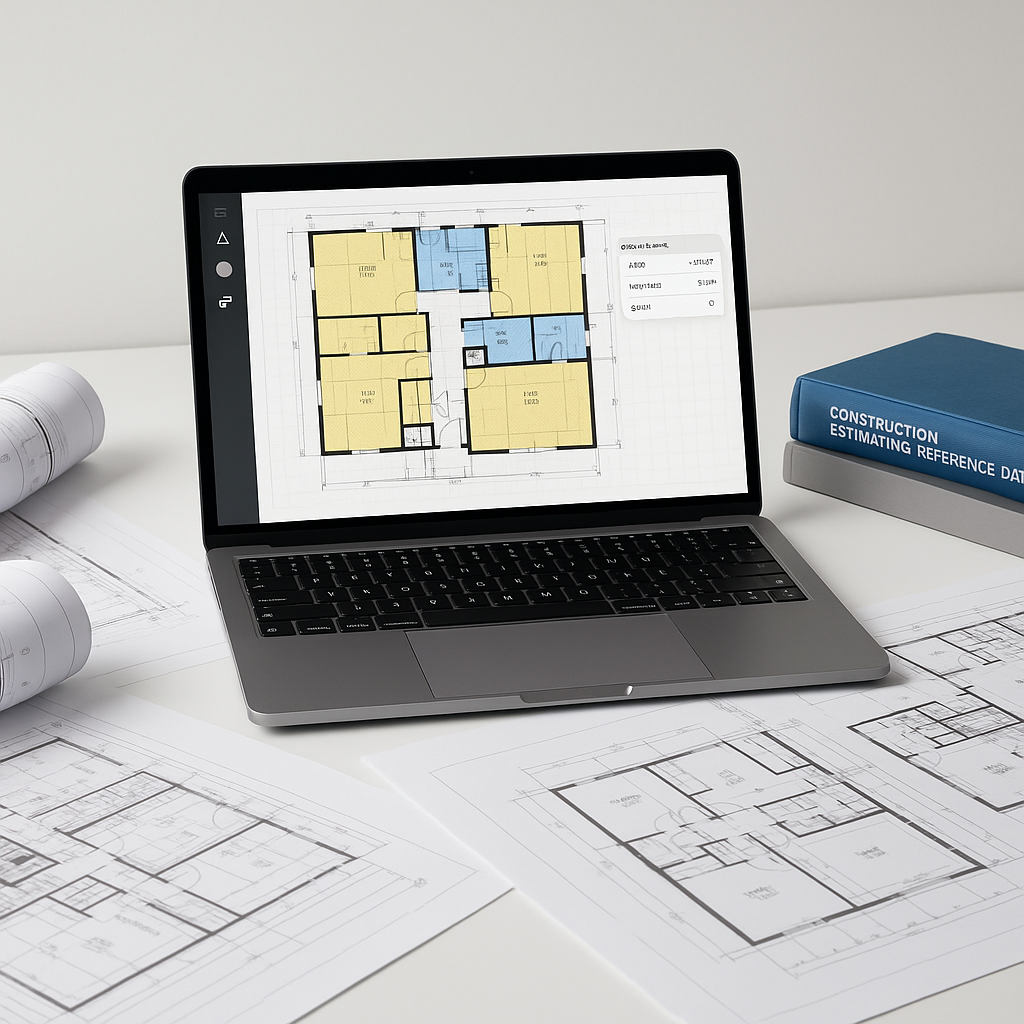
The Hidden Cost of Manual Quantity Takeoffs
Let’s not sugarcoat it. Manual quantity takeoffs are slow, frustrating, and expensive. You’re staring at drawings, calibrating scales, and painstakingly tracing every wall, beam, and fixture. It’s a grind. For a typical mid-size bid, this process takes about 40 hours—two estimators locked in for two full days. Multiply that by five GMP pursuits a year, and you’re looking at 200 hours wasted.
And what’s worse? Mistakes happen. Human error creeps in. Misread dimensions or missed revisions can lead to underbidding or padding costs unnecessarily. Either way, you lose.
But what if you could cut those 40 hours down to just 10 minutes? That’s not a typo—10 minutes. AI-powered estimation tools like EstimateNext are making this possible.
How AI Takeoff Works in Practice
Here’s the basic workflow:
- Upload Your Drawings: PDFs, DWGs, or scanned plans—AI tools can handle them all. EstimateNext’s Vision AI, for example, reads PDFs and extracts quantities for walls, slabs, doors, windows, and more.
- Automated Detection: The AI identifies and measures areas, lengths, and counts using pre-built algorithms. Need room dimensions and perimeters? Done. Need sprinkler head counts? Done.
- Confidence Scoring: AI isn’t perfect, but it flags low-confidence results for manual review. You can override these with a few clicks, ensuring accuracy.
- Generate Reports: The system outputs everything into your preferred format—Excel, CPWD DSR, CSI MasterFormat, NRM2, or CESMM3.
Case Study: High-Rise Bid
For instance, a mid-size GC working on a high-rise bid recently saved 120 hours using EstimateNext’s Vision AI. That’s two weeks of labor avoided while still meeting a tight deadline. Their own case study notes: “It’s like hiring a full-time estimator without the overhead.”
Example: Residential Renovation
Even smaller projects benefit. An interior fit-out contractor doing $1 million renovation bids reported cutting takeoff time by 85% using AI tools. Instead of spending two days estimating drywall quantities, the task was done in under an hour.
The Skeptic’s Objection: “AI Can’t Think Like an Estimator”
You’re right—AI doesn’t have judgment or intuition. It won’t understand why you need to add contingency for a tricky subcontractor. It won’t suggest alternative materials based on availability. That’s your job.
But that’s not the point. AI isn’t here to replace you. It’s here to handle the grunt work: tracing lines, matching rates, recalculating costs after every what-if scenario. You still make the calls, negotiate with subs, and decide on markups. The AI just clears your plate so you can focus on the high-value tasks.
Actionable Steps to Overcome Skepticism
- Test AI on Small Projects: Start with a smaller-scale project to see how well the tool matches your expectations.
- Use AI for Revisions: Let AI handle minor revisions, freeing you to focus on major adjustments.
- Integrate Manual Oversight: Always review flagged items and low-confidence areas as part of your workflow.
Why Speed Matters
Think about the consequences of faster takeoffs:
- More Bids: The faster you complete one bid, the sooner you can move to the next. For MEP subcontractors responding to 30–60 packages a year, cutting takeoff time from 3 days to 4 hours means responding to more bids—and winning more contracts.
- Better Accuracy: AI tools reduce takeoff discrepancies by 80% compared to manual methods, according to McKinsey. Fewer errors mean fewer headaches downstream.
- Cost Savings: Every hour saved is an hour you’re not paying for. If your estimators charge $130/hr, saving 36 hours per bid equals $4,680 saved—per bid.
Real-World Numbers
- GC Director: 40 hours saved per estimate x $130/hr = $5,200 saved per pursuit.
- MEP Subcontractor: 50% more bids = 4–8 additional wins/year at $200K avg revenue per win = $800K–$1.6M incremental revenue.
- Interior Fit-Out QS: 45-min what-if iterations reduced to seconds = total hours saved per project: 20–30.
Edge Cases: What About Small Projects?
You might be thinking, “This sounds great for billion-dollar rail projects, but what about my $1 million renovation bids?” Good news: AI tools scale to any project size. Whether you’re estimating a hospital wing or a residential build, the same principles apply. Smaller projects simply benefit faster.
Concrete Example: Small Contractor
A small contractor specializing in home additions used AI tools to complete takeoffs for a 3,200-square-foot project in just 15 minutes. Without the tool, they estimated it would have taken 5 hours. That’s a significant time savings for a small business with limited resources.
Decision Framework: Manual vs. AI Takeoff
| Criteria | Manual Takeoff | AI-Powered Takeoff |
|---|---|---|
| Speed | 20–40 hours per project | 10–20 minutes per project |
| Accuracy | Prone to human error | Reduced discrepancies (80% fewer errors) |
| Scalability | Limited by human resources | Scales effortlessly across projects |
| Cost | Estimator hourly rate ($100–$150/hr) | Subscription fee or usage-based pricing |
| Flexibility | Full control, but labor-intensive | Requires manual review for flagged items |
| ROI | Dependent on project size | High ROI across all scales |
Call to Action
If you’re tired of wasting 40 hours on manual takeoffs, EstimateNext can help. Upload your first BOQ and get a priced estimate in minutes. Get started free →


