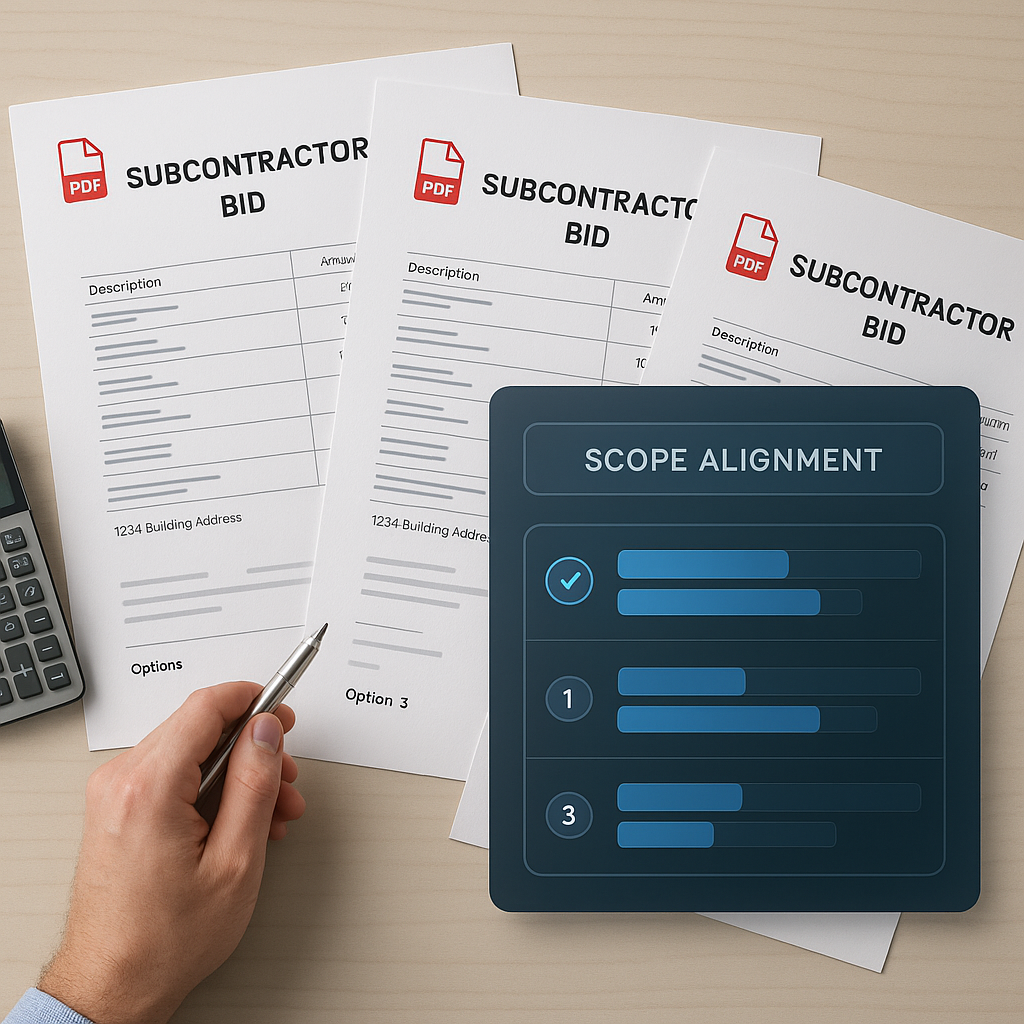
Why Sub Bid Leveling Still Sucks in 2024
You know the drill: the bid package lands on your desk, and you've got seven subcontractor quotes to sort through. Each one is formatted differently—some include exclusions buried on page three, others are missing critical scope items entirely. You spend six hours normalizing these bids, manually building a comparison spreadsheet, and trying not to miss anything. And even then, there’s always the sinking feeling you might have.
This process isn’t just tedious—it’s risky. A misstep here can mean awarding to the wrong sub or underestimating costs, which cascades into blown budgets down the line. Yet, most teams are still doing this manually.
The AI-Driven Alternative: 30 Minutes, Not 6 Hours
AI tools like EstimateNext flip this workflow on its head. Instead of starting with a blank Excel sheet, you upload the bids directly into the platform. AI parses the data, aligns scope items, flags discrepancies, and even ranks subs based on L1/L2/L3 pricing. What used to take hours now takes 30 minutes.
Want proof? A mid-sized general contractor (GC) handling five Guaranteed Maximum Price (GMP) pursuits a year recently cut sub bid leveling time by 85%. Their preconstruction director put it bluntly: "We’re no longer guessing. The AI catches scope mismatches we might’ve missed."
Case Study: Residential High-Rise Project
A regional GC bidding on a 30-story residential high-rise faced the usual chaos of mismatched subcontractor quotes. Using EstimateNext, they discovered that one sub had excluded balcony waterproofing—a $750K oversight. Thanks to AI, they flagged it early and adjusted the bid. The GC not only avoided a costly change order but also impressed the developer by presenting a more accurate estimate upfront.
What Makes AI Better for Bid Leveling?
1. Scope Alignment
AI automatically maps scope items across bids, even if subs use different terminology. For instance, one sub calls it "metal conduit installation," while another says "electrical pipe." The AI knows they’re the same. This is particularly valuable for complex trades like mechanical, electrical, and plumbing (MEP), where scope overlaps are common.
Actionable Tip: When submitting bid requests, encourage subcontractors to use standardized scope templates. While AI can handle inconsistencies, clean data improves accuracy.
2. Exclusion Detection
AI highlights missing items or exclusions in quotes. No more hunting through PDFs to figure out if sub #3 included fire caulking or omitted epoxy coating. It flags discrepancies immediately, saving your team hours of detective work.
Example: On a healthcare project, a GC’s estimator used EstimateNext to identify that a plumbing subcontractor had excluded backflow preventers—a small detail but critical for compliance. Catching it early avoided a $30K change order.
3. Ranking Intelligence
Beyond just price, the system factors in past performance data, change order frequency, compliance history, and even safety records (if available). You get a ranked recommendation, not just a raw number.
Comparison:
| Traditional Method | AI-Powered Method |
|---|---|
| Manually compare quotes based on price | AI ranks bids based on price, scope completeness, and historical performance |
| Exclusions often missed | Exclusions flagged instantly |
| No visibility into past sub performance | AI incorporates past data for better decision-making |
4. Audit Trail
Every adjustment or override you make is logged. If someone asks why you went with sub #2 over sub #1, you’ve got a clear, documented answer.
Real-World Scenario: A GC defending its choice of subcontractor on a municipal project used the platform’s audit trail to show the client that the selected bid accounted for local compliance costs that others had excluded.
The Obvious Objection: "AI Can’t Think Like an Estimator"
I get it—you’re skeptical. How can a tool possibly know the nuances of subcontractor pricing? But here’s the thing: AI doesn’t replace your judgment; it amplifies it. You’re still in control, making the final call. The AI just clears the noise—normalizing quotes, flagging issues, and saving you hours of grunt work.
Actionable Tip: Use AI as a first pass, not the final decision-maker. Let it structure and organize the bids, then apply your expertise to validate the results.
Real-World Example: A $1B Rail Project
On a $1 billion rail bid, a GC used AI to level bids for structural steel, concrete, and rail systems. The AI flagged that one sub had excluded epoxy coating for rebar, which would’ve added $1.2M in change orders later. Catching that upfront saved the team from a major headache—and solidified their reputation with the client as detail-oriented and thorough.
Expanded Example: University Expansion Project
Another GC bidding on a $200M university expansion used AI to level HVAC subcontractor bids. The platform flagged discrepancies in ductwork insulation scope—a $500K mistake that could have derailed the project timeline. By catching it early, the GC avoided delays and won the trust of the university’s procurement team.
Is AI Perfect? No—but It’s Getting Close
No system is flawless. AI works best when you feed it clean data. If your subs submit incomplete or inconsistent quotes, you’ll still need to step in. But even then, the AI gives you a head start by organizing what it can and flagging what it can’t.
Actionable Tip: Train your subs to submit bids in a standardized format. Even simple tweaks like consistent file naming conventions and including detailed exclusions upfront can dramatically improve AI results.
Don’t Let Manual Processes Hold You Back
Sub bid leveling shouldn’t take six hours. It shouldn’t require a senior estimator to babysit the process. AI-powered tools like EstimateNext make it faster, simpler, and less prone to error. And they free up your team to focus on what really matters: winning more work.
Action Step: Evaluate your current bid leveling process and identify where AI could save time. Platforms like EstimateNext offer free trials to help you test the waters.


