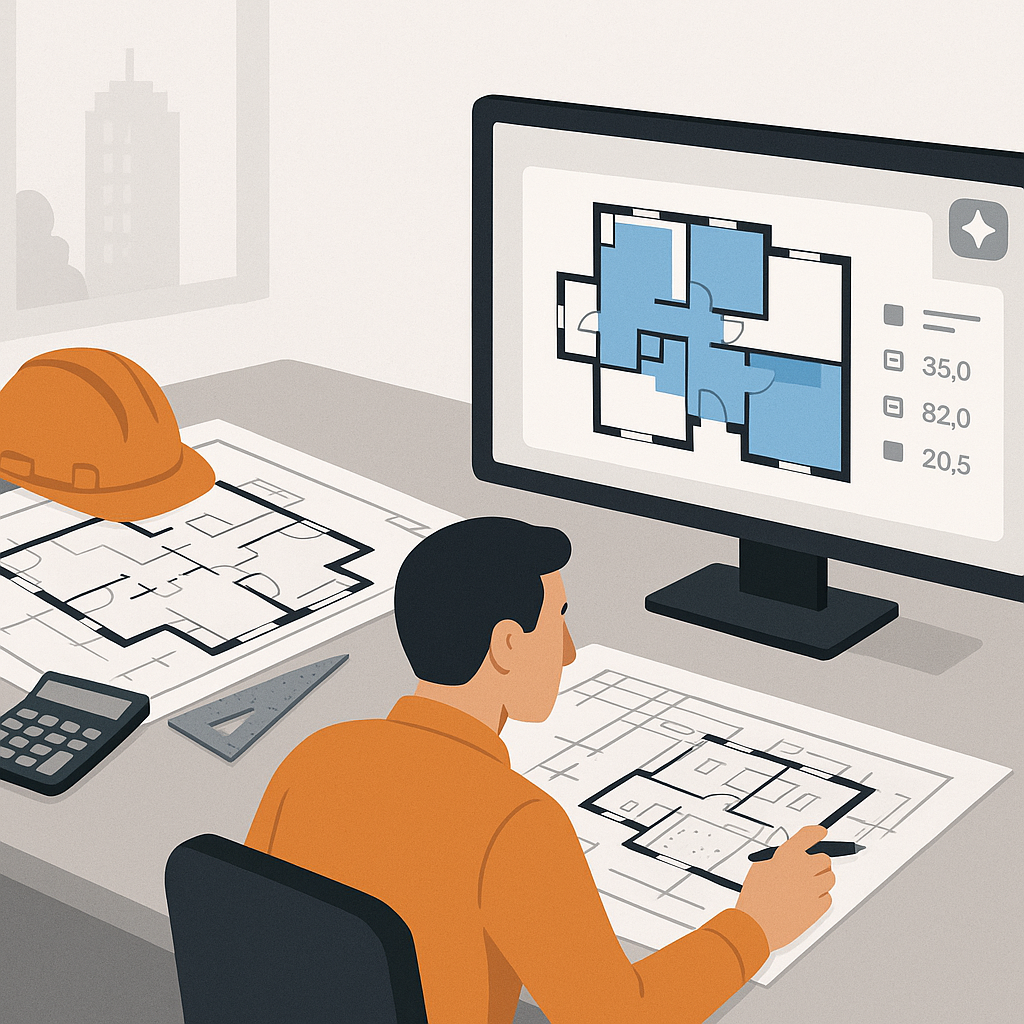
Why Manual Takeoffs Are Killing Your Bid Pipeline
Let’s start with a reality check: manual drawing takeoffs are slow. Painfully slow. A typical general contractor spends 40 hours—two full workdays—just extracting quantities from PDFs. And that's assuming no errors or revisions. If mistakes occur or plans are updated mid-process, the time commitment skyrockets.
For subcontractors, the math is even worse. Teams handling dozens of bids a month often can't keep up. They either miss deadlines or rush estimates, risking accuracy. A rushed estimate can lead to underpricing, eating into your margins, or overpricing, losing the bid entirely. It’s a lose-lose situation.
But here's the kicker: this isn’t a manpower problem. Throwing more junior estimators at the task doesn’t fix it. The bottleneck is the process itself—manual tools like Bluebeam and Excel weren’t designed for speed. They’re operational Band-Aids, not solutions.
The AI Takeoff Revolution
This is where tools like EstimateNext's Vision AI flip the script. Instead of spending 40 hours tracing walls, counting fixtures, and recalibrating drawings, you upload your PDFs and let the AI extract quantities in just 10 minutes. That’s a 10X improvement.
How does it work? Vision AI uses machine learning models trained on thousands of construction drawings to identify shapes, areas, and counts directly from the plan. It can handle revisions too—upload new sets, and it highlights changes automatically. No rework, no headaches.
Real-World Example: Saving Two Weeks of Labor
A mid-sized general contractor (GC) recently saved 120 hours on a high-rise bid using Vision AI. That’s two full weeks of labor costs avoided. The project manager explained, “It’s like hiring a full-time estimator without the overhead. We didn’t just save time; we reduced errors and improved our bid accuracy.” Source: EstimateNext blog.
Subcontractor Benefits: Faster Turnarounds
Subcontractors see even greater gains. For example, an HVAC contractor processing 20 bids per month reduced their takeoff time from 3 days to 4 hours per project. The faster turnaround allowed them to pursue more jobs, increasing their win rate by 15%. Efficiency isn’t just about speed—it’s about unlocking growth potential.
Why Speed Matters More Than Ever
You might be thinking, “Saving time is nice, but does it really move the needle?” Absolutely. Here’s why:
1. More Bids, More Wins
In preconstruction, volume matters. If you can process estimates in hours instead of days, you respond to more RFQs. Simple math: more bids = more chances to win. A GC submitting 50 bids per year can double that output with AI-powered takeoffs—without additional staff.
2. Better Negotiations
Faster takeoffs mean earlier engagement with subcontractors. Subcontractors can refine scope and pricing sooner, giving you leverage to adjust rates or negotiate terms before deadlines. This can be the difference between winning and losing in competitive markets.
3. Focus on Strategy
By automating grunt work, senior estimators spend more time on high-value tasks—margin optimization, risk analysis, or bid/no-bid decisions. These strategic moves directly impact profitability.
Data-Driven Insights
In fact, McKinsey reports that early adopters of AI tools in construction see average cost savings of 10-20% per project. For a $10 million project, that’s up to $2 million saved. The ROI becomes undeniable, especially for larger bids. Source: McKinsey report on AI in construction.
The Obvious Objection: “But AI Can’t Think Like an Estimator”
I get this pushback all the time. You might be wondering, “Sure, AI is fast, but it doesn’t understand the nuances of construction.”
That’s partially true—but it’s also missing the point. AI doesn’t replace your expertise; it amplifies it. You’re still the one making judgment calls, negotiating with subs, and deciding on markup. The AI handles the grunt work—like takeoffs, rate matching, and recalculations. It’s a tool, not a replacement.
Hybrid Approach: Human + AI
Anecdotally, teams that pair junior estimators with AI platforms see the best results. The junior staff handles the initial AI input and reviews, while senior estimators focus on strategic decisions. This hybrid model blends human judgment with machine efficiency, optimizing both speed and accuracy.
What About Smaller Projects?
Another question I hear: “Is this overkill for smaller jobs?” Not at all. AI tools scale to any project size. Whether you’re handling a $1 million fit-out or a $1 billion rail bridge, the process is the same. In fact, smaller teams often see the biggest gains because their resource constraints are tighter.
Case Study: Regional Contractor Scaling Up
A regional contractor in India used EstimateNext to price CPWD tenders faster. Instead of flipping through 2,000-page DSR rate books, they searched 78,000 SOR items in seconds. The result? 200 hours saved annually, enabling them to bid on more projects without additional staff. Source: EstimateNext blog.
Comparison Table: Manual vs. AI Takeoffs
| Feature | Manual Takeoffs | AI Takeoffs |
|---|---|---|
| Time per bid | 40 hours | 10 minutes |
| Error rate | High (human fatigue) | Low (confidence scoring) |
| Revision handling | Manual rework | Automated highlights |
| Scalability | Limited | Unlimited |
| ROI | Low | High |
Call to Action
If you're tired of wasting 40 hours on manual takeoffs, EstimateNext’s Vision AI can help. Get quantities extracted in minutes—and free up your team for the work that really matters. Get started free →


