The Bottleneck No One Talks About
Let’s be real: manual takeoffs are a nightmare. For most preconstruction teams, it’s the same routine every bid—tracing lines on PDFs, counting symbols, and cross-checking quantities. It’s tedious, error-prone, and slow. How slow? A typical mid-sized project takes 40 hours just for takeoffs. That’s two full workweeks for a team of two estimators.
Now, multiply that by four or five bids a month. The math is brutal. And what’s worse? All that effort still doesn’t guarantee accuracy. A missed dimension or miscounted symbol can snowball into big cost overruns later on. For example, a miscalculation on a $10M commercial project could result in $100K+ in lost profits due to underbidding.
If you’re nodding along, you already know the pain. But here’s the good news: you don’t have to operate like this anymore.
AI Takeoffs: 10 Minutes, Not 40 Hours
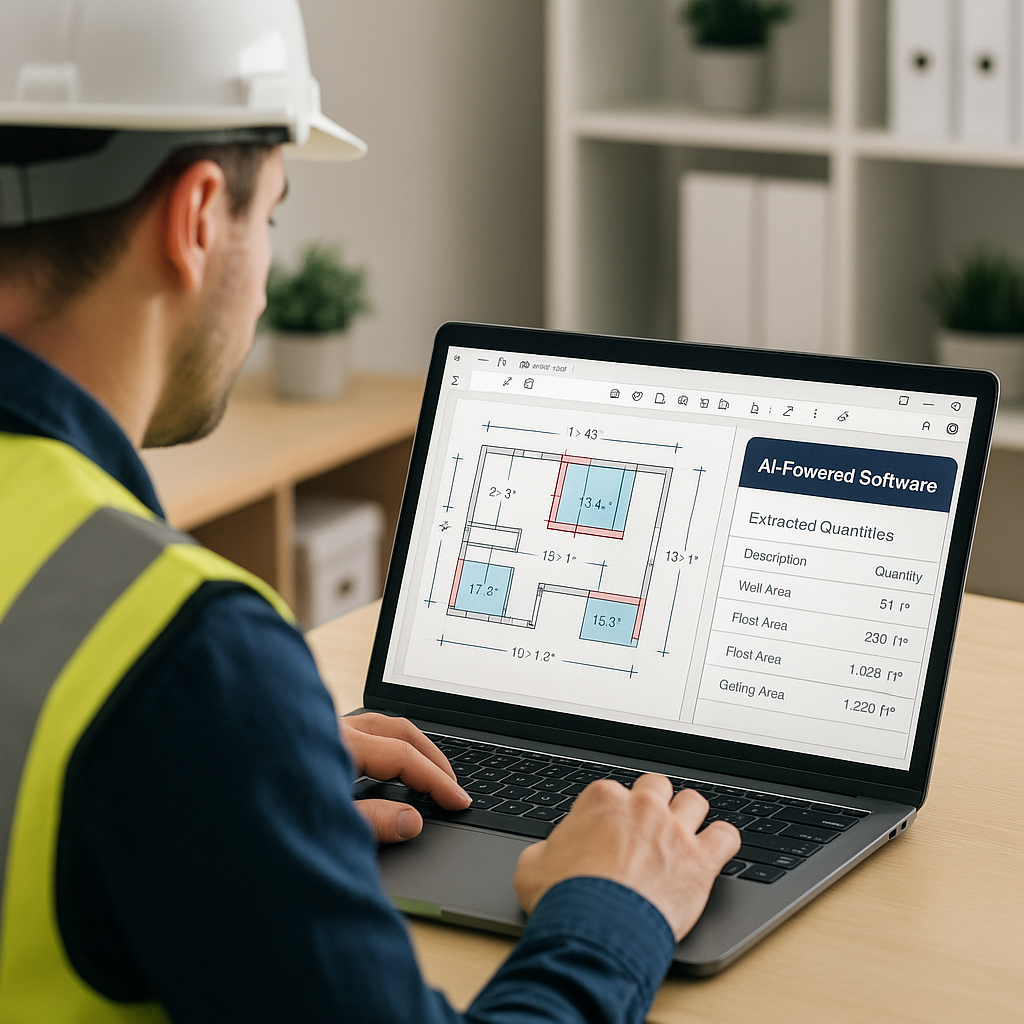
AI-powered tools like EstimateNext are flipping the script on takeoffs. Instead of spending days manually extracting quantities from drawings, you can upload your PDF set and let the AI handle the grunt work. In minutes, it spits out room areas, wall lengths, door/window counts, and more—all with confidence scores so you know where to double-check.
Concrete Example: A Small Office Build-Out
Imagine you’re estimating a $3M office fit-out. The project involves 12,000 square feet of drywall, 100 doors, and 25,000 square feet of flooring. Manually, you’d spend two full days measuring and counting these quantities. With EstimateNext, you upload the drawings, and within 10 minutes, you receive an itemized takeoff report. Instead of spending hours measuring door openings, the AI identifies them automatically and flags areas with complex structures for manual review.
How It Works in Practice:
- Step 1: Upload your drawings (PDFs, DWGs, or BIM files).
- Step 2: The AI scans for dimensions, symbols, and annotations, then extracts quantities automatically.
- Step 3: Review low-confidence areas flagged for manual validation.
Done. What used to take 40 hours now takes 10 minutes. Even if you spend another hour reviewing the output, you’re still saving 90% of your time.
Case Study: Hospital Project
A mid-sized general contractor recently used EstimateNext for a $120M hospital project. Their estimators saved 120 hours on takeoffs—three full workweeks. Instead of scrambling to meet the bid deadline, they used the extra time to refine their pricing strategy and negotiate better sub bids. They won the contract with a profit margin 2% higher than their usual projects, translating to $2.4M in additional revenue.
And it’s not just speed. AI tools like EstimateNext learn as you go. The more projects you process, the smarter the system gets. By the third bid, many teams report takeoff accuracy improvements of up to 80%, according to their case studies.
The Obvious Pushback: "But AI Can’t Think Like Us"
I hear this argument all the time. "Sure, AI is fast, but it doesn’t understand the nuances of construction." And you know what? That’s true. AI won’t replace your expertise. It won’t negotiate with subs or catch a poorly worded spec clause.
But that’s not the point. AI isn’t here to replace you—it’s here to take the busywork off your plate. Think of it like hiring an unpaid intern who works 24/7 without mistakes. You’re still making the judgment calls; the AI just handles the repetitive, time-sucking tasks.
Actionable Insight:
To make AI work for you, treat it like a junior estimator. Use it to handle the grunt work—measuring, counting, and calculating—while reserving your expertise for high-value tasks like scope reviews, sub negotiations, and risk assessments. Pairing AI with your judgment creates a hybrid workflow that’s both fast and accurate.
The ROI Is a No-Brainer
Let’s talk numbers. If your team spends 40 hours per estimate at $130/hour (a standard GC rate), that’s $5,200 in labor per bid. With AI, that drops to maybe $200 in tool costs and review time. Over five bids a month, you’re saving over $25,000 in labor costs alone. That’s not just ROI—that’s a competitive advantage.
Comparison Table: Manual vs AI-Powered Takeoffs
| Metric | Manual Takeoffs | AI-Powered Takeoffs |
|---|---|---|
| Time per Estimate | ~40 hours | ~1 hour |
| Labor Cost per Estimate | $5,200 | $200 |
| Accuracy Improvement | Baseline | Up to 80% |
| Max Bids per Month | ~5 | ~10 |
| Potential Cost Overruns | High risk | Significantly reduced |
Faster takeoffs mean you can bid on more projects without burning out your team. Imagine responding to 10 bids a month instead of five. Even if you win just one extra project, the revenue boost could be massive.
The Bigger Picture
Beyond takeoffs, AI is reshaping the entire preconstruction process. Tools like EstimateNext integrate with platforms like Procore and Autodesk, creating a seamless workflow from bid-to-build. Rate matching, sub bid leveling, what-if scenarios—it’s all faster and more accurate with AI in the mix.
Action Steps for Getting Started:
- Start Small: Test AI on a mid-tier project to understand its capabilities.
- Compare Results: Use AI and manual methods side by side for your first project to benchmark accuracy.
- Scale Gradually: Once you see time savings firsthand, expand usage to larger and more complex bids.
- Train Your Team: Invest in training so your estimators feel confident using the tools.
McKinsey reports that early adopters of AI in construction see cost savings of 10-20% per project. When you’re dealing with multi-million-dollar bids, that’s a lot of money back in your pocket.


