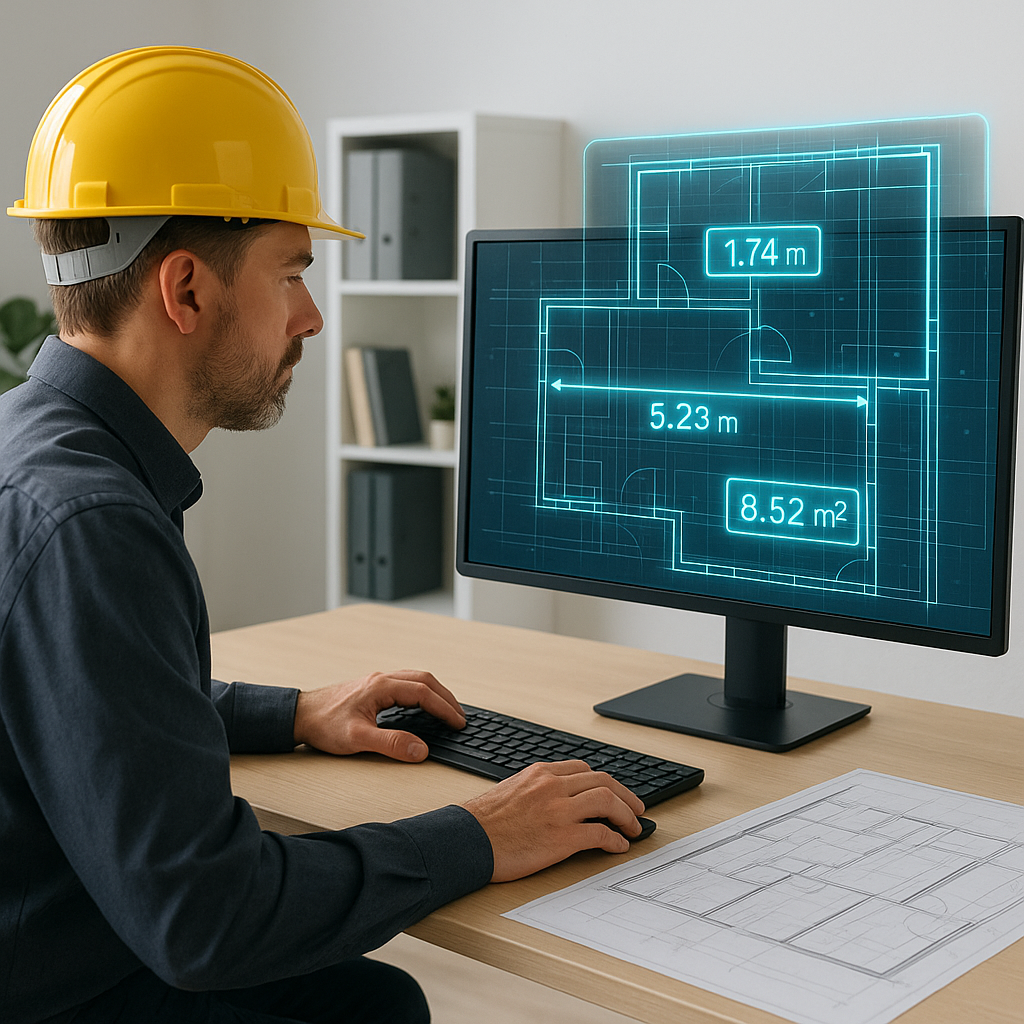
The Brutal Math of Manual Takeoffs
Manual drawing takeoffs are a time sink. If you’ve ever had two estimators spend two full days measuring linear footage, counting fixtures, and double-checking revisions, you know the drill. That’s 40 hours wasted per bid. Multiply that across five GMP pursuits a year, and you’re looking at 200 hours—just on takeoffs.
Why does it take so long? PDFs weren’t designed for construction. You calibrate scales, trace dimensions, and manually input quantities into Excel. One mistake cascades into hours of rework. And revisions? Forget it. You’re remeasuring everything from scratch.
This isn’t just frustrating; it’s expensive. At $130/hour for skilled estimators, that’s $5,200 per bid and over $25,000 a year in labor costs. For smaller firms, this can mean the difference between profit and loss.
Concrete Example: The Small Contractor’s Struggle
Take a small drywall contractor bidding for a $500,000 tenant improvement project. They have two estimators, each earning $130/hour. If they spend 40 hours on manual takeoffs for a single bid and submit 10 bids a year, that’s $52,000 in labor costs—just for takeoffs. That’s 10% of their annual revenue spent on a process that could be automated.
Now consider the potential for error. If their manual process results in an inaccurate takeoff—and they win the job—they could face unforeseen costs that eat into their already razor-thin margins. For smaller contractors, these inefficiencies add up quickly.
How AI Cuts Takeoff Time to 10 Minutes
Here’s where AI-powered tools like EstimateNext change the game. Their Vision AI reads PDF drawings and extracts quantities in 10 minutes. No tracing, no manual input. The AI identifies room areas, wall lengths, and fixture counts automatically—with confidence scoring to flag any low-certainty measurements.
Actionable Steps to Implement AI Takeoffs:
- Start Small: Test AI on a single project to understand its capabilities and limitations. For example, upload a set of PDF drawings from a completed project and compare the AI’s output to your team’s manual work.
- Integrate Custom Rates: Most AI tools allow you to upload rate catalogs or define custom pricing. This ensures the takeoffs align with your specific pricing structure.
- Leverage Confidence Scoring: Use the tool’s confidence scoring to identify areas where manual review is needed. This step ensures accuracy while still saving time.
- Train Your Team: Invest in a short training session for your estimators. Platforms like EstimateNext are user-friendly, but a few hours of training can ensure your team uses the tool effectively.
Case Study: Saving 120 Hours on a High-Rise Project
A mid-sized general contractor shared their story: while bidding on a high-rise project with 200+ pages of drawings, they used Vision AI for takeoffs. The software completed measurements and quantity extraction in just 10 minutes per floor. In total, they saved 120 hours—equivalent to two full weeks of labor. At $130/hour, that’s $15,600 in labor costs avoided on a single bid. They described the experience as “like hiring a full-time estimator without the overhead.”
Addressing Accuracy Concerns
Some might worry about accuracy. AI isn’t perfect—it’s only as good as the input data. However, tools like EstimateNext include manual overrides and audit trails. If the AI makes a mistake, you can catch it and adjust. This hybrid approach—AI for speed, human oversight for precision—is faster and more reliable than starting from zero.
Why Speed Matters Beyond Labor Costs
Saving 40 hours is great, but the real value of AI takeoffs is what you can do with the time you save. For general contractors, it means more bids submitted and better subcontractor negotiations. For MEP subs, it means hitting tight deadlines without sacrificing quality.
Example: Faster Bids, Bigger Wins
Consider an HVAC subcontractor bidding on a $200,000 high school renovation. With manual takeoffs, they’d need three days to measure ductwork, count grills, and calculate tonnage. Using EstimateNext, they completed the takeoff in under an hour and submitted their bid two days early. That early submission gave them a competitive edge, helping them secure the contract.
For businesses responding to 30-60 bid packages a year, these wins add up. If each saved bid lands an additional $200,000 in work, even a 10% success rate means an extra $600,000 to $1.2 million in annual revenue.
Risk Reduction Through Consistency
Manual processes leave room for errors—missing quantities, misreading scales, or forgetting revisions. According to a case study, AI takeoffs reduce discrepancies by up to 80%. Fewer errors mean fewer surprises during construction, fewer change orders, and fewer arguments with clients.
The Obvious Objection: “AI Can’t Think Like an Estimator”
I hear this argument all the time. “AI is fast, but it doesn’t understand the nuances of construction.” True, to a point. AI won’t replace your expertise—it amplifies it. You’re still the one making judgment calls, negotiating with subs, and deciding on markup.
How to Combine AI with Human Expertise:
- Pair Junior Estimators with AI: Let AI handle the grunt work while junior estimators focus on learning the nuances of your trade.
- Use AI as a Second Pair of Eyes: Even experienced estimators can benefit from a tool that double-checks their work.
- Focus on Strategy: With AI handling repetitive tasks, senior staff can dedicate more time to high-value activities like bid strategy and client relationships.
The AI handles the measurements, rate matching, and what-if recalculations. It’s a tool, not a replacement. In my view, that’s how you build a smarter preconstruction team.
Comparison Table: Manual vs. AI Takeoffs
| Feature | Manual Takeoffs | AI-Powered Takeoffs |
|---|---|---|
| Time Per Takeoff | ~40 hours | ~10 minutes |
| Cost Per Bid | $5,200 (at $130/hour) | ~$300 (software subscription) |
| Accuracy | Prone to human error | High, with manual overrides |
| Revision Handling | Fully remeasured manually | Automatic comparison |
| Scalability | Limited by team size | Scales easily across projects |
| Training Required | High (expertise in drawings, Excel) | Low (user-friendly platforms) |
Call to Action
If you’re tired of wasting 40 hours on manual takeoffs, EstimateNext can help. Get started free today and see how AI-powered tools can save you thousands.


