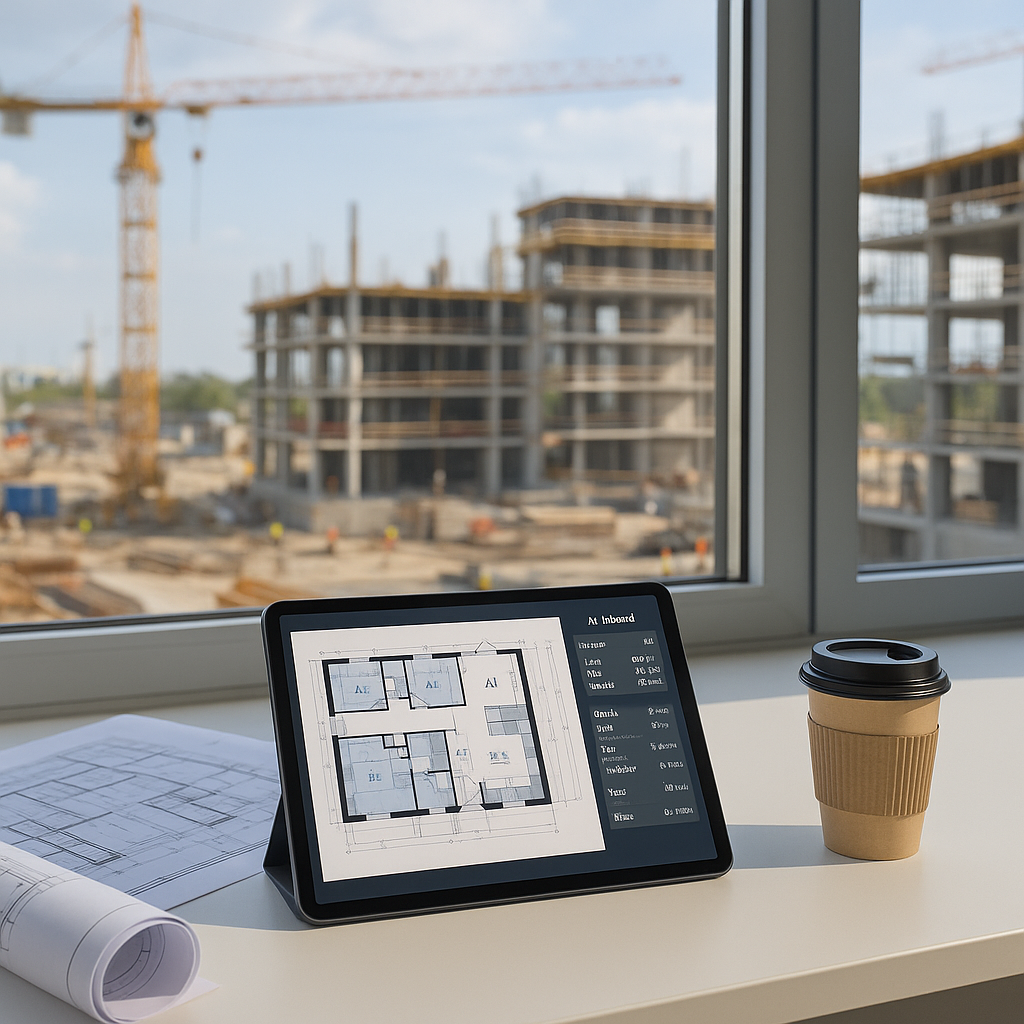
10 Minutes vs. 40 Hours: How AI Cuts Preconstruction Takeoff Time
Let me paint you a picture: It’s Monday morning, and your team just received a 300-page drawing set for a high-stakes bid. You’ve got 72 hours to identify, measure, and quantify every material, room area, and labor cost. No pressure, right? Now imagine one of your estimators calling in sick, and suddenly, you’re staring at an all-nighter. Sound familiar?
If you’ve worked in preconstruction, you know the grind. Manual drawing takeoffs are a time sink, often eating up 40 hours or more on complex projects. That’s two estimators working full-time for two days—just to get the basics done. And let’s be honest, the margin for error is high, especially when fatigue sets in. But what if I told you this whole process could take just 10 minutes?
The Problem with Manual Takeoffs
Manual takeoffs are tedious. You’re flipping between prints or PDFs, tracing over walls, counting doors, and measuring areas with a scale. Then you’re keying everything into an Excel sheet and hoping you didn’t misplace a decimal point. It’s not only time-consuming but also error-prone. How many times have you discovered a miscalculation after submitting a bid? Probably too many to count.
For example, a case study by the Construction Industry Institute found that manual takeoff errors can inflate project costs by 5-15%. These errors often stem from fatigue, poor documentation, or simply the repetitive nature of the task. One estimator I spoke to described it as "death by a thousand cuts."
And here’s the kicker: A lot of this work doesn’t require expertise. Senior estimators—highly skilled professionals—are often stuck doing grunt work that could be done faster and more accurately by a machine. That’s where AI-powered tools come in.
How AI Changes the Game
AI-powered preconstruction tools like EstimateNext flip the script. Instead of spending hours on manual takeoffs, you upload your PDF drawings, calibrate the scale, and let AI handle the rest. Vision AI, for instance, extracts quantities for room areas, wall lengths, and even door and window counts. The entire process takes about 10 minutes.
A Real-World Example
Here’s a real-world example: A mid-sized general contractor working on a high-rise bid saved 120 hours using AI for takeoffs. That’s two full weeks of labor costs avoided. More importantly, they submitted their bid on time without sacrificing accuracy. Their words? “It’s like hiring a full-time estimator without the overhead.”
Another example involves an MEP (mechanical, electrical, plumbing) contractor who reduced their takeoff time on a 200,000-square-foot hospital renovation project by 80%. The AI tool flagged potential discrepancies in ductwork quantities, saving the client nearly $50,000 in potential rework costs.
Actionable Steps to Adopt AI Tools
- Start Small: Begin with smaller, less complex projects to familiarize your team with the AI platform.
- Set Benchmarks: Track the time and cost savings for each project to measure ROI.
- Combine Human Oversight: Use AI for the heavy lifting, but have a senior estimator review flagged areas for accuracy.
- Integrate with Existing Tools: Look for platforms that work seamlessly with Procore, Bluebeam, or Excel to avoid disrupting current workflows.
Why Speed Matters
In preconstruction, time isn’t just money—it’s opportunity. The faster you can complete takeoffs, the more bids you can pursue. A typical GC might handle 5-8 GMP (Guaranteed Maximum Price) pursuits per year. If you’re spending 40 hours per estimate, that’s nearly 15% of your team’s annual capacity wasted on manual work.
Competitive Edge
Faster bids create a competitive edge. Let’s say two contractors are bidding on the same project. Contractor A submits their bid within 24 hours, while Contractor B takes the full 72 hours. Who looks more competent and prepared in the client’s eyes? Speed signals professionalism, and in a highly competitive industry, perception matters.
Opportunity Cost
Consider the opportunity cost of not using AI. If your team spends 1,200 hours annually on manual takeoffs, that’s time they could have spent on value engineering, client relationship-building, or exploring additional projects. In an industry with razor-thin margins, this lost opportunity can be the difference between thriving and just surviving.
Accuracy You Can Trust
Skeptical about AI accuracy? You’re not alone. One of the most common objections I hear is, “AI can’t think like an estimator.” And that’s true—to a point. AI doesn’t replace human judgment; it enhances it. Tools like EstimateNext include confidence scoring and manual override features. If the AI flags a low-confidence line, you can remeasure it yourself. Think of it as a safety net, not a replacement.
Data-Backed Results
According to McKinsey, early adopters of AI in construction see cost savings of 10-20% per project. Why? Because reducing errors and rework is just as valuable as speeding up workflows. For example, one general contractor reported a 15% reduction in change orders after switching to AI-powered takeoffs.
AI Gets Smarter
Another advantage is that AI improves over time. Each new project trains the algorithm, making it more accurate and tailored to your workflow. By the third or fourth project, most users report a noticeable improvement in both speed and accuracy.
The ROI Is Hard to Ignore
Let’s do the math. Say you’re a GC preconstruction director with a team of six estimators. Each estimator costs you $130/hour fully loaded. If AI saves 36 hours per estimate, that’s $4,680 saved—per bid. Multiply that by your annual GMP pursuits, and you’re looking at tens of thousands in savings. All for a tool that costs $99/month per seat.
Subcontractor Perspective
For subcontractors, the ROI is even more dramatic. Faster takeoffs mean faster quotes, which means more bids submitted. One MEP firm reported a 50% increase in bid volume after adopting AI-powered tools. With an average win value of $200K, that’s $800K-$1.6M in incremental revenue per year.
Comparison Table: Manual vs. AI Takeoffs
| Aspect | Manual Takeoffs | AI-Powered Takeoffs |
|---|---|---|
| Time per estimate | 40 hours | 10 minutes |
| Error rate | 5-15% | <1% (with human review) |
| Labor cost per bid | $5,200 (at $130/hour) | ~$21 (AI subscription) |
| Scalability | Limited by manpower | Unlimited |
| Accuracy improvement | N/A | Increases over time |
What About Smaller Projects?
You might be thinking, “This all sounds great, but what about my $1M renovation projects? Is AI overkill?” Not at all. AI tools scale to any project size. Whether you’re pricing a $1B rail bridge or a 10,000-square-foot office fit-out, the process is the same. In fact, smaller projects often benefit the most because the time saved is proportionally greater.
For instance, a small architecture firm used AI to complete takeoffs for a $500K retail buildout in just 15 minutes, freeing up their sole estimator to work on design refinements instead.
Getting Your Team Onboard
Change is hard, especially for seasoned estimators who’ve been using the same methods for decades. The key is to frame AI as a tool that amplifies their expertise, not a replacement. Start with smaller projects to build trust in the system. Pair junior estimators with AI tools to free up senior staff for strategic work. Most platforms, including EstimateNext, are designed for ease of use, with training typically taking less than two weeks.
The Bottom Line
AI-powered preconstruction tools aren’t just a nice-to-have—they’re quickly becoming a necessity. If your competitors are using AI and you’re not, you’re already behind. The good news? It’s not too late to catch up. Start small, measure the results, and scale up as your team gets comfortable.
If you’re tired of wasting 40 hours on manual takeoffs, it’s time to make a change. EstimateNext can help. Get started free →


