The 40-Hour Problem No One Talks About
If you've ever handled a large bid, you know the pain: 40 hours, two estimators, four cups of coffee per day, and a pile of drawings that never seems to shrink. Manual quantity takeoff is one of the most time-consuming—and frankly soul-crushing—parts of construction estimation. And while everyone talks about bid strategy and rate accuracy, no one likes to admit how much time is wasted just tracing lines on PDFs.
Here’s an example: A mid-sized general contractor bidding on a $120M high-rise spent two full weeks on takeoffs alone. That’s 80 hours of work just to figure out quantities for concrete, steel, and drywall. Now multiply that by 5-8 GMP pursuits a year. You’re looking at 300+ hours sunk into tasks that don’t even require decision-making—just brute force.
But this isn’t just inefficient. It’s risky. The more time your team spends on takeoffs, the less time they have to refine rates, negotiate with subs, or improve bid accuracy. And when deadlines are tight, mistakes creep in. A missed line item here, a doubled quantity there—it adds up fast. The consequences can range from overbidding (and losing the job) to underbidding (and eating into your profit margins).
Now imagine this: cutting that 40-hour task down to just 10 minutes.
The AI Solution: 10 Minutes to Done
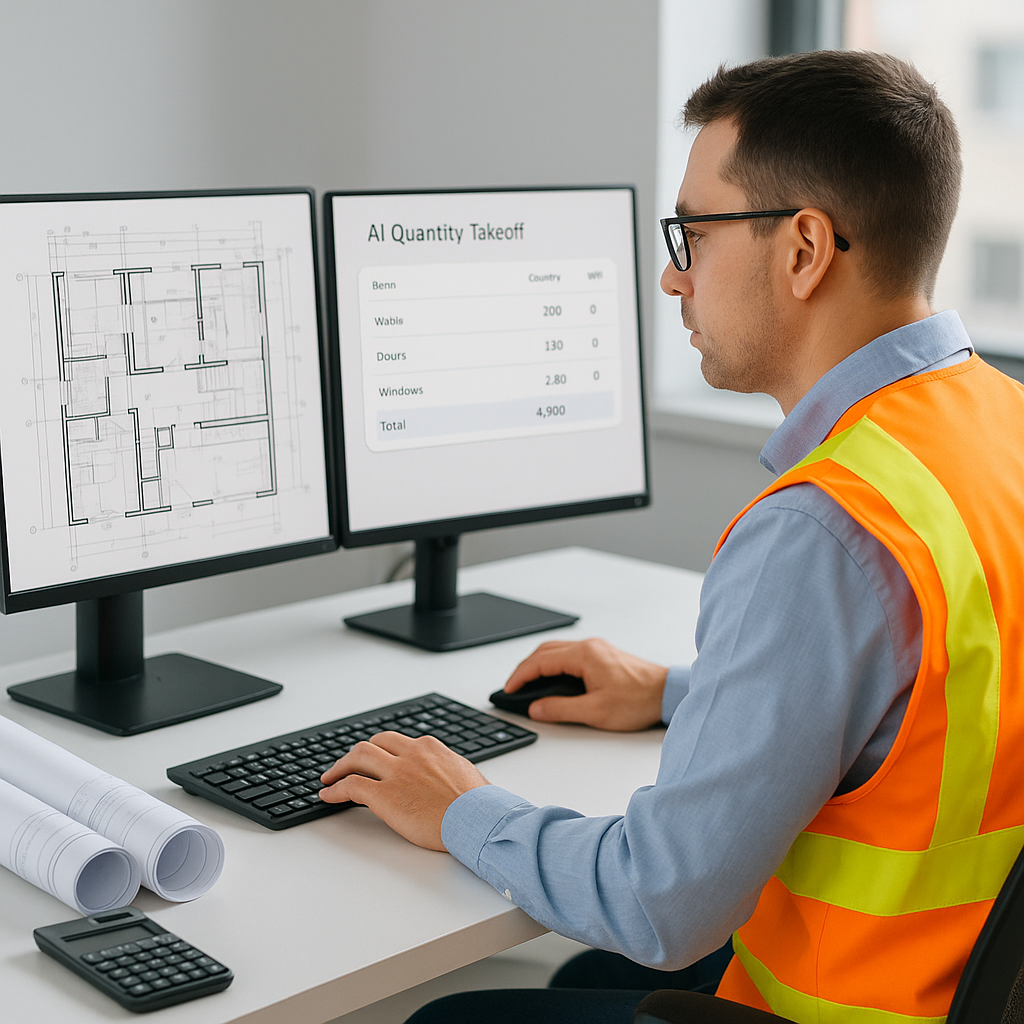
AI-powered takeoff tools like EstimateNext are flipping the script. Instead of manually measuring every wall length, room area, or beam count, you upload your PDF drawings, and the AI does the rest. It’s not magic—it’s math, machine learning, and a lot of training data. But to you, it feels like magic.
Here’s how it works:
- Upload Your Drawings: Drag and drop a PDF set into the platform.
- Let the AI Extract Quantities: The Vision AI reads the drawings and pulls out areas, lengths, counts, and more. Think room areas, door/window counts, wall lengths—it’s all automatic.
- Review and Adjust: Got a tricky section? The AI flags low-confidence areas so you can remeasure or override.
- Export the QTO: Once you’re happy, you export the quantities into your BOQ format of choice—Excel, CSI MasterFormat, or whatever your client prefers.
A Case Study: Real Numbers from the Field
On a $1B rail infrastructure project, an estimating team used AI to complete their takeoff. The results? They saved 56 hours per bid. That’s not just a productivity boost—it’s a stress reducer. Imagine finishing a takeoff in the time it takes to grab lunch instead of burning two days on it. Another contractor working on a $65M mixed-use development found they could complete takeoffs 80% faster, allowing them to reallocate their estimator’s time toward value engineering and subcontractor negotiations.
For smaller projects, the time savings are just as impactful. A residential framing contractor shared that they reduced their typical takeoff time from 12 hours to under 90 minutes for single-family homes. That means they could process more bids without hiring additional staff.
Objections—and Why They Don’t Hold Up
I can already hear the skeptics. "Sure, AI is fast, but it doesn’t understand construction." You’re not wrong. AI won’t replace your expertise—it’s not supposed to. But that’s not the point.
AI handles the grunt work so you can focus on the high-value tasks that make or break a bid. It’s not replacing you; it’s freeing you. Think of it as a calculator. You could still do long division by hand, but why waste the time?
Common Concerns, Addressed
-
"What if the AI misses something?" No system is perfect, which is why tools like EstimateNext include confidence scoring and manual override options. The AI flags areas where it’s unsure, giving you the chance to double-check and refine. You’re still in control.
-
"Won’t this disrupt my workflow?" Quite the opposite. Most AI tools integrate seamlessly with existing software like Bluebeam, Procore, or Excel. You don’t have to rebuild your process—just augment it.
-
"Is it worth the cost?" If your team saves 40 hours per bid and your average hourly cost per estimator is $130, that’s $5,200 saved on every single project. For firms handling 30 bids annually, that’s $156,000 in savings. The ROI makes the investment a no-brainer.
Why This Matters for Your Bottom Line
Let’s get real: time is money. If your team spends less time on manual takeoffs, they have more bandwidth for strategic tasks like refining rates, negotiating with subs, and improving bid accuracy. This doesn’t just save time—it increases your win rate.
For smaller firms, the math is even more compelling. If you’re an MEP subcontractor handling 30-60 bid packages a year, cutting takeoff time from 3 days to 4 hours means you can respond to 50% more bids. More bids mean more wins. More wins mean more revenue. Simple as that.
A Decision Framework for AI Adoption
| Question | AI Takeoff Tools | Manual Process |
|---|---|---|
| Time per Bid | ~10 minutes | 40+ hours |
| Accuracy | High, with review | Dependent on estimator |
| Cost | Software subscription | Labor hours |
| Scalability | Unlimited bids | Limited by staff hours |
| Stress Reduction | High | Low |
The table above shows why AI is a game-changer. It’s not about replacing humans—it’s about amplifying their capabilities.
The Real-World Impact
One mid-sized GC director put it like this: "It’s like hiring a full-time estimator without the overhead." They used EstimateNext on a high-rise project and saved 120 hours. That’s two full weeks of labor costs avoided—time they reinvested into refining rates and negotiating with subs.
Another contractor bidding on a $108M water infrastructure project used AI to speed up takeoffs and focus more on cost engineering. The result? A bid that was not just faster but also more competitive.
Take Action
You don’t need to overhaul your entire process overnight. Start small. Test an AI-powered takeoff tool on a low-stakes project. See how it integrates with your existing workflow. Once you’re comfortable, scale up.
If you’re tired of spending 40 hours on manual takeoffs, EstimateNext can help you cut that to just 10 minutes. Get started for free →
By embracing AI for takeoffs, you can reclaim your time, reduce errors, and focus on what truly matters: winning more bids and growing your bottom line.


