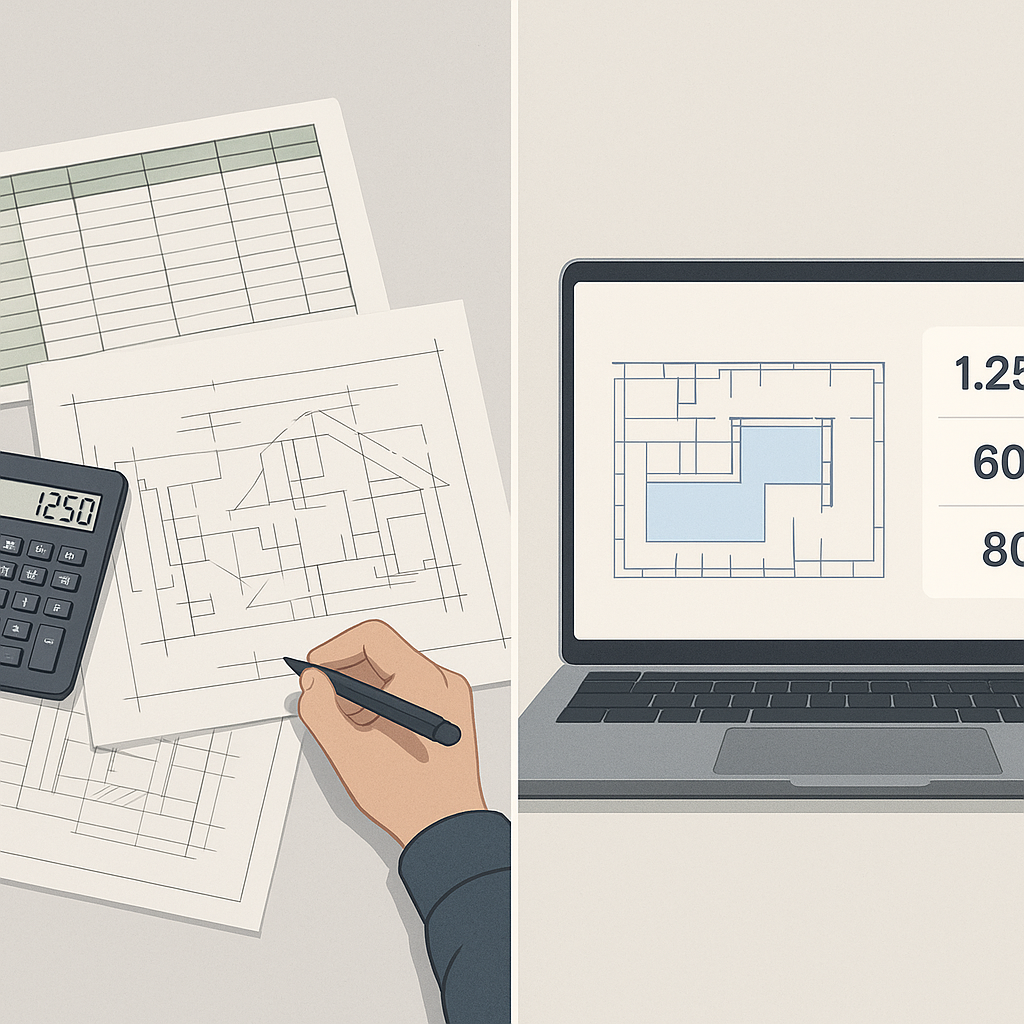
The Problem: Why Are We Still Doing This Manually?
If you’ve ever been in the preconstruction trenches, you know the grind: flipping through drawings, manually measuring areas, and double-checking quantities. It’s painfully slow. A typical takeoff can take two estimators 40 hours (or more) to complete. That’s half a workweek gone per person.
Why does it take so long? Because you’re working with tools that were never designed to handle today’s complexity. Bluebeam’s fine for marking PDFs, but it stops short of automating the real work. Excel? Great for final numbers, but a nightmare for iterative changes. The result? Hours wasted on repetitive tasks that don’t move the needle.
Case in Point: Manual Takeoff vs. AI Tools
Let’s consider an example. A small general contractor bidding on a commercial office project spends 80 hours (two weeks) on manual takeoffs. The task involves:
- Cross-referencing drawings from multiple disciplines (architecture, MEP, structural).
- Entering measurements manually into Excel.
- Rechecking numbers for accuracy.
By the time the estimate is ready, the bid deadline is right around the corner, leaving no breathing room for value engineering or revisions. Worse, if a small error is found, it could undo hours of work. This cycle repeats itself for every project.
Enter AI-Powered Takeoffs
Here’s the pitch: What if you could take that 40-hour slog and shrink it to 10 minutes? Not an exaggeration. Tools like EstimateNext use AI to extract quantities directly from PDF drawings. Upload your plans, and the system does the heavy lifting—measuring areas, counting fixtures, and calculating lengths. It’s like having a full-time estimator in your back pocket.
Real-World Example: Saving 120 Hours on a High-Rise Project
A mid-sized general contractor (GC) recently shared their experience with us. They had a high-rise bid on a tight deadline. Traditional methods would’ve required two full weeks of takeoff work. Instead, they used Vision AI from EstimateNext. The result? 120 hours saved. That’s two weeks of labor costs avoided, and they hit their deadline comfortably.
Think about what that could mean for your team:
- More bids: You can pursue additional opportunities without overloading your team.
- Better focus: Free up time for high-value tasks like cost analysis or client presentations.
- Less stress: Avoid burnout and improve morale by eliminating tedious, repetitive tasks.
Actionable Steps to Get Started
- Evaluate your current takeoff process: How much time and money are you spending on manual methods?
- Trial AI tools: Most solutions offer free trials or demos. Test them out on a small project.
- Train your team: While AI tools are user-friendly, a short training session ensures everyone knows how to maximize the software’s potential.
- Benchmark results: Compare the time, costs, and accuracy of AI-powered takeoffs versus your manual process.
The Skeptic’s Take: “AI Can’t Think Like an Estimator”
This is the most common pushback I hear. And it’s valid—to a point. AI isn’t perfect (yet). It doesn’t understand project nuances the way a human does. But that’s not the point. AI doesn’t replace your expertise; it amplifies it.
Here’s how we see it: Let the AI handle the grunt work, like measuring and counting. You stay in control of judgment calls, value engineering, and negotiations. It’s a partnership, not a replacement.
Addressing Concerns
- “AI doesn’t understand unique project requirements.” True, but most AI tools allow customization. You can adjust measurements, define project-specific rates, and upload your own rate catalogs.
- “What if the AI makes errors?” Confidence scoring highlights measurements that may need human review. You’re still the final decision-maker.
Comparison: Manual Takeoffs vs. AI-Powered Takeoffs
| Aspect | Manual Takeoffs | AI-Powered Takeoffs |
|---|---|---|
| Time Required | 40+ hours per project | 10 minutes per project |
| Accuracy | Prone to human error | High, with confidence scoring |
| Cost | $5,200 per estimate (e.g., 40 hours at $130/hour) | $99/month subscription |
| Scalability | Limited by manpower | Scales easily to multiple bids |
| Stress Level | High (tedious, repetitive) | Low (automated, efficient) |
The Numbers Don’t Lie
Here’s some quick math. If your team spends 40 hours on manual takeoffs and you’re paying $130/hour per estimator, that’s $5,200 per estimate. AI takeoff tools, like EstimateNext, cost $99/month. Even if you only use it for one project, you’re looking at a 52X ROI.
For larger GCs bidding on multiple projects per year, the savings multiply fast. And for smaller firms, it’s the difference between being able to compete or not.
Real Data: AI in Construction
According to McKinsey’s 2023 construction report, early adopters of AI in construction see:
- 10-20% cost savings per project.
- 50% reduction in project delays related to preconstruction inefficiencies.
- 2-3x bidding capacity, as teams can handle more projects simultaneously.
What About Accuracy?
You’re probably wondering, “How accurate is it?” AI tools like EstimateNext are highly accurate—often reducing takeoff discrepancies by up to 80%. But here’s the kicker: they’re designed with human oversight in mind. Confidence scoring highlights areas that need a second look. You can manually override any measurement, ensuring the final output matches your standards.
How to Improve Accuracy
- Provide feedback: Most AI tools learn from your corrections, improving over time.
- Audit the results: Focus on high-impact areas flagged by the system.
- Combine AI with human review: Use AI for speed and humans for quality assurance.
Why Speed Matters More Than Ever
It’s not just about saving time—it’s about staying competitive. According to the same McKinsey report, early adopters of AI in construction are already seeing significant advantages:
- Faster bid turnarounds.
- Improved client satisfaction.
- Higher win rates on competitive bids.
In today’s market, speed wins. AI isn’t a luxury anymore; it’s table stakes.
Final Thoughts
If you’re still spending 40 hours on manual takeoffs, you’re leaving money on the table. AI tools like EstimateNext don’t just save time—they give you a competitive edge. The construction industry is changing fast, and staying stuck in old methods isn’t an option.


