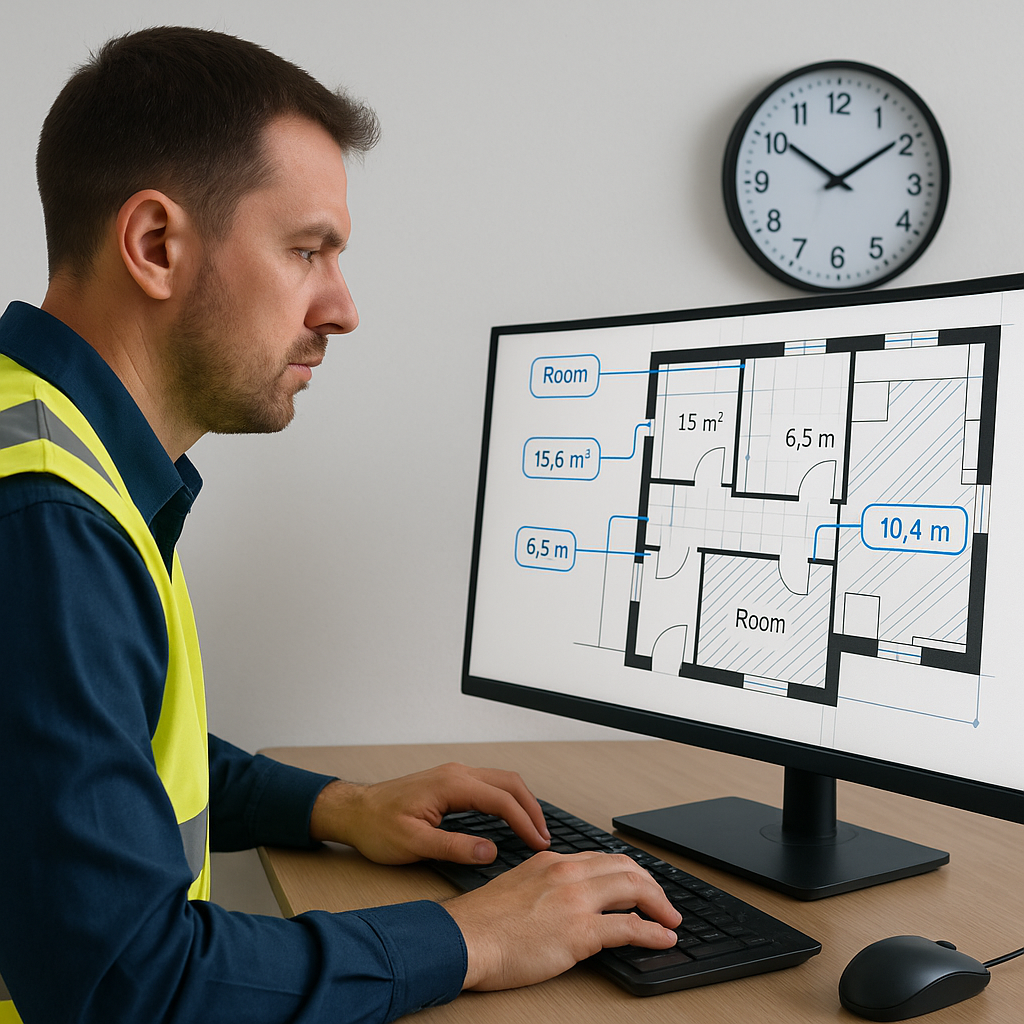
The Brutal Math of Preconstruction Estimation
Let’s start with a number: 40 hours. That’s how long it typically takes two estimators to complete a manual quantity takeoff for a mid-sized project. Two full workdays, per person, gone. And that’s just one estimate. Multiply that by five GMP pursuits a year for a general contractor — you’re looking at 400 hours annually. What could your team do with those 400 hours back? More bids? Better scope reviews? Actual weekends?
Here’s the reality: manual takeoffs are a productivity killer. Flipping through drawings, measuring areas, counting fixtures — it’s tedious and prone to human error. And when deadlines are tight, mistakes happen. A missed quantity or a miscalculated rate can tank your bid competitiveness or, worse, eat into your profit margin.
This is where AI-powered tools like EstimateNext’s Vision AI come in. Instead of spending 40 hours on takeoffs, you can get the job done in 10 minutes. Yes, 10 minutes. Let’s break this down.
How AI Handles Quantity Takeoff
At its core, AI-powered takeoff tools use machine learning to analyze construction drawings. Here’s how it works:
- Upload Your Drawings: PDFs, DWGs, scanned images — it doesn’t matter. The system reads them all.
- AI Detection: The tool identifies and extracts quantities for elements like walls, doors, windows, and more. For example, Vision AI can pull room areas, wall lengths, and fixture counts automatically.
- Confidence Scores: Every line item comes with a confidence percentage. Low-confidence items can be manually reviewed and adjusted, leaving you in control.
- Audit Trail: Need to explain your takeoff to a client or colleague? Every measurement and adjustment is documented.
What’s the result? A process that used to take two days is now done before your coffee gets cold. One mid-sized GC saved 120 hours on a high-rise bid using Vision AI. That’s two full weeks of labor costs avoided.
Real-World Example: A High-Rise Project
Consider a 15-story mixed-use development. Traditional takeoffs required two estimators to spend four full days measuring walls, counting fixtures, and cross-referencing drawings. Using Vision AI, the same task was completed in just under an hour. The team redirected the saved time to optimizing their bid strategy, ultimately winning the project by a slim margin of 0.8% cost competitiveness — a difference that might not have been possible without AI.
The Obvious Objection: “AI Can’t Think Like an Estimator”
I hear this a lot. And sure, AI isn’t perfect. It doesn’t understand the nuances of every project. But it doesn’t need to. AI isn’t replacing your expertise — it’s amplifying it. Think of it as a junior estimator who handles the grunt work so you can focus on high-value tasks like scope review or subcontractor negotiations.
Actionable Tip: Pair AI with Human Oversight
Treat AI as your assistant, not your replacement. Use it to generate the base takeoff, then review it for project-specific adjustments. For instance:
- AI might measure a window opening but not account for the unique framing requirements dictated by project specs. That’s where your expertise comes in.
And here’s the kicker: AI tools improve over time. With every project you price, platforms like EstimateNext get smarter. By the third project, most users report significant accuracy improvements.
Case Study: A General Contractor in Texas
A small GC in Texas was hesitant to adopt AI for fear it would miss critical details. After a trial run, they found that while the AI initially skipped some custom items, their manual corrections trained the system. By their fourth project, the AI captured over 95% of quantities accurately, reducing their overall estimation time by 70%.
What About Multi-Market Complexity?
Here’s another headache AI solves: different market standards. Whether you’re working with CSI MasterFormat in the U.S., CPWD DSR in India, or CESMM3 in the GCC, AI tools can handle it. EstimateNext’s MarketProfile architecture adjusts for measurement standards, currencies, and tax regimes automatically.
Example: Handling CPWD Standards
For instance, an Indian contractor responding to CPWD tenders no longer needs to flip through a 2,000-page DSR PDF. With semantic search across 78,000+ SOR items, you can find the exact rate you need in seconds. This eliminates hours of manual cross-referencing and reduces the risk of using outdated rates.
ROI: Why This Isn’t Just a Nice-to-Have
Let’s talk numbers again.
General Contractors
- A GC director saves 40 hours per estimate, at an average labor rate of $130/hour. That’s $5,200 in savings per bid.
- Multiply that by five GMP pursuits a year, and you’re looking at $26,000 saved annually.
- Compare that to the $100/month cost of a tool like EstimateNext, and the ROI is undeniable: 52X.
MEP Subcontractors
For MEP subcontractors, the benefits are even more dramatic. Faster quote turnarounds mean 50% more bids submitted, leading to 4-8 additional wins per year at $200K average revenue per project. That’s $800K-$1.6M in incremental revenue.
Comparison Table: Manual vs AI-Powered Takeoffs
| Feature | Manual Takeoffs | AI-Powered Takeoffs |
|---|---|---|
| Time per project | 40 hours | 10 minutes |
| Accuracy | Prone to human error | Up to 95% with oversight |
| Labor cost per estimate | $5,200 | $20 |
| Annual savings (5 bids) | N/A | $26,000 |
| Scalability | Limited by manpower | Unlimited |
The Bottom Line
Manual takeoffs are a relic of the past, and they’re costing you time and money. AI-powered tools like EstimateNext aren’t just faster — they’re smarter. By automating the grunt work, they let you focus on what really matters: winning bids and delivering value.
If you’re tired of wasting 40 hours on every estimate, it’s time to make the switch. Get started free →


