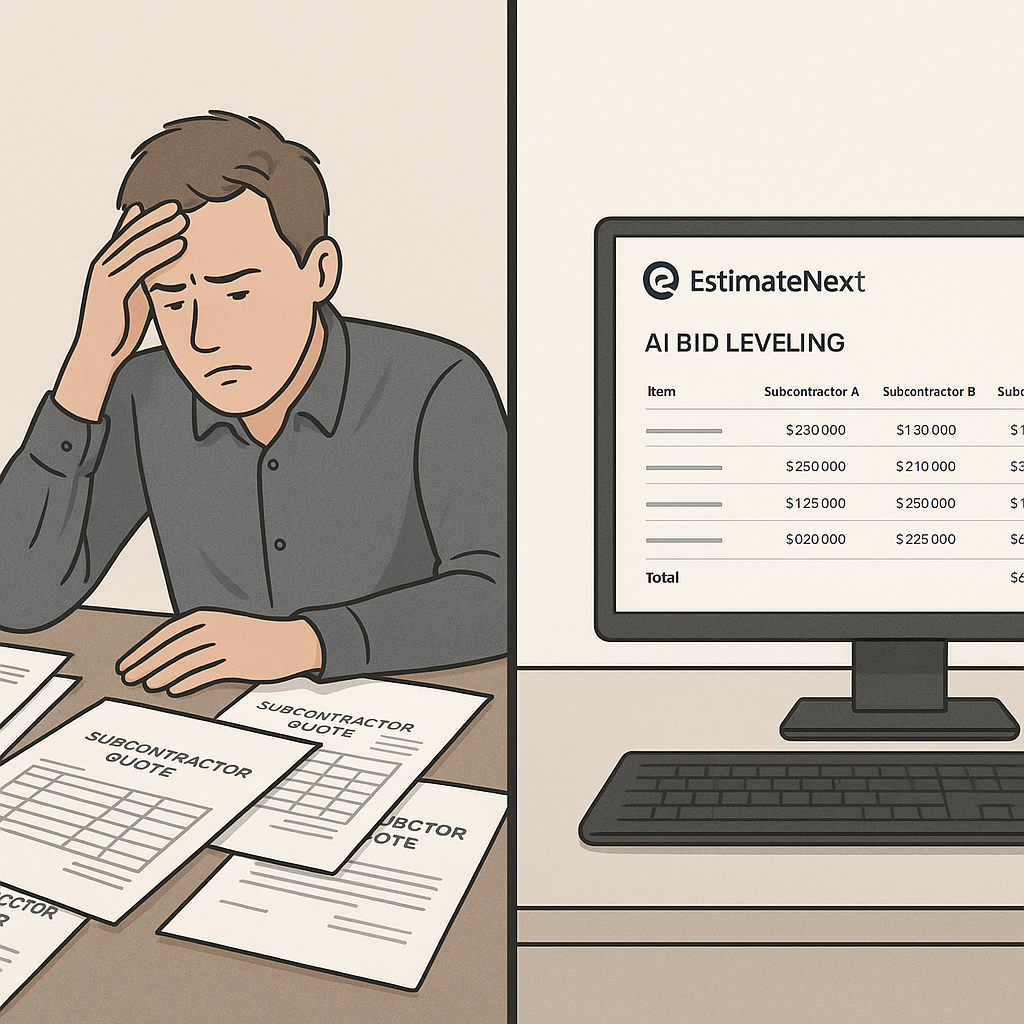
The Silent Time Sink: Sub Bid Leveling
Every general contractor knows the drill. A big project drops, and suddenly you're juggling quotes from five to seven subcontractors per trade. Plumbing, electrical, HVAC—it’s all a mess of PDFs, Excel sheets, and handwritten notes. Normalizing these bids manually can take six hours or more. And let’s not kid ourselves—it’s easy to miss something. A scope gap here, a miscalculated unit rate there, and boom, you’re eating the cost halfway through the project.
If you’re still doing this manually, you’re wasting time and risking accuracy. AI can fix this. Not in some vague, futuristic way—but right now.
What AI-Powered Sub Bid Leveling Looks Like
Let’s get specific. With tools like EstimateNext, you upload your subcontractor quotes—PDFs, Excel files, even screenshots. The platform’s AI parses the data, maps it against your BOQ (Bill of Quantities), and flags mismatches in scope. It doesn’t just give you a price comparison; it gives you a clear, ranked breakdown of L1 (lowest bid), L2, and L3 options, complete with detailed scope alignment.
Example: A $10M Office Fit-Out
Take a $10 million office fit-out project. You’ve received six bids for the HVAC package. Manually, you’d have to:
- Open each bid and review the scope of work.
- Compare quantities to your BOQ.
- Check unit rates against your benchmarks.
- Identify exclusions or assumptions.
- Build a summary spreadsheet.
This process can chew through an entire day. With AI, the same work takes 30 minutes. It’s not just faster—it’s smarter. The AI flags potential issues, like a subcontractor excluding ductwork installation or using outdated labor rates.
Case Study: $1B Rail Project
In one high-profile example, a mid-sized general contractor bidding on a $1 billion rail infrastructure project used EstimateNext to level bids across 20 trades. Before AI, they spent 8 hours per trade manually reconciling quotes. After implementing AI, they cut that time down to 1 hour per trade and uncovered $3 million in potential savings by catching scope gaps early. The streamlined bid process allowed them to submit 15% more proposals than they could have otherwise.
The Real-World Benefits of AI Bid Leveling
1. Accuracy Without the Stress
Let’s be honest: manual bid leveling is stressful. There’s always that nagging feeling you missed something. AI eliminates that. It catches scope gaps, mismatched quantities, and inconsistent rates automatically. You still make the final call, but now you’re working with clean, verified data.
Actionable Tip:
Before you trust AI entirely, test it against a trade you’re confident in. Run your manual process alongside the AI output, and compare the results. You’ll see how much detail the AI catches that might slip through manual reviews.
2. More Time for Strategy
Time saved isn’t just about efficiency—it’s about opportunity. Imagine reclaiming five hours per bid. You could use that time to refine your bid strategy, negotiate with subs, or even pursue an additional project. One mid-sized GC shared in an EstimateNext case study that they increased bid submissions by 30% after automating sub bid leveling.
Actionable Tip:
Use the extra time to dive deeper into subcontractor vetting. AI can flag mismatches in bid scope, but you can use that time to investigate subcontractors’ track records, ensuring quality performance.
3. Fewer Costly Mistakes
Every estimator has a horror story. A missed exclusion that cost six figures. A scope gap that led to an ugly change order. AI doesn’t just save time; it saves you from those expensive “oops” moments.
Example:
A GC in Texas shared that they missed a subcontractor’s exclusion for concrete reinforcement in their structural bid. This oversight led to a $250,000 change order mid-project. After switching to AI-powered bid leveling, they caught similar exclusions before submission, saving thousands in potential change orders.
Comparing Manual vs AI Bid Leveling
| Criteria | Manual Leveling | AI-Powered Leveling |
|---|---|---|
| Time per Trade | 6–8 hours | 30–60 minutes |
| Error Rate | High (human oversight only) | Low (automated checks) |
| Flexibility | Limited to human capacity | Scales across multiple trades |
| Cost Savings | Missed scope gaps lead to change orders | Early detection prevents costly mistakes |
| Ease of Use | Requires advanced subcontractor knowledge | Intuitive tools with minimal learning curve |
Common Pushbacks (and Why They’re Wrong)
“AI Can’t Understand My Scope of Work”
You’d be surprised. AI tools like EstimateNext get smarter with every project. For example, if you regularly exclude demolition in your HVAC packages, the system learns that and flags quotes that don’t align.
What You Can Do:
Provide clear parameters when uploading quotes. Most AI platforms allow you to set standard exclusions or inclusions per trade, fine-tuning the results.
“It’s Faster to Do It Myself”
Is it, though? Even if you’re fast, manual bid leveling still takes hours. AI gets it done in 30 minutes—every time. Plus, it’s not prone to the fatigue or distractions that slow humans down.
What You Can Do:
Try AI on a single trade package to compare speed. Track the time it takes manually versus AI, and calculate the difference.
“What If the AI Misses Something?”
Good question. That’s why tools like EstimateNext include manual override and audit trails. You get the speed of AI with the safety net of human oversight.
What You Can Do:
Review flagged mismatches as part of your process. AI will catch 90% of issues, but you can use manual checks for final validation.
The Bottom Line
If you’re still spending hours normalizing subcontractor bids, you’re leaving time—and money—on the table. AI-powered tools like EstimateNext can handle the grunt work, so you can focus on strategy and winning more projects.


