10 Minutes vs. 40 Hours: The AI Feature Every Estimator Needs
Imagine this: you've got a $100M project bid deadline looming, and your team spends two full days manually doing drawing takeoffs. That’s 40 hours of tracing, measuring, and double-checking. Not ideal. Now, what if you could cut that to just 10 minutes? That’s not wishful thinking — it’s what AI-powered tools like EstimateNext already do.
The Problem with Manual Takeoffs
Manual takeoff is a time sink. Estimators use tools like Bluebeam to measure drawings, but the process is still largely manual. Count every door, measure every wall length, multiply by rates. It's tedious, and honestly, it’s where most mistakes creep in.
Think about it: one missed line can throw off your quantities, which then snowballs into incorrect bids. Worse, manual takeoff doesn’t scale. Whether it’s a small office fit-out or a billion-dollar infrastructure project, you're stuck spending days on the same repetitive process.
Concrete Example: Mistakes in Manual Takeoffs
A mid-sized general contractor shared their experience bidding on a $50M commercial project. Their team miscounted the number of fire-rated doors, underestimating the required quantity by 15 units. This error wasn’t caught until the procurement phase, resulting in a $12,000 cost overrun. For larger projects, these mistakes can compound exponentially.
And here's the kicker — while your team is buried in this grunt work, your competitors are already refining their bids or locking down subcontractors. You’re playing catch-up.
Actionable Steps to Reduce Errors
- Double-Check Critical Components: Door counts, fire-rated assemblies, and structural wall measurements are often culprits for errors.
- Cross-Reference with Specs: Verify quantities against specification sheets to ensure alignment.
- Adopt Hybrid Methods: Use AI tools to handle repetitive tasks while manually reviewing high-impact areas.
How AI Changes the Game
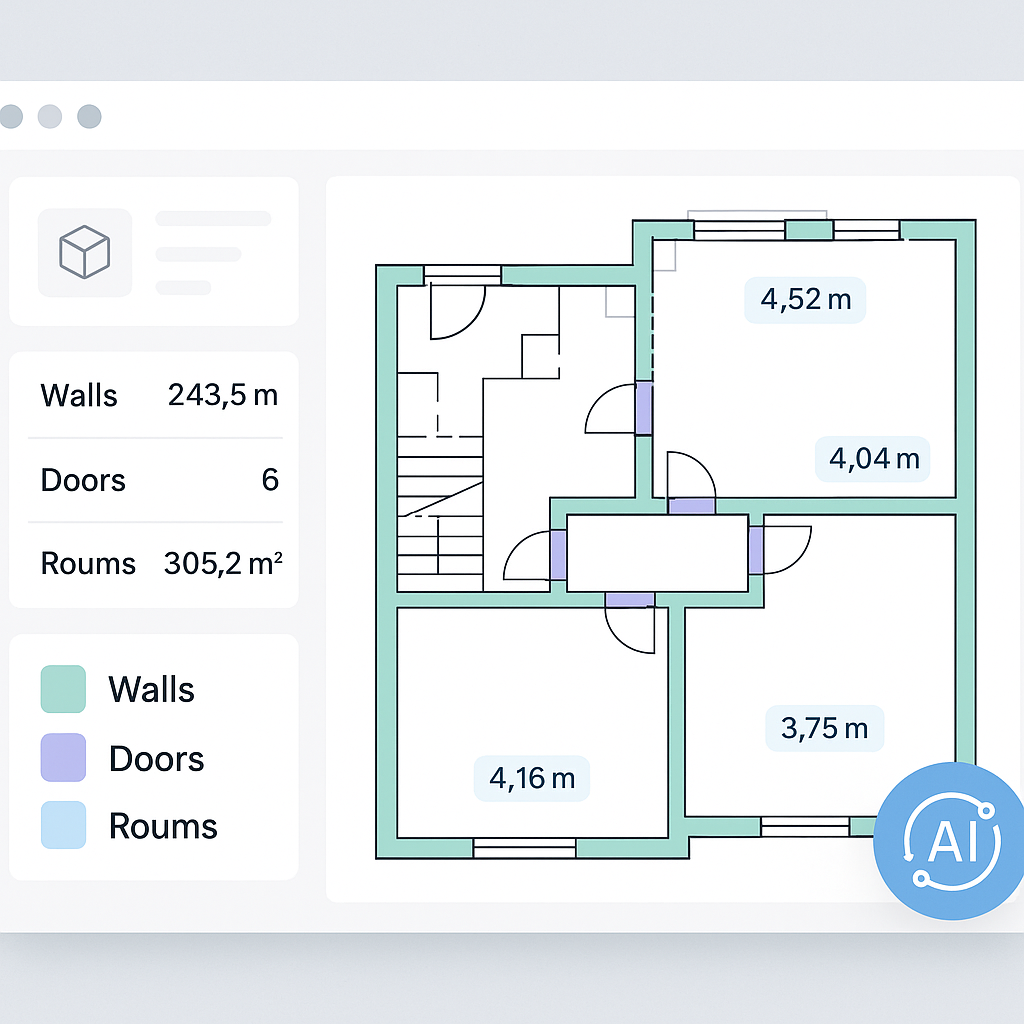
AI-powered tools like EstimateNext use something called Vision AI. It’s not just a fancy buzzword. This feature scans PDF drawings and extracts quantities like room areas, wall lengths, and even door/window counts automatically. It’s like having a junior estimator who works at superhuman speed.
Step-by-Step: How AI Takeoffs Work
- Upload Your Drawings: Drag and drop your PDFs into the platform.
- AI Scans Everything: The system reads the drawings and identifies elements like walls, rooms, and fixtures. It uses machine learning models trained on thousands of blueprints.
- Review Low Confidence Areas: The tool flags anything it’s unsure about, so you can double-check.
- Export Quantities: Get a clean, detailed quantity takeoff in minutes that integrates directly into your estimating software.
Case Study: Saving 120 Hours on a High-Rise Bid
One mid-sized contractor used EstimateNext for a 25-story high-rise bid. The AI tool completed the full takeoff in just 7 minutes, identifying wall lengths, door counts, and window areas. Compared to their traditional methods, this saved them 120 hours of labor. The extra time allowed the team to focus on refining their bid, ultimately lowering their contingency by 2% and winning the project.
Key Comparison: AI vs. Manual Takeoff
| Feature | Manual Takeoff | AI Takeoff |
|---|---|---|
| Speed | 40 hours | 10 minutes |
| Error Rate | High (human oversight only) | Low (AI + confidence scoring) |
| Scalability | Limited by manpower | Scales with software |
| Cost Per Estimate | $5,200 (40 hrs at $130/hr) | $39/month subscription |
Why Accuracy Still Matters
Now, you might be thinking: “Sure, AI is fast, but can it actually be accurate?” Fair question. AI isn’t perfect — no tool is. But platforms like EstimateNext include features like confidence scoring and manual overrides. That means the system flags areas it’s unsure about, so you can step in and make corrections.
Real-World Accuracy Metrics
In tests conducted by EstimateNext, their Vision AI tool achieved an 82% accuracy rate for complex commercial drawings and a 93% accuracy rate for simpler residential layouts. When paired with manual reviews, companies reported accuracy levels comparable to traditional methods — but completed in a fraction of the time.
Actionable Ways to Maximize Accuracy
- Train Your Team: Ensure your estimators understand how to interpret and review flagged errors.
- Standardize Drawing Formats: Use consistent drawing templates to improve AI recognition.
- Perform Spot Audits: Regularly compare AI-generated takeoffs to manual results for quality control.
The ROI of AI Takeoff Tools
Let’s talk numbers. If you’re a GC preconstruction director, your team’s time isn’t cheap. Estimators typically cost $130/hour. For a single bid, saving 36 hours translates to $4,680. If you’re handling five GMP pursuits a year, that’s over $23,000 in labor savings — just from automating one part of the process.
Example ROI Scenarios
- Subcontractor: A drywall company uses AI takeoff to respond to 50% more RFQs annually. Even with a conservative win rate increase of 10%, that’s $250,000 in additional revenue.
- Regional Contractor: In Dubai, a contractor leveraged AI to compare CPWD DSR rates across multiple countries. Savings on material procurement alone exceeded $18,000 for one project.
Common Pushbacks (and Why They’re Wrong)
-
“AI tools are too expensive.” Not true. While legacy tools like CostX can cost upwards of $15,000/year, platforms like EstimateNext start at just $39/month. That’s coffee money compared to the ROI.
-
“We’ve always done it this way.” Fine, but that’s not a good reason to stick with inefficiency. The industry is moving forward, and clinging to old methods could cost you bids.
-
“The learning curve is too steep.” Most AI tools are designed for ease of use. Training takes less than two weeks, and support teams are there to help.
Final Thoughts
AI-powered takeoff isn’t just a “nice-to-have” anymore. It’s becoming table stakes for staying competitive in construction. You might be skeptical, but early adopters are already reaping the benefits. Faster bids, fewer errors, and lower labor costs — the math speaks for itself.
If you’re ready to leave manual takeoffs behind, EstimateNext can help. Upload your first BOQ and see how much time you save.


