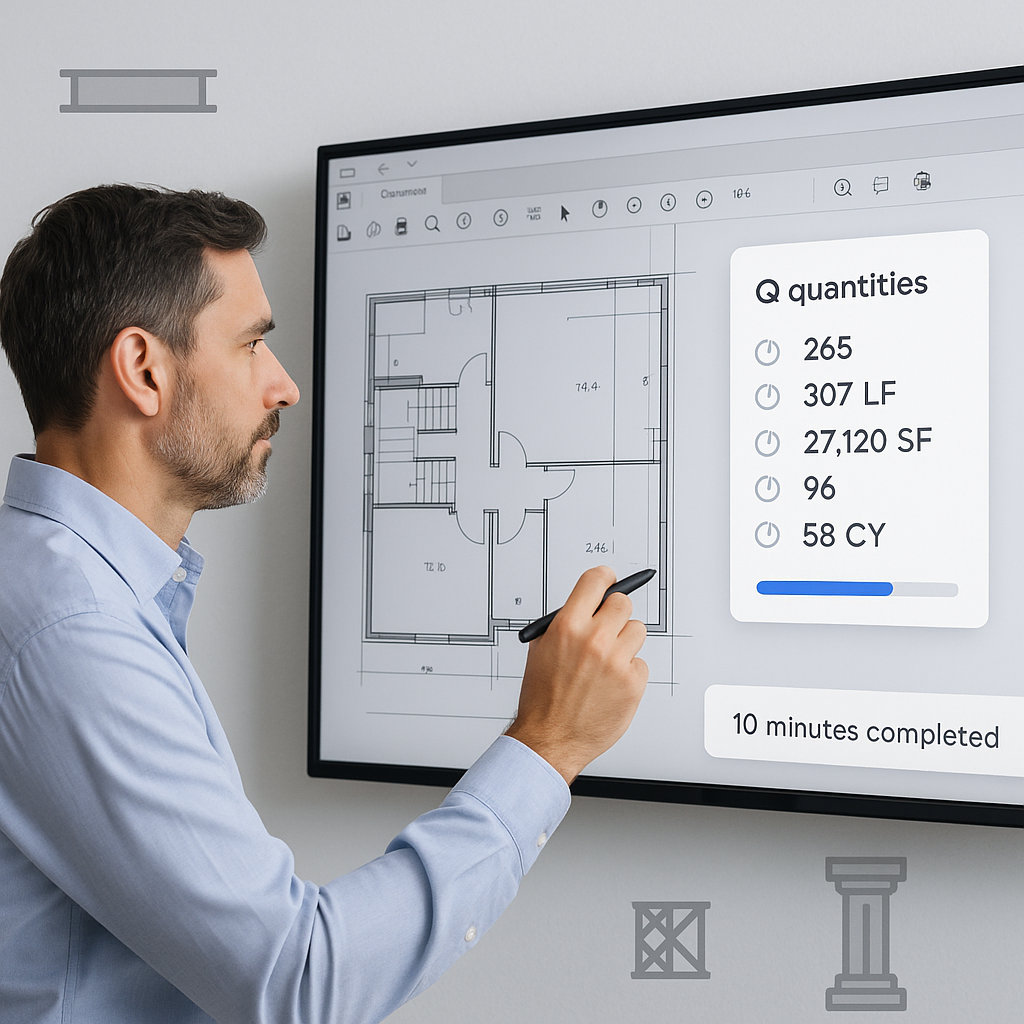
Stop Burning Hours on Drawing Takeoffs
Let’s be real—manual takeoffs are the worst. Two estimators spend two full days tracing PDFs, counting fixtures, and measuring areas. That’s 40 hours per bid, wasted on grunt work. And if you’re juggling multiple GMP pursuits, guess what? Your team is drowning.
AI changes the game. Tools like EstimateNext’s Vision AI extract quantities directly from PDF drawings in just 10 minutes. No tracing, no spreadsheets, no headaches. Imagine uploading a plan set for a $1 billion rail project and getting accurate quantities for concrete columns, beams, and rail decks before your coffee cools. It’s that fast.
Why Manual Takeoffs Are a Problem
Manual takeoffs aren’t just tedious—they’re error-prone. It’s easy to miscount fixtures, skip a crucial measurement, or misinterpret a drawing. These small mistakes can snowball into big problems: underbidding, overbidding, or costly RFIs down the line.
Here’s a real-world example: In 2021, a mid-sized general contractor lost a $3 million project because their manual takeoff underestimated material quantities by 15%. By the time they caught the error, the competitor had already secured the bid. With AI tools like Vision AI, this kind of mistake becomes significantly less likely.
The Accuracy Question
“But AI can’t think like an estimator,” you might say. That’s true—to a point. AI doesn’t replace your judgment; it amplifies it. Vision AI flags low-confidence areas for manual review and lets you override errors with a few clicks. Think of it as an extra estimator who never sleeps.
Here’s the kicker: AI tools reduce takeoff discrepancies by up to 80%. That’s fewer RFIs, fewer last-minute changes, and fewer arguments with subs over scope.
Concrete Example: One large-scale contractor used Vision AI on a $500 million mixed-use development project. The AI flagged inconsistencies in wall area measurements across multiple floors. The team reviewed them manually and identified errors that would have cost $250,000 in change orders. The result? A smoother project kickoff and a stronger client relationship.
Accuracy isn’t just about fewer mistakes—it’s about trust. When your bids are consistent and reliable, your clients notice. And in a competitive market, trust can be the difference between winning and losing a project.
Real ROI: What’s the Math?
Let’s break it down. Say your team charges $130/hour per estimator. Saving 36 hours per bid equals $4,680 back in your pocket. On a typical annual pipeline of five GMP pursuits, that’s $23,400 saved. And we’re not even counting the bids you couldn’t chase because your team was bogged down in manual work.
For mid-sized GCs, that’s like hiring a full-time estimator without the overhead. More bids, better margins, faster decisions—it’s a no-brainer.
But let’s go deeper. According to Dodge Data & Analytics, 10% of construction budgets are wasted due to inefficiencies. On a $10 million project, that’s $1 million wasted. AI takeoff tools directly target some of these inefficiencies, cutting errors and speeding up processes. Even a 5% reduction in waste translates to $50,000 in savings per project.
Case Study: Small Contractor, Big Results
A regional contractor specializing in commercial office fit-outs switched to AI-driven takeoffs in 2022. Before the switch, their two estimators spent 15 hours on each bid. With Vision AI, they cut that time to just 2 hours. Over the course of 20 bids, they saved 260 hours—equivalent to more than 6 full workweeks. The kicker? They used the extra time to pursue additional projects and grew their revenue by 15% that year.
What About Small Projects?
You might think AI tools are overkill for smaller bids. Not true. Whether it’s a $1 million office fit-out or a $1 billion rail bridge, AI scales seamlessly. Same speed, same accuracy—just fewer quantities.
Take residential projects, for example. Small contractors often work on razor-thin margins. One miscalculation can mean the difference between profit and loss. Anecdotally, I’ve seen contractors use Vision AI to knock out residential takeoffs in under an hour. No more late nights flipping through rate books. They’re saving time and winning more bids. Isn’t that the goal?
Actionable Steps for Small Contractors
- Start Small: Use Vision AI on one or two bids to get a feel for the process.
- Leverage Training Resources: Most AI tools offer tutorials or customer support. Take advantage of them to shorten the learning curve.
- Focus on High-Value Tasks: Use the time saved to refine your bid strategy or strengthen client relationships.
The Obvious Objection: Learning Curve
Here’s the elephant in the room: training. New tools always come with friction. But most AI platforms, including EstimateNext, are designed for ease of use. Training takes under two weeks, and junior estimators can start handling takeoffs immediately. Pair them with senior staff for oversight, and you’re up and running.
For example, a mid-sized contractor implemented Vision AI in Q1 2023. They assigned a junior estimator to learn the system, with oversight from a senior team member. Within a month, the junior estimator was independently handling 80% of the company’s takeoffs. The result? A 25% reduction in overall bid preparation time.
Overcoming Resistance
Change is hard, especially in an industry that values tradition. Here’s how to ease the transition:
- Show the Numbers: Demonstrate the ROI of AI tools to your team.
- Pilot the Tool: Start with a single project to build confidence.
- Provide Support: Make sure your team knows where to turn for help.
Why You Should Care
If your team is stuck in the manual takeoff grind, you’re leaving money on the table. AI-powered tools don’t just save time—they free up your team to focus on what actually matters: subcontractor negotiations, margin optimization, and bid strategy.
FAQ
Q: Are AI takeoffs reliable for complex projects?
A: Yes, but input quality matters. Vision AI works best with clean PDFs and structured BOQs. Low-confidence areas can be manually reviewed. For example, on a large hospital project, Vision AI accurately quantified steel beams but flagged a few areas with unclear annotations. These were quickly resolved by the team.
Q: Can AI tools handle revisions?
A: Absolutely. Upload revision sets, compare changes, and adjust quantities in minutes. This is especially useful for fast-moving projects where design updates are common.
Q: Do AI tools integrate with existing software?
A: Yes, EstimateNext integrates with Procore, Bluebeam, and Excel. Export estimates directly into your workflows. This eliminates the need for double entry and speeds up the handoff to project managers.
Q: What if my project has custom rates?
A: You can upload custom catalogs or define project-specific rates. The AI learns and applies them automatically. For example, one contractor uploaded a custom pricing catalog for a retail chain client, ensuring accuracy across all bids.
Q: Is AI cost-effective for small contractors?
A: Definitely. EstimateNext starts at $39/month, making it affordable even for regional players. For the cost of one estimator’s hourly rate, you can automate your takeoffs for an entire month.
Decision Framework: Is AI Right for You?
| Factor | Manual Takeoffs | AI Takeoffs |
|---|---|---|
| Speed | 10-40 hours per bid | 10-30 minutes per bid |
| Accuracy | High error risk | 80% fewer discrepancies |
| Scalability | Limited by manpower | Scales seamlessly |
| Cost | High labor costs | Low subscription cost |
| Ease of Revisions | Time-consuming | Instant updates |
Call-to-Action
If your team is wasting hours on manual drawing takeoffs, EstimateNext can help. Get started free →


