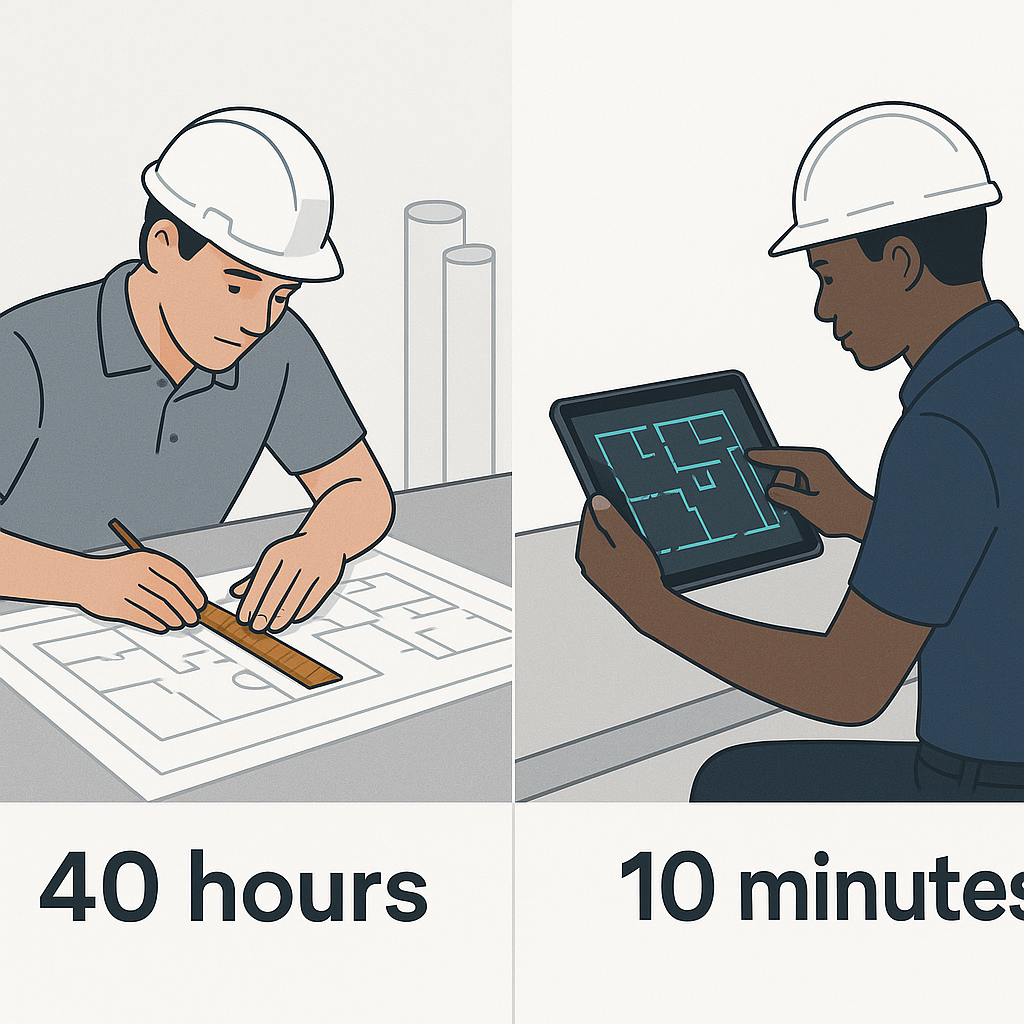
The Brutal Truth About Manual Takeoffs
Let’s not sugarcoat it: manual takeoffs are a time sink. On average, two estimators spend 40 hours—essentially a full workweek—extracting quantities from drawings for a single bid. And it’s not just time; it’s mental fatigue, human error, and frustration. Miss a window schedule? Miscalculate wall lengths? That’s your profit margin slipping through the cracks.
Why Manual Takeoffs Hurt Your Business
Consider this: a typical general contractor bids on 10-15 projects per month. If two estimators spend 40 hours per project, that’s 400-600 hours every month dedicated solely to takeoffs. Assuming the average estimator earns $35/hour, that’s $14,000-$21,000 in labor costs monthly—just for takeoffs. And this doesn’t account for the hidden costs of errors. For example, a miscalculated wall length might lead to ordering too much drywall, tying up cash flow, or worse, too little drywall, delaying the project and incurring penalties.
Real-World Example: The Domino Effect of Takeoff Errors
Take the case of a regional builder estimating a 120-unit apartment complex. During manual takeoffs, they missed a set of balcony railings. The mistake wasn’t caught until the procurement phase, leading to rushed orders, increased material costs, and a two-week delay in construction. The result? A $75,000 hit to their bottom line and lost trust with their client.
How AI Takeoffs Actually Work
AI tools flip the script. EstimateNext’s Vision AI, for example, processes the same drawings in just 10 minutes. Yes, 10 minutes. Imagine what your team could do with the 36 hours they’d save per estimate. More bids? Better subcontractor negotiations? Or just going home on time for once.
Step-by-Step Breakdown of AI Takeoffs
- Upload Your Drawings: PDF, CAD files, scanned blueprints—whatever format you have, the AI doesn’t care. Tools like Vision AI can instantly process them.
- Calibration: Set the scale once, and you’re good to go. Linear measurements, area calculations, even door counts—it’s all automated.
- Confidence Scoring: AI highlights low-confidence areas or anomalies for manual review, ensuring human oversight where it matters most.
- Revisions? No Problem: Upload a revised set of drawings, and the AI flags changes instantly. No more flipping between sheets trying to spot differences manually.
Case Study: AI Takeoffs in Action
A mid-sized general contractor used Vision AI on a $50M office project. They saved 120 hours on takeoffs alone—equivalent to two full weeks of labor costs. Their senior estimator said, “It’s like hiring a full-time junior without the overhead.” The freed-up time allowed them to increase bid capacity by 30% that quarter, ultimately winning three additional projects.
“But AI Can’t Think Like an Estimator”
I hear this all the time. And it’s true—AI doesn’t understand construction like you do. But that’s not the point. AI isn’t replacing you; it’s amplifying you. It handles the repetitive tasks so you can focus on what really matters: value engineering, negotiating with subs, and making judgment calls.
Why AI Complements Human Expertise
Think of AI as a power tool. A circular saw doesn’t replace a carpenter—it makes their work faster and more precise. Similarly, AI handles the grunt work of measurements and calculations, while human estimators focus on higher-level tasks. For example, AI might calculate the square footage of drywall needed, but it’s up to you to decide whether to spec Type X fire-resistant drywall for code compliance.
Why Speed Matters More Than Ever
The construction industry is in a sprint. According to McKinsey, early adopters of AI in construction estimation see cost savings of 10-20% per project. That’s not just because AI is fast; it’s because speed lets you respond to more bids, with more accuracy, and less stress.
Competitive Advantage Through Speed
Here’s a scenario: Two contractors bid on the same project. Contractor A uses manual takeoffs and submits their bid on Day 5. Contractor B uses AI, submits their bid on Day 2, and has time to refine their pricing and negotiate better subcontractor rates. Who do you think wins the bid?
Getting Started with AI Takeoffs
If you’re skeptical, start small. Test an AI tool like EstimateNext on a low-stakes project. Upload a BOQ, calibrate one drawing, and see how it performs. Most platforms (including ours) offer free trials, so you’ve got nothing to lose.
Actionable Steps to Implement AI Takeoffs
- Start with a Free Trial: Most AI platforms offer free trials. Test the tool on a single project and evaluate its speed and accuracy.
- Train Your Team: AI tools are designed to be user-friendly. Invest 1-2 hours in training your estimators to use the platform effectively.
- Evaluate ROI: Compare the time saved and error reduction against your previous manual process. For many firms, the ROI becomes clear after just one project.
- Scale Gradually: Once you’re comfortable, expand usage to larger or more complex projects.
Decision Framework: AI vs. Manual Takeoffs
| Factor | Manual Takeoffs | AI Takeoffs |
|---|---|---|
| Speed | 40 hours/project | 10 minutes/project |
| Accuracy | Prone to human error | Up to 99% accurate with oversight |
| Cost | $35/hour/estimator | Starting at $39/month |
| Scalability | Limited by team size | Scales to any project size |
| Revisions | Time-intensive | Automated change detection |
The Bottom Line
If you’re still doing takeoffs manually, you’re leaving time and money on the table. AI-powered tools like EstimateNext don’t just speed up the process—they make it more accurate, scalable, and stress-free.


