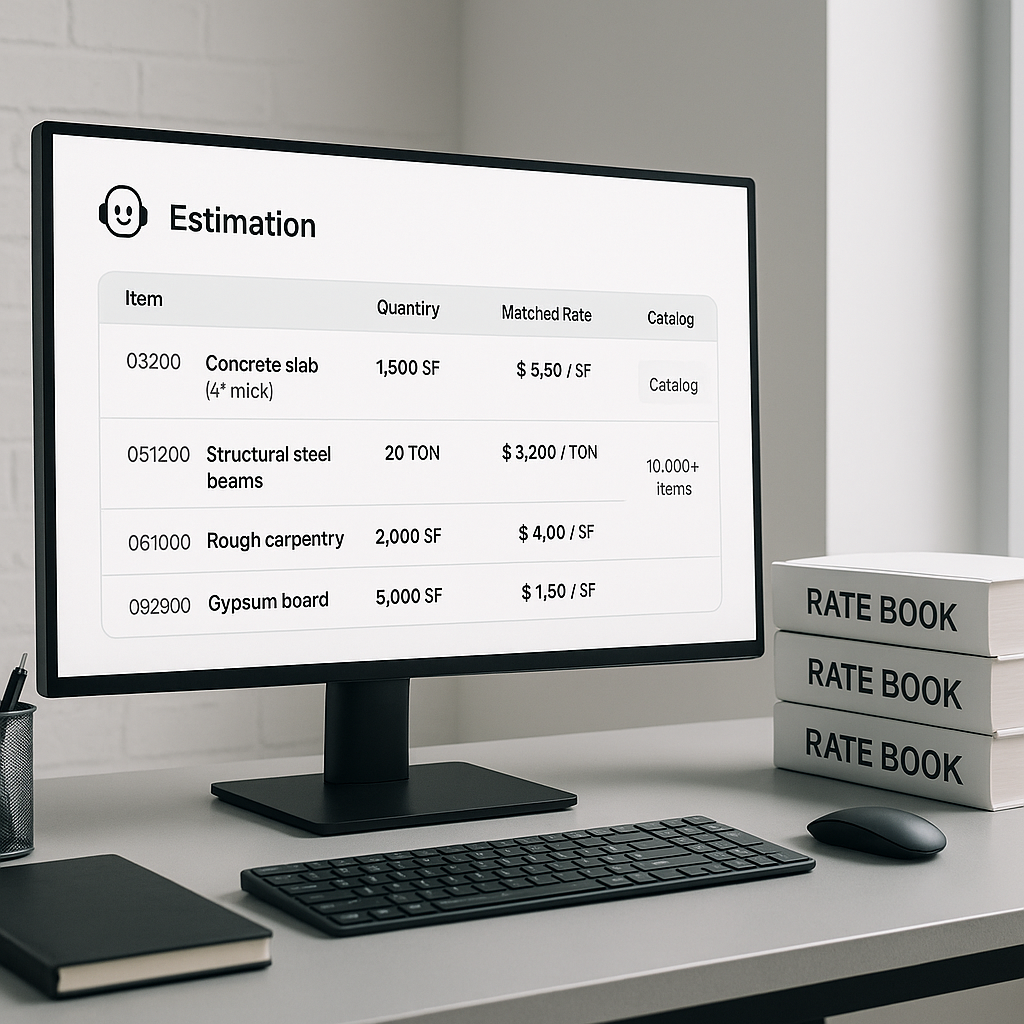
Stop Wasting Time on Rate Books
Estimators spend hours—sometimes days—flipping through rate books like RSMeans, CPWD DSR, or state DOT manuals. Why? Because pricing a Bill of Quantities (BOQ) accurately depends on finding the right rates for materials, labor, and equipment. But here’s the brutal truth: manual rate matching is a bottleneck. It’s slow. It’s error-prone. And most importantly, it’s avoidable.
AI-powered rate matching tools like EstimateNext are changing the game. Instead of flipping through PDFs or Excel sheets, you type in what you need—say, “labor rate for installing pre-stressed concrete girders.” The AI matches your query to over 78,000 catalog items in seconds. Done.
How AI Rate Matching Works
Here’s the magic: AI doesn’t just search for exact keywords. It uses semantic search to understand what you mean. For example, if your BOQ mentions “ceramic tile flooring,” the AI knows to include related items like adhesives, grout, and underlayment in your results. This isn’t just faster—it’s smarter.
And it gets better over time. Every time you accept or reject a suggestion, the system learns. By your third project, the matches are significantly more accurate. Users have reported up to 99% accuracy after just a few projects. That’s not just a claim—it’s backed by EstimateNext’s own case study on a $1 billion rail project, where AI saved 56 hours of manual effort per bid.
Concrete Example: Tile Installation
Let’s say you’re estimating costs for ceramic tile flooring in a 10,000 sq. ft. office project. Manually, you’d need to:
- Look up labor rates for tile installers.
- Calculate materials like tiles, grout, adhesive, and underlayment.
- Cross-check vendor pricing and regional adjustments.
This process would take hours, if not days. With AI, you input “ceramic tile flooring, 10,000 sq. ft.,” and the system returns an itemized breakdown—labor, materials, and even regional adjustments—in under 30 seconds. That’s hours saved on just one line item.
Case Study: $1 Billion Rail Project
In a recent $1 billion rail project, an AI tool like EstimateNext saved a team 56 hours of manual rate lookup per bid. Over the course of the project, the team estimated they saved over 300 hours—time they redirected toward refining designs and improving bid strategies. This is the kind of efficiency AI delivers in real-world scenarios.
Why It Matters
Let’s talk ROI. A mid-sized GC preconstruction team spends an average of 12 hours per estimate just on rate lookup. At $130/hour for a senior estimator, that’s $1,560 per project. Multiply that by 5-8 GMP pursuits a year, and you’re burning $7,800-$12,480 annually just flipping pages.
AI-powered tools slash that to minutes. That’s not just cost savings—it’s an opportunity to bid on more projects, refine your margins, or focus on high-value tasks like subcontractor negotiations. As McKinsey notes, early adopters of AI in construction see cost savings of 10-20% per project. Why leave that money on the table?
Actionable Steps to Calculate ROI:
- Track Current Time Spent: Start by logging how long your team spends on manual rate lookup per project.
- Estimate Potential Savings: Use the formula: (Time Saved x Hourly Rate) x Number of Projects Annually.
- Compare Tools: Evaluate platforms like EstimateNext, and compare their subscription fees against your potential ROI.
Data Point: Industry-Wide Savings
According to a Deloitte report, construction firms that adopt AI for estimation can reduce bid preparation costs by up to 30%. For a company spending $100,000 annually on preconstruction, that’s $30,000 back in your pocket.
The Obvious Pushback: “Can AI Really Handle This?”
You might be thinking, “Sure, AI is fast, but does it actually understand construction?” It’s a fair question. AI doesn’t replace your expertise—it amplifies it. You’re still in control of the final numbers, the negotiations, the markup decisions. The AI just handles the grunt work.
Misconception: AI Can’t Handle Complex Projects
Let’s address this head-on. AI is particularly effective because it learns from your specific workflows. For example, if you regularly work on DOT projects with strict catalog requirements, you can train the system to prioritize those catalogs. In fact, platforms like EstimateNext allow you to:
- Upload custom catalogs.
- Define project-specific adjustments (e.g., regional labor rates).
- Integrate vendor pricing directly into the system.
Real-World Example: A $108M Water Project
Take a major contractor’s $108M municipal water project. This wasn’t a small job—pricing required pulling rates for everything from structural steel to pipeline fittings, each needing to comply with DOT-approved catalogs. Using AI, the team cut rate lookup time by 90%. Imagine applying that kind of efficiency to your next bid.
What Happens If You Don’t Adapt
Let’s be blunt: the industry is moving toward AI-assisted estimation. Competitors who adopt these tools will bid faster, price more accurately, and win more contracts. Those who stick to manual processes? They’ll lose ground. It’s that simple.
Comparison Table: Manual vs. AI-Assisted Estimation
| Feature | Manual Process | AI-Assisted Process |
|---|---|---|
| Time for Rate Lookup | 8-12 hours per estimate | 10-15 minutes per estimate |
| Accuracy | Prone to human error | 95-99% accuracy after training |
| Scalability | Limited by team capacity | Easily scalable |
| Customization | Requires manual adjustments | Seamless integration of custom rates |
| ROI | High labor costs, slow process | Significant time and cost savings |
Key Takeaways
- Manual rate lookup is outdated and inefficient.
- AI-powered rate matching saves hours per estimate and learns as you go.
- Tools like EstimateNext integrate custom rates and adapt to your needs.
- The ROI is undeniable—time savings, cost reductions, and competitive advantages.


