The 40-Hour Problem Nobody Talks About
Let’s be honest: manual takeoffs are a grind. Two days (or more) of flipping through drawings, scaling measurements, verifying counts, and hoping you didn’t miss that one wall or fixture buried on page 34 of the plans. It’s not just time-consuming—it’s error-prone. Miss something critical, and you’ll either underbid (goodbye profit) or overbid (goodbye contract).
I’ve sat in rooms where teams debated over a single quantity for hours, verifying and re-verifying. It’s exhausting. And worse, it’s unnecessary now.
AI Takeoffs: From 40 Hours to 10 Minutes
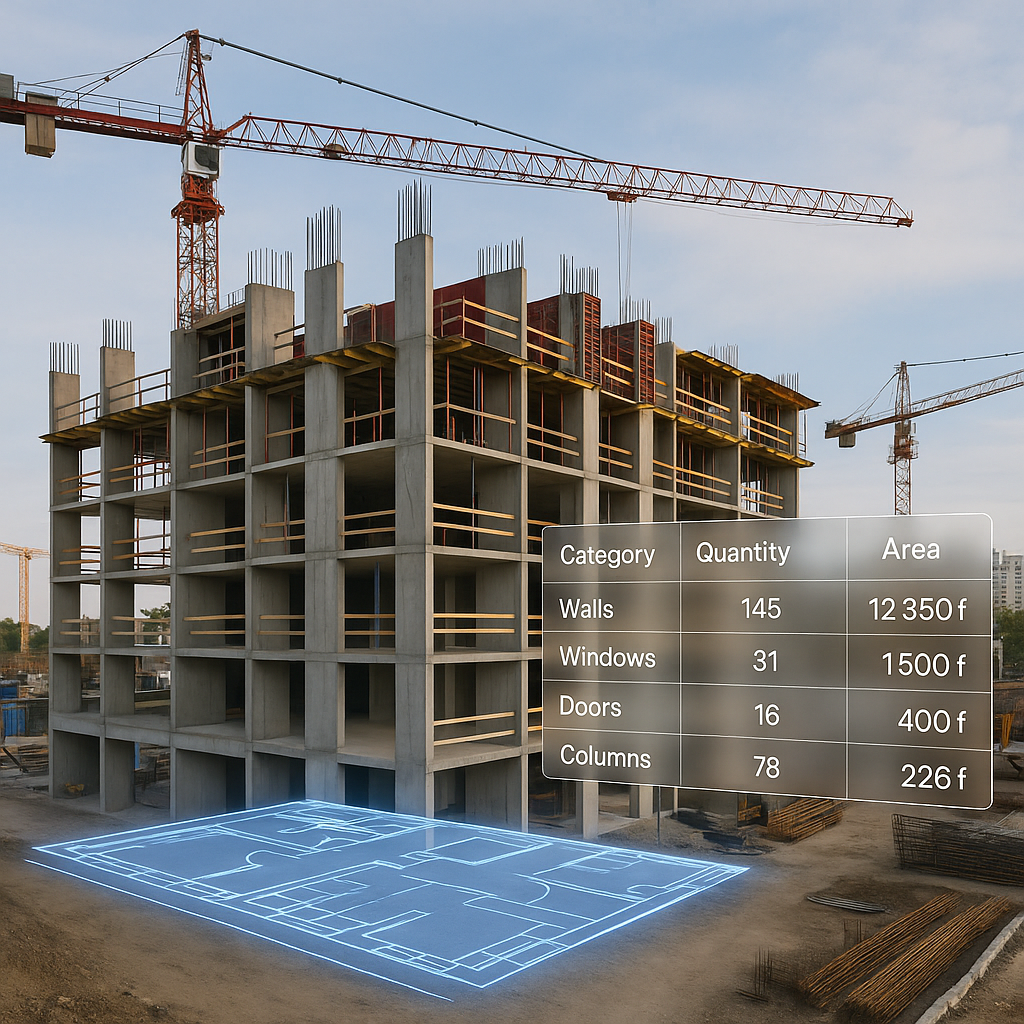
AI-powered tools like EstimateNext are flipping this workflow on its head. Instead of manually tracing every line and counting every door, you upload your PDF drawings. The system processes them in minutes, extracting quantities for walls, floors, windows, fixtures—you name it. What used to take two estimators multiple days now happens in the time it takes to grab a coffee.
Real-World Example: A Mid-Sized GC
A mid-sized general contractor (GC) working on a $50M high-rise project saved 120 hours on a single bid by switching to Vision AI. That’s two full weeks of estimator time freed up. Their words? “It’s like hiring an extra estimator without the extra payroll.”
Case Study: Residential Renovation Projects
Even on smaller projects, the time savings are undeniable. A residential contractor in North Carolina used an AI platform to reduce takeoff time on a 5,000-square-foot custom home. They trimmed a two-day process to under an hour. The contractor noted, “We’re now able to handle twice the volume of bids without sacrificing quality.”
Is It Accurate?
Skepticism is fair. “Can AI really match human accuracy?” The short answer is: almost. AI tools like EstimateNext include confidence scoring for takeoffs, flagging low-confidence areas for human review. In practice, this means the grunt work is automated, but you still have control over critical decisions.
And let’s not forget—manual takeoffs aren’t perfect either. A 2023 McKinsey report found that human error in preconstruction estimation contributes to 10-15% cost overruns on average. AI drastically reduces those discrepancies.
Actionable Tip: Build a QA Process Around AI
Don’t treat AI as a black box. Use its confidence scoring to check flagged areas and verify quantities in sections that are critical to your bid. For instance, focus on high-cost materials like structural steel or custom finishes.
The Ripple Effect on Bidding
So you’ve saved 40 hours on takeoffs. What now? You have more time to:
- Respond to more bids: Instead of cherry-picking projects because of limited bandwidth, you can expand your pipeline.
- Refine your estimates: Use the extra time to deep-dive into scope details, ensuring your bids are hyper-competitive.
- Focus on strategy: Spend those saved hours analyzing market trends, pricing strategies, or subcontractor negotiations.
Example: Boosting Bid Volume
One GC in California reported a 30% increase in bid submissions after adopting AI takeoff software. By automating tedious tasks, they freed up their estimators to focus on higher-value work, like reaching out to subcontractors for updated pricing and clarifying scope details.
What About Smaller Firms?
You might be thinking, “That’s great for big GCs, but my team is tiny. We don’t have the budget for fancy software.” Here’s the thing: AI tools like EstimateNext scale to your needs. A $1M renovation project or a $1B rail bridge—it doesn’t matter. The ROI is there regardless of project size.
Example: Interior Fit-Out Projects
One interior fit-out quantity surveyor (QS) used the platform’s Fit-Out Designer tool to run 45-minute what-if scenarios. They could iterate target costs in real-time, something that used to take hours in Excel. The result? Faster decisions, fewer headaches, and more accurate bids.
Actionable Tip: Start Small
If you’re hesitant to commit to a full AI platform, look for tools that offer a free trial or pay-per-project pricing. This lets you test the waters without blowing your budget.
The Obvious Objection: “AI Doesn’t Get Construction”
I hear this a lot. “AI doesn’t understand the nuances of a project.” And you’re right—sort of. AI isn’t replacing your expertise. It’s augmenting it. Your judgment, experience, and relationships with subs are still irreplaceable. What AI does is handle the repetitive, time-sucking tasks so you can focus on what you’re best at: making the calls that win bids and drive profit.
Comparison Table: Manual vs. AI Takeoffs
| Factor | Manual Takeoffs | AI Takeoffs |
|---|---|---|
| Time Required | 20-40 hours per project | 10-30 minutes |
| Error Rate | 10-15% (human error) | Under 5% (with human review) |
| Scalability | Limited by manpower | Highly scalable |
| Cost | Labor-intensive | Software subscription fee |
| Flexibility | Slow to adapt to changes | Real-time updates possible |
Why the Time to Switch Is Now
The construction industry isn’t exactly known for embracing change quickly. But the firms that adopt AI tools early are already seeing major advantages. A 2022 Dodge Data report found that early adopters of construction tech see 25% higher win rates. Why? Because they can respond faster, with more accurate bids.
Actionable Tip: Evaluate the ROI
Calculate how many hours your team spends on takeoffs monthly. Multiply that by your average labor cost. Compare it to the cost of an AI subscription. For most firms, the math makes adoption a no-brainer.
Final Thoughts
Manual estimation workflows are dying. And good riddance. They’re too slow, too error-prone, and too inflexible for today’s fast-paced bidding environment. Tools like EstimateNext aren’t just making life easier—they’re making it possible to compete in a world that demands speed and precision.
If you’re tired of wasting 40 hours on takeoffs, it’s time to try AI. Get started free →


