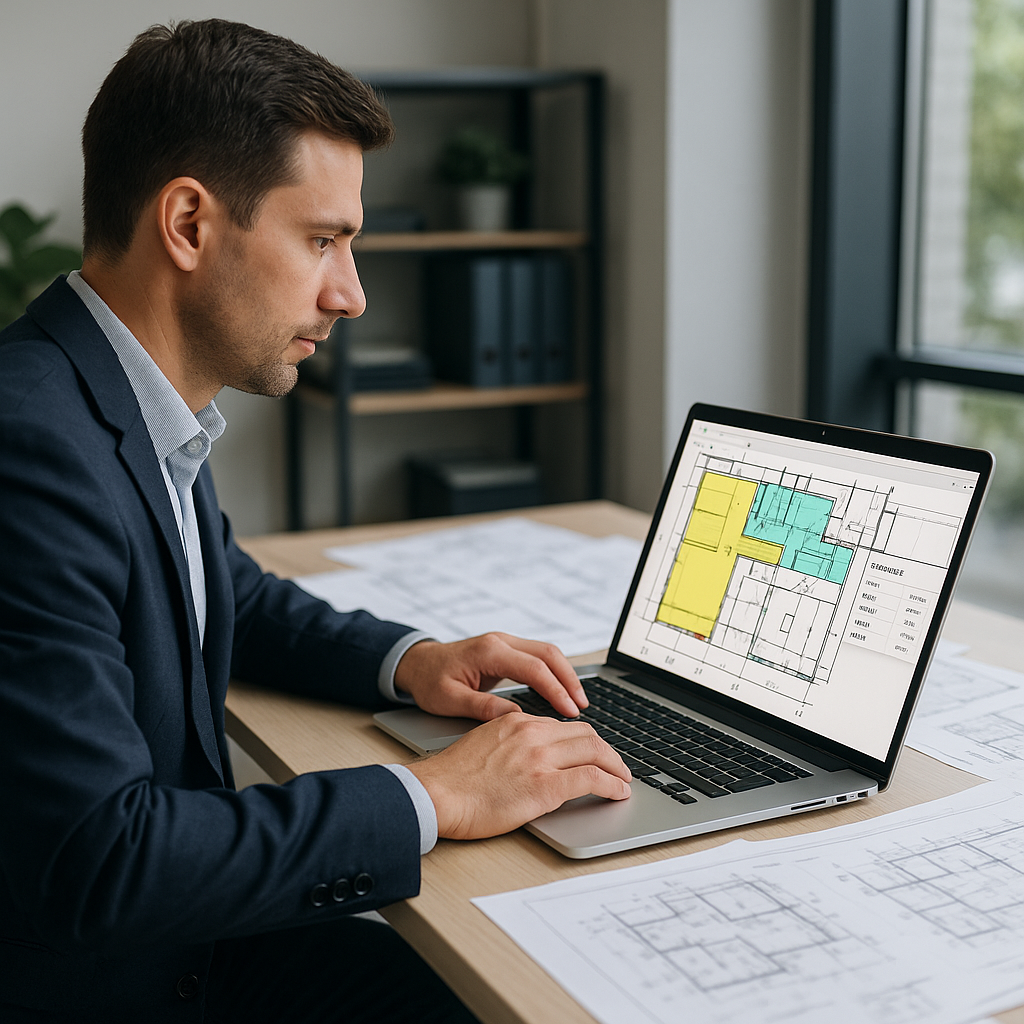
The Problem: Manual Drawing Takeoffs Are Brutal
If you've ever spent days measuring wall lengths, counting fixtures, or tracing room areas on a PDF, you know how painful manual takeoffs are. It's slow, repetitive, and prone to mistakes. For a typical mid-sized project, it takes two estimators roughly 40 hours to complete a quantity takeoff. That’s an entire week gone before you even start pricing.
The cost of manual takeoffs isn’t just time—it’s also opportunity. Every hour spent tracing PDFs is an hour you could’ve spent refining your bid strategy, coordinating subcontractors, or pursuing more projects. In industries where speed and accuracy can make or break a deal, the inefficiency of manual takeoffs can leave you dead in the water.
The Hidden Costs of Errors
Mistakes during manual takeoffs can be expensive. For example, miscounting fixtures or mismeasuring areas could lead to material overages or shortages. Let’s say you underestimate drywall quantities by 10%. On a $500,000 interior renovation, that could easily add $50,000 in unexpected costs. For small contractors, errors like this can erode already thin profit margins.
The Solution: AI Takeoff Tools
AI-powered takeoff tools like EstimateNext are flipping the script. Instead of spending days on manual measurements, you upload your PDF drawings into the platform. The system uses Vision AI to extract quantities in just 10 minutes. Not 10 hours. Not even one hour. Ten minutes.
How does it work? It’s like having a superhuman estimator. The AI scans the drawings, detects areas, counts objects (doors, windows, fixtures), and calculates lengths or volumes. You get a detailed quantity takeoff report without lifting a finger.
Real Numbers: Case Study
A mid-sized general contractor tested this on a high-rise bid. Instead of spending 120 hours on manual takeoffs, they used EstimateNext’s AI to handle it in under an hour. That’s two full weeks of labor saved. They used the extra time to chase more bids and negotiate better subcontractor pricing. The result? A win on a project they might’ve missed otherwise.
Here’s another example: A residential contractor bidding on five projects per month saved 200 hours by switching to AI. With each hour valued at $100, that’s $20,000 in labor saved every month. They reinvested that time into value engineering and client follow-ups, increasing their project win rate by 15%.
Why Speed Matters More Than Ever
Construction timelines are shrinking. Clients expect bids yesterday, not next week. If your team spends a week on takeoffs, you’re already behind. AI tools free up your estimators to focus on pricing strategies, subcontractor coordination, and margin optimization—the work that actually wins bids.
Let’s say you’re pricing a $50 million project. Saving 40 hours on takeoffs means you can hit the deadline without rushing. More importantly, you can spend those extra hours refining your bid instead of scrambling to finish the QTO.
Competitive Advantage in Tight Markets
In tight bidding markets, speed isn’t just a convenience—it’s a competitive edge. A subcontractor who can deliver an accurate bid in three days instead of seven is more likely to win work. General contractors juggling multiple bids can respond faster, giving them the bandwidth to pursue more opportunities.
The Obvious Objection: “AI Can’t Think Like an Estimator”
You’re probably thinking, “Sure, AI is fast, but it doesn’t understand the nuances of construction.” That’s fair—but it’s also missing the point. AI doesn’t replace your expertise; it amplifies it. You’re still the one reviewing outputs, making judgment calls, and adjusting for site-specific conditions. The AI just handles the grunt work.
What About Accuracy?
AI takeoff tools like EstimateNext include confidence scoring for every measurement. If the system isn’t sure about a dimension, it flags it for manual review. You can override values, remeasure specific lines, and track changes with an audit trail. It’s not perfect, but it’s 80% faster and 80% less error-prone than doing it by hand.
For example, a contractor working on a school renovation used AI to process a 50-page drawing set. The AI flagged 12 areas for manual review, which the estimator adjusted in under an hour. Despite minor tweaks, the overall process was still 70% faster than their manual approach.
What About Smaller Projects?
AI isn’t just for billion-dollar bridges. It scales to any project size. Whether it’s a $1 million office fit-out or a $100 million hospital, the time savings add up. Even small contractors handling tight margins benefit from faster takeoffs.
Example: Residential Contractors
Residential contractors often juggle multiple bids in parallel. Manual takeoffs eat up 40% of their time. AI tools cut that down to almost nothing, letting them respond to more RFPs and win more work. It’s like hiring another estimator without the payroll hit.
Take a two-person remodeling company bidding on kitchen renovations. Each takeoff typically takes eight hours. By using AI, they reduce that to 30 minutes. Over a year, they save 400 hours—time they can use to visit clients, improve designs, or expand their business.
Decision Framework: Is AI Right for Your Business?
| Factor | Manual Takeoff | AI Takeoff |
|---|---|---|
| Speed | 30-40 hours per project | 10-30 minutes per project |
| Accuracy | Prone to human errors | 80% fewer errors |
| Scalability | Limited by team size | Scales effortlessly |
| Cost | High labor cost ($100+/hr) | Low subscription cost |
| Learning Curve | None | 1-2 weeks training |
If your team is consistently overwhelmed by takeoffs, AI is a no-brainer. For teams handling smaller projects, the ROI is still significant—saving hours per bid adds up quickly.
Call to Action
If you’re tired of wasting weeks on manual takeoffs, it’s time to try AI-powered tools. EstimateNext cuts drawing extraction from 40 hours to 10 minutes, freeing your team to focus on the work that wins bids. Get started free →


