Stop Wasting Weeks on Manual Takeoffs
Manual drawing takeoffs are a nightmare—and if you’ve ever spent hours measuring walls, counting fixtures, and tracing floor areas, you know exactly why. Two estimators can easily spend two full days just to complete one bid. That’s 40 hours per pursuit. For companies chasing five GMP bids annually, this adds up to 200 hours wasted on repetitive, manual tasks. Let’s put that into dollars: for most general contractors (GCs), that’s over $26,000 in labor costs every year.
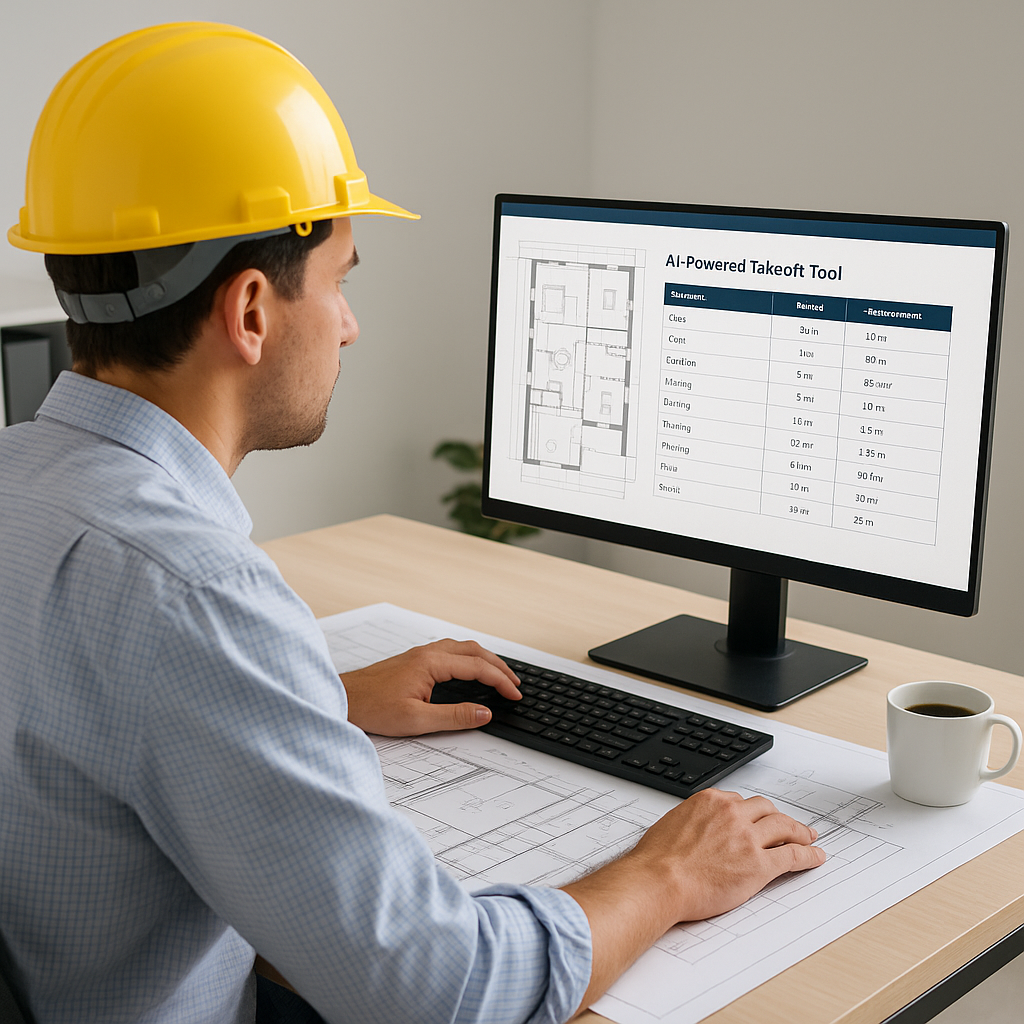
It doesn’t have to be this way. AI-powered tools like EstimateNext’s Vision AI can extract quantities from your drawings in just 10 minutes. That’s a 10X speed improvement. Picture this: uploading a PDF drawing set and having room areas, wall lengths, and fixture counts auto-calculated before you’ve finished your coffee.
How Does AI Takeoff Work?
AI-powered takeoff tools work in a surprisingly straightforward way. Here’s the process:
- Upload Your Drawing Set: Whether it’s a PDF, CAD file, or even a scanned image, the AI takes it from there.
- Automatic Detection: The software scans the drawings, identifies dimensions, counts objects like fixtures and doors, and calculates areas—just as a human estimator would.
- Confidence Scoring: Areas flagged as low-confidence (due to unclear drawings or missing details) are highlighted for manual review.
- Final Adjustments: You make the final calls, but the grunt work—tracing, measuring, and counting—is handled by the AI.
Take the example of a mid-sized GC bidding on a high-rise project. Using Vision AI, they cut takeoff time by 120 hours. That’s two full weeks of labor costs avoided. Not only did they save time, but they also met a tight deadline without hiring extra staff.
Actionable Steps to Transition to AI Takeoffs
If you’re ready to ditch manual takeoffs, here’s how to get started:
- Evaluate Your Current Process: How many hours does your team spend on takeoffs annually? Multiply that by your hourly labor rate to understand the financial impact.
- Research AI Tools: Look into platforms like EstimateNext. Compare features, pricing, and integrations with tools you already use (e.g., Bluebeam, Procore).
- Pilot a Small Project: Start with a straightforward bid—perhaps a $1M renovation—to test the software’s capabilities without risking a major project.
- Train Your Team: Most AI takeoff tools are user-friendly, but training ensures your estimators make the most of the technology. Most teams get up to speed in under two weeks.
- Measure Your ROI: Track the time saved and calculate how much money you’re keeping in your pocket. Use this data to scale AI adoption across your team.
The Obvious Skepticism: “AI Can’t Think Like an Estimator”
Skepticism is natural. After all, AI doesn’t “understand” construction the way you do. It can’t walk a site or negotiate with subs. But that’s not the point. AI is a tool to amplify your expertise.
Imagine this: Would you rather spend two days tracing PDFs or use that time to refine your bid strategy? AI tools like EstimateNext let you focus on the high-value work—negotiating better prices, refining markups, or analyzing risk.
Real ROI: Why AI Isn’t Just “Cool”—It’s Profitable
Let’s crunch the numbers. If you’re a GC director saving 40 hours per bid at $130/hour, you’re pocketing $5,200 per pursuit. Over five pursuits, that’s $26,000 saved annually. Now compare that to EstimateNext’s $99/month GC plan—just $1,188 per year. The ROI? A staggering 52X.
For MEP subcontractors handling higher volumes (e.g., 30-60 bid packages annually), the savings scale dramatically. Reducing quote turnaround from 72 hours to just 4 hours translates to responding to 50% more bids. That’s $800K–$1.6M in incremental revenue.
Here’s a case study: A regional subcontractor specializing in HVAC systems used AI takeoffs to bid on 40% more projects over six months. They landed $1.2M in additional contracts, all while reducing their estimating team’s overtime hours by 80%.
What About Smaller Projects?
AI isn’t just for billion-dollar infrastructure projects or massive commercial builds. It scales beautifully for smaller jobs, like $1M office renovations or $500K retail fit-outs.
For example, drywall contractors can use AI tools to measure wall areas and ceiling heights for a small office build-out. Sprinkler installers can calculate spacing and coverage for retail spaces. These tools work across project sizes, and setup is quick—most teams are comfortable with the software in under two weeks.
Comparison Table: Manual vs. AI Takeoffs
| Criteria | Manual Takeoffs | AI-Powered Takeoffs |
|---|---|---|
| Time | 40 hours per bid | 10 minutes per bid |
| Accuracy | Human error possible | Confidence scoring for review |
| Cost | $130/hour estimator rate | $99/month subscription |
| Scalability | Limited by staff capacity | Respond to 50% more bids |
| Learning Curve | High, requires expertise | Low, 2-week training |
Call to Action
Stop wasting weeks on manual takeoffs. AI-powered tools like EstimateNext can save you time, cut costs, and help you bid smarter. Whether you’re a GC or a specialized subcontractor, the technology scales to fit your needs. Start saving today—Get started free →


