10X Faster Construction Takeoffs: The AI Solution You Need
Imagine this: You’ve got just two days to prep a bid for a $50 million project. Your team is buried under drawings, rate books, and Excel sheets. Manual takeoffs alone will eat up 40 hours. By the time you’re done, there’s barely enough room to finalize costs, and you’re left crossing your fingers that the numbers hold up. Sound familiar?
What if I told you there’s a way to cut that 40 hours down to 10 minutes? Not a typo — 10 minutes. That’s exactly what AI-powered tools like EstimateNext deliver with Vision AI for construction takeoffs. Let’s break down why this matters and how it can transform your preconstruction workflow.
The Takeoff Problem: 40 Hours of Lost Time
Takeoffs are the foundation of every estimate. But they’re also the #1 bottleneck in preconstruction workflows. Manually measuring areas, counting fixtures, and tracing drawings is tedious, time-consuming, and highly error-prone. It’s not just about lost time; it’s about what that time costs — both directly and indirectly.
The Hidden Costs of Manual Takeoffs
For a typical general contractor (GC), two estimators spending two days on takeoffs translates to $5,200 in labor costs alone, based on industry-standard rates of $130/hour. If you’re bidding on 5-8 guaranteed maximum price (GMP) projects per year, that’s $26,000-$41,600 wasted annually — just on takeoffs. And that’s assuming everything goes smoothly.
Now, factor in the inevitable: human errors. Miscounts, missed measurements, or overlooked details lead to change orders down the road. According to a 2018 FMI report, change orders account for up to 14% of total project costs. For a $50 million project, that’s $7 million tied up in preventable issues.
Real-World Example
A regional GC in Texas shared their experience with manual takeoffs. On a recent $10 million school project, they underestimated flooring quantities by 5%. This mistake led to a $50,000 change order mid-project. Beyond the financial hit, it also damaged their reputation with the client. Now imagine if they had caught that discrepancy during preconstruction — AI tools make that possible.
Here’s Where AI Steps In
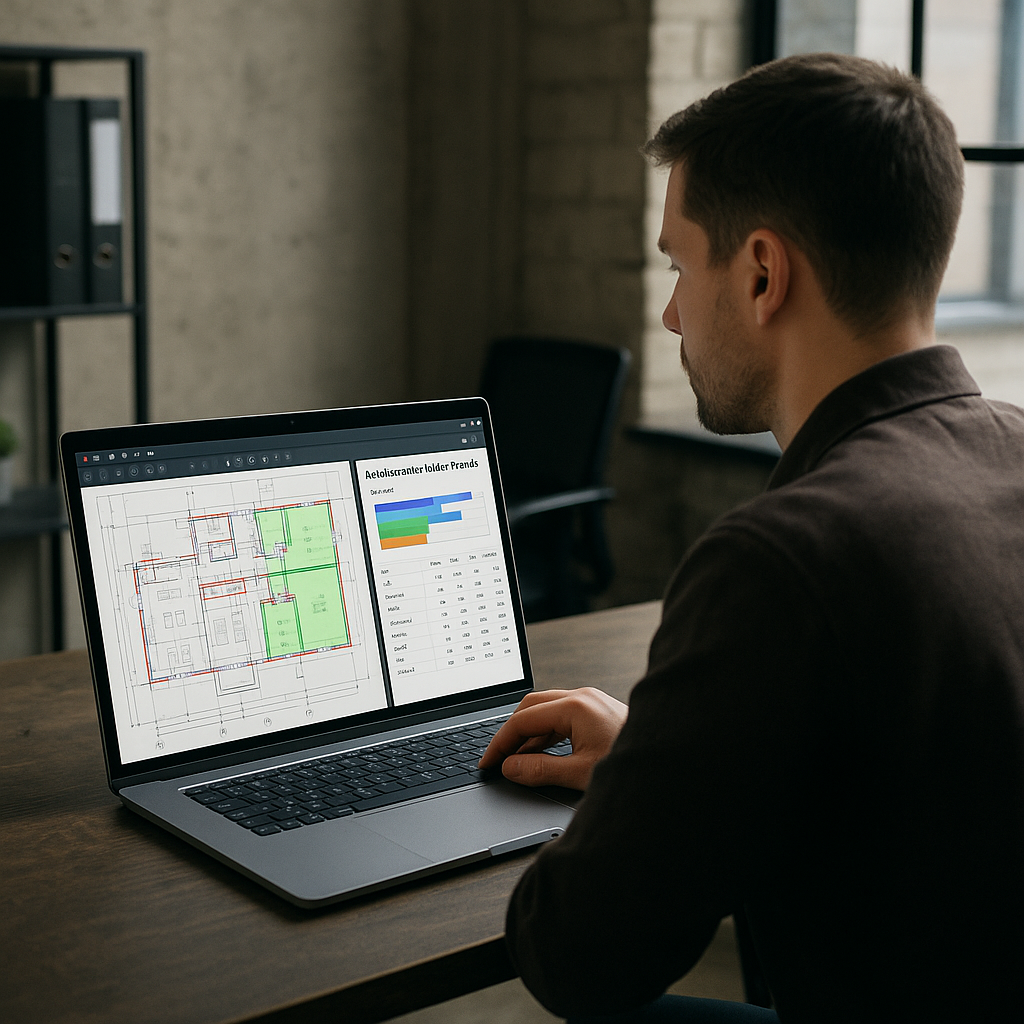
AI-powered takeoff tools like Vision AI fundamentally change the game. Instead of manually tracing PDFs or CAD files, you upload the drawings, and AI handles the heavy lifting. It scans the file, extracts quantities (room areas, wall lengths, fixture counts), and presents everything in a structured, editable format.
How AI Works in Practice
Here’s an example: A mid-sized GC saved 120 hours on a high-rise bid using Vision AI, according to EstimateNext’s case studies. That’s two full weeks of labor costs avoided. The estimator on the project described it as “like hiring a full-time estimator without the overhead.”
The AI isn’t just fast; it’s also adaptive. If it detects low-confidence measurements (e.g., ambiguous walls or unclear dimensions), it flags them for manual review. This ensures accuracy while still dramatically reducing time spent on takeoffs.
The Obvious Pushback: “AI Can’t Think Like an Estimator”
Skepticism is natural. Many contractors ask, “Can AI really understand the nuances of construction?” The answer: No, and that’s not the point.
AI as an Amplifier, Not a Replacement
AI doesn’t replace your expertise; it amplifies it. You’re still in control of judgment calls, negotiating with subs, and deciding on markup. The AI takes care of the grunt work — measuring room dimensions, counting fixtures, and calculating quantities. It’s a tool to free you up for higher-value tasks.
Addressing Common Concerns
- Accuracy: Modern AI tools have confidence scoring, which allows you to review and override flagged areas.
- Customization: Platforms like EstimateNext allow you to upload custom rate catalogs, so the system aligns with your specific needs.
- Learning Curve: Most AI tools are designed to be user-friendly. Training takes less than two weeks in most cases, and many offer 24/7 support or onboarding assistance.
Real ROI: Why Speed Matters
Speed isn’t just about saving time; it’s about bidding smarter and more competitively. Faster takeoffs mean more bandwidth for other tasks: detailed rate analysis, subcontractor negotiations, and margin optimization.
Concrete ROI
- If a GC director saves 40 hours per estimate, that’s $5,200 in labor costs saved.
- Faster takeoffs free up time to pursue more bids. Winning even one additional project per year can mean hundreds of thousands (or even millions) in incremental revenue.
For MEP subs, faster takeoffs can enable 50% more bids, translating to 4-8 additional contract wins annually. If the average contract is worth $200,000, that’s $800K-$1.6M in additional revenue per year.
Cost Comparison
Tools like EstimateNext cost $99/month. Compare that to traditional software like CostX, which can run upwards of $6,000 annually. The ROI is clear: AI platforms are 60X cheaper, with comparable (if not superior) performance.
What About Smaller Projects?
It’s easy to assume AI is overkill for smaller contracts. But that’s a misconception.
Scalable Benefits
Whether it’s a $1M office renovation or a $10M restaurant buildout, the time savings apply. McKinsey reports that early adopters of AI in construction see 10-20% cost savings per project (McKinsey Report, 2023). That’s money you’re leaving on the table if you’re stuck in manual workflows.
For example, a small residential contractor in Colorado saved 8 hours on a $500,000 kitchen remodel using Vision AI. While the job was smaller, the time savings allowed them to finalize the bid faster and secure the project ahead of competitors.
Tools to Watch
Not all AI tools are created equal. Here’s what to look for in a preconstruction platform:
| Feature | Why It Matters | Example (EstimateNext) |
|---|---|---|
| Speed | Reduces takeoff time by up to 99% | Cuts 40 hours to 10 minutes |
| Integration | Syncs with Procore, Bluebeam, etc. | Seamless export to Excel |
| Learning Curve | Easy adoption, minimal training needed | Onboarded in under two weeks |
| Accuracy | Confidence scoring + manual overrides | 80-90% error reduction |


