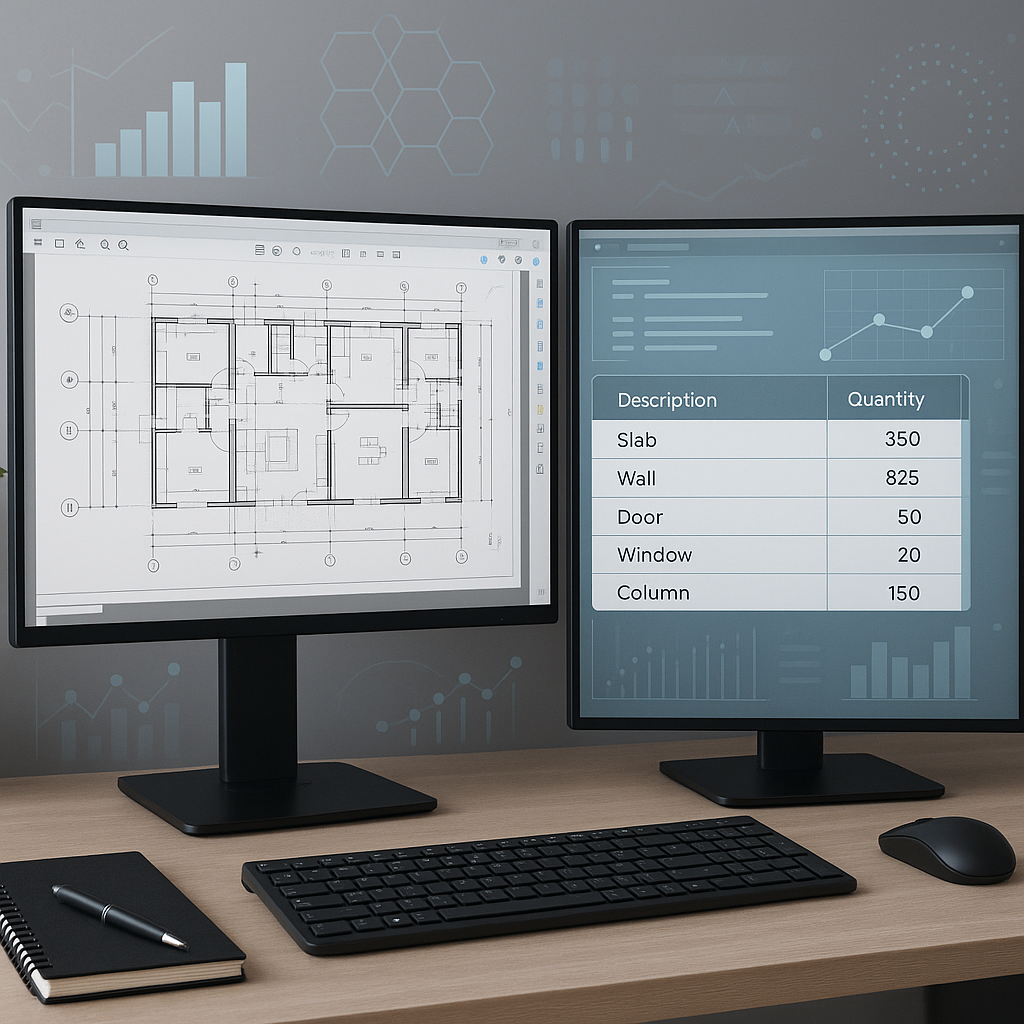
Preconstruction Takeoffs: The Bottleneck Nobody Talks About
Ask any estimator what eats up the most time in preconstruction, and they'll point to one thing: quantity takeoffs. Flipping through drawings, measuring dimensions, and calculating quantities manually can take 40 hours or more per bid. That’s two full workdays gone, just for one step in the process.
In my experience, this bottleneck doesn’t just waste time—it creates stress. Deadlines get tighter, errors creep in, and teams end up rushing through other critical steps like rate analysis or subcontractor negotiations. What’s worse? The whole process repeats with every bid.
The AI Shortcut: Vision AI Takeoffs
AI-powered tools like EstimateNext’s Vision AI have flipped the script on takeoffs. Instead of spending 40 hours tracing drawings by hand, Vision AI extracts quantities directly from PDFs in just 10 minutes. That’s not hyperbole—it’s real time saved that teams can reinvest elsewhere.
How It Works
Here’s how Vision AI streamlines takeoffs:
- Upload Drawings: Whether it’s a 200-page set of architectural plans or a single-floor layout, Vision AI scans the file in seconds.
- Automated Quantity Extraction: The AI identifies key elements like wall lengths, room areas, and even door/window counts. No manual measurement required.
- Confidence Scoring: For tricky areas (e.g., unclear dimensions), Vision AI assigns a confidence score so you know where a manual review might be needed.
Real-Life Example: Saving 120 Hours on a Bid
A mid-sized contractor recently saved 120 hours on a high-rise bid using Vision AI. That’s two full weeks of labor costs avoided while still meeting deadlines. Imagine the impact across multiple bids—those saved hours can be reinvested into fine-tuning estimates, vetting subcontractors, or improving client presentations.
Why Accuracy Still Matters
You might be thinking, “Sure, AI is fast, but can it match the accuracy of a human estimator?” Fair question. The truth is, AI-powered takeoffs are highly accurate—often reducing discrepancies by up to 80%.
How AI Tools Ensure Accuracy
AI tools like EstimateNext incorporate several features to minimize errors:
- Manual Overrides: Estimators can adjust quantities when they spot inconsistencies.
- Audit Trails: Every AI-generated quantity is logged, making it easy to trace back and verify.
- Confidence Scoring: Low-confidence areas are flagged for review, allowing human judgment to step in.
The Hybrid Approach: Humans + AI
In my view, this hybrid approach—AI for speed, humans for judgment—is where the real value lies. You’re not replacing your team; you’re empowering them. For example, junior estimators can focus on AI-assisted takeoffs, freeing up senior estimators for strategic tasks such as risk analysis or value engineering.
The ROI of Faster Takeoffs
Let’s talk numbers.
Cost-Savings Breakdown
If you’re saving 36 hours per estimate (40 hours manual minus 4 hours with AI), and your estimators cost $130/hour, that’s $4,680 saved per bid. Multiply that by 5-8 GMP pursuits per year, and you’re looking at $23,400 to $37,440 in savings annually.
For subcontractors, the math gets even more compelling. Faster takeoffs mean faster quote turnarounds—critical for winning more bids. One MEP subcontractor I worked with used AI-powered tools to cut their quote cycle from 72 hours to just 4 hours, responding to 50% more bids.
Productivity Gains
Beyond direct cost savings, AI tools unlock broader productivity gains. Estimators can shift focus to high-value tasks like:
- Negotiating better rates with vendors.
- Conducting detailed risk analyses.
- Exploring alternative design options to save clients money.
Edge Case: Complex Projects
What about projects with unusual specs—like a nuclear facility or a rail bridge? AI tools handle these surprisingly well.
Case Study: $1 Billion Rail Project
For instance, Vision AI accurately extracted quantities for concrete columns and rail decks on a $1 billion rail project. The catch? High-quality input data is essential. Garbage in, garbage out. For complex projects, pairing AI with experienced estimators ensures nothing gets missed. The AI handles the grunt work, while your team focuses on the high-value tasks.
Action Items for Complex Projects
- Invest in Data Quality: Ensure your drawings are clear and detailed.
- Pair AI with Senior Staff: Complex specs benefit from human oversight.
- Leverage Audit Trails: Use AI logs to cross-check quantities and ensure compliance.
Actionable Steps to Get Started
Not sure how to integrate AI into your workflow? Here’s a step-by-step guide:
- Test AI on Smaller Projects: Start with a renovation or fit-out project to get familiar with the tool’s capabilities.
- Train Your Team: Pair junior estimators with AI software—freeing up senior staff for strategic work.
- Use Confidence Scoring: Review flagged areas manually to ensure accuracy.
- Monitor Progress: Track time saved and accuracy improvements to measure ROI.
Comparison Table: Manual vs AI Takeoffs
| Feature | Manual Takeoffs | AI Takeoffs |
|---|---|---|
| Time per bid | 40+ hours | 4 hours |
| Accuracy | Human-dependent | Up to 80% error reduction |
| Cost per bid | $5,200 (at $130/hour) | $520 (software license + labor) |
| Scalability | Limited | Highly scalable |
| Revision Handling | Manual | Automated |
Final Thoughts
Quantity takeoffs don’t have to be a bottleneck anymore. With AI-powered tools like EstimateNext, you’re saving time, reducing errors, and freeing up your team for the work that really moves the needle. If you’re still tracing drawings by hand, it’s time to rethink your workflow.


