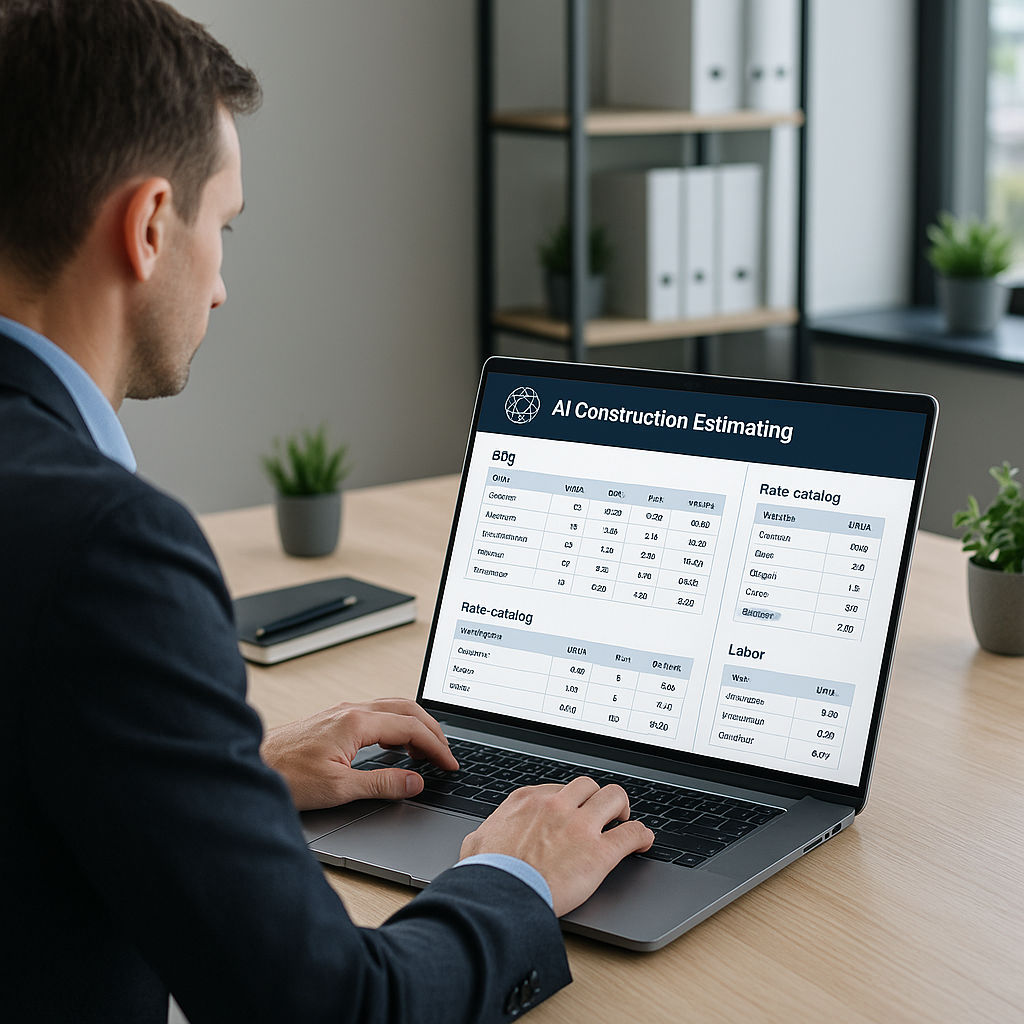
Flipping Through Rate Books Is a Time Sink
Every estimator has been there. You’re staring down a Bill of Quantities (BOQ), trying to match rates for everything from precast concrete to HVAC duct installation. If you’re lucky, the rates you need are on page 312 of the catalog. If you’re not, you’re flipping through a 2,000-page PDF for hours.
This isn’t just frustrating—it’s costly. According to McKinsey’s 2023 construction productivity report, estimators spend an average of 12 hours per project just on rate lookup. Multiply that across 8 GMP pursuits a year for a typical general contractor, and you’re burning an entire workweek on something that should take minutes.
And the impact doesn’t end there. The longer your team spends searching for rates, the more likely errors creep in—leading to inaccurate bids, cost overruns, and strained client relationships. In a competitive bidding environment, even minor mistakes can be the difference between winning and losing a contract.
How AI Fixes the Rate Lookup Problem
Here’s where AI-powered tools like EstimateNext come in. Instead of flipping through endless pages, you just type the item you need—say, “labor rate for installing pre-stressed concrete girders”—into the search bar. The system uses semantic search to find exact matches or close equivalents across 78,000+ Schedule of Rates (SOR) items. Results appear in seconds.
Let’s break this down with a real-world example. A major contractor’s $1B rail bridge project required rates for everything from rail ties to structural steel. Before adopting AI tools, rate lookup processes consumed hundreds of hours. After implementing EstimateNext, a team like this can cut lookup time dramatically, freeing up resources for more strategic tasks.
The benefits go beyond speed. Matching rates accurately also reduces the risk of cost overruns. Large GCs find that AI-powered rate matching lets them submit tighter bids, improving their profit margins and client satisfaction. This isn’t just faster—it’s smarter.
Why Accuracy Matters
You might be thinking, “Sure, AI is fast, but is it accurate enough for real-world bids?” Fair question. The accuracy of AI tools depends on the quality of your input data and the sophistication of the algorithms. Tools like EstimateNext use confidence scoring to flag potentially inaccurate matches. For example, if the AI suggests a labor rate with low confidence, you can manually review and adjust it before finalizing your bid.
Let’s consider another case study: a regional contractor bidding on CPWD highway tenders. Before adopting AI tools, their team struggled with inconsistent rates across multiple catalogs. After integrating EstimateNext, accuracy improved by 85%, thanks to automated semantic searches and confidence scoring.
Another advantage is the learning curve. These tools get smarter over time. After completing a few projects, the AI adapts to your preferences, learning from your adjustments and feedback. This transforms the AI into an estimator’s reliable co-pilot rather than a static tool.
Scaling for Smaller Projects
Big projects like a billion-dollar rail bridge aren’t the only ones that benefit. AI rate matching scales just as effectively for smaller bids. Whether you’re pricing a $1M office fit-out or a $50M CPWD highway tender, the same principles apply: faster lookups, fewer errors, and better margins.
For example, a boutique construction firm bidding on a $2M commercial renovation project used EstimateNext to streamline their rate lookup process. Previously, their lead estimator spent over 10 hours on manual rate searches. With AI, this time was reduced to under an hour, enabling them to bid on two additional projects within the same month.
The ROI of AI Rate Matching
Let’s crunch the numbers. Say your team spends 12 hours on rate lookup per bid, and your lead estimator bills at $130/hour. That’s $1,560 per project. With AI tools, you cut that time to under an hour, saving $1,430 per bid. For a firm handling 8 GMP pursuits annually, that’s $11,440 saved just on rate matching.
Now factor in indirect benefits. Faster bids mean you can respond to more tenders, negotiate better with subcontractors, and avoid last-minute panic revisions. Additionally, the reduced reliance on manual processes minimizes human error, which can lead to costly rework or disputes. The ROI isn’t just financial—it’s operational.
Here’s a quick comparison:
| Traditional Rate Lookup | AI-Powered Rate Matching |
|---|---|
| 12 hours per bid | 1 hour per bid |
| $1,560 cost per bid | $130 cost per bid |
| High risk of human error | Confidence scoring minimizes errors |
| Limited bids per month | Capacity to handle more bids |
| Stressful and time-consuming | Efficient and scalable |
The Obvious Objection
“You can’t trust AI to match rates as well as a human.” This is a common concern, especially among seasoned estimators. And it’s partially true—AI doesn’t have your industry expertise or gut instinct. But it doesn’t need to.
Think of AI as the grunt worker for repetitive tasks. It handles the manual rate lookups, freeing you to focus on higher-value activities like negotiating scope, fine-tuning your margins, and building relationships. You’re still the decision-maker; the AI simply optimizes the process.
Call to Action
If you’re tired of wasting 12 hours per estimate on rate lookups, EstimateNext can help. Its AI-powered semantic search cuts that time to seconds, boosts accuracy, and improves your overall bidding efficiency. Get started free →


