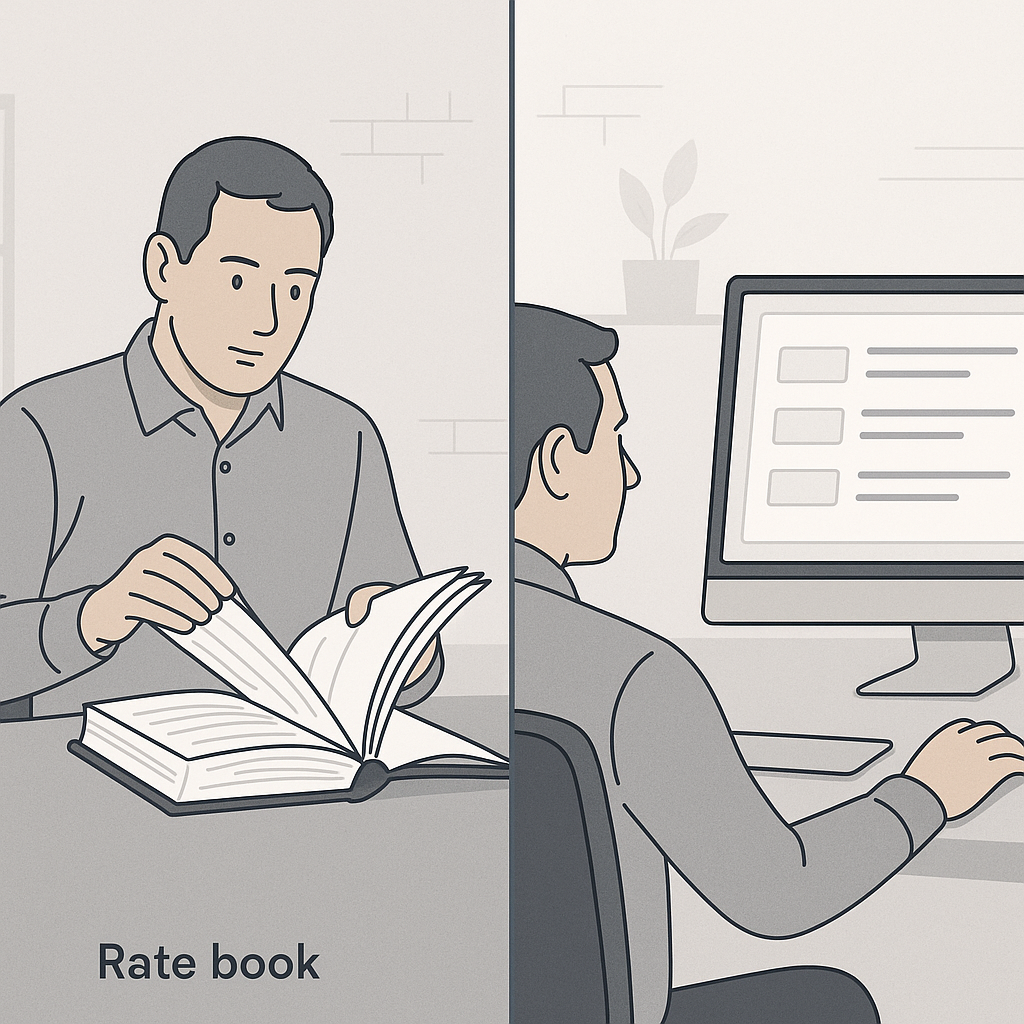
Stop Wasting Time on Rate Lookups
Flipping through 2,000-page rate books is no badge of honor. It’s a slog. Whether you’re a general contractor estimating a $200M commercial build or a subcontractor pricing a 20,000 SF fit-out, rate lookups eat up time. On average, construction estimators spend about 12 hours per estimate, according to industry reports.
And let’s be honest—manual lookups are error-prone. What happens if you miss a small line item buried on page 1,247 of the CPWD DSR? Or if you accidentally use last year’s labor rate for a state-specific project? Mistakes like these don’t just cost time—they can tank your margins. One misplaced decimal point or outdated rate can result in underbidding or overpricing, either of which can cost you the project.
AI rate matching fixes this. Tools like EstimateNext allow you to type in a line item (say, "polished concrete flooring" or "HVAC duct installation") and get instant matches from 78,000+ preloaded items across catalogs like RSMeans, CPWD DSR, and AECOM Middle East. No flipping. No guessing. Just results.
How Does It Work?
The magic is in semantic search. Instead of relying on exact keywords, AI understands context. For example, if you type "wooden door installation," it can fetch related rates like "hardwood frame finishing" or "double-panel door hanging costs"—even if the exact phrasing doesn’t match. This contextual matching eliminates the need to manually comb through hundreds of similar items.
The system also gets smarter with use. Add custom rates or tweak matches, and it remembers your preferences for future projects. By the third or fourth estimate, it's practically tailored to your workflow.
Real-World Example
Let’s consider a mid-sized interior fit-out contractor in Dubai. Before switching to EstimateNext, the firm was spending an average of 14 hours per bid on manual rate lookups. After adopting AI-driven rate matching, they cut that time down to under 20 minutes per bid. Multiply that by 30 bids/year, and they saved over 400 hours annually. That’s time better spent on client relationships, value engineering, or winning more work.
Another Case Study
In the U.S., a general contractor working on a $120M mixed-use development project used AI rate matching to optimize their bidding process. They reduced manual errors by 65% and improved bid accuracy, which helped them win the contract over a competing firm that relied on traditional, manual methods.
Why It Matters
You might be thinking, "I’ve got RSMeans and Excel. Do I really need AI?" Fair question. But here’s the thing: RSMeans is static. It’s a book (or digital equivalent). AI tools are dynamic and self-learning. They account for inflation, regional variations, and even project-specific quirks in real time.
For instance, if you’re pricing a project in Texas, AI can prioritize labor rates from Dallas or materials costs adjusted for Houston’s market index. Need to account for a 15% steel price hike mid-project? AI rate matching adjusts instantly, ensuring your bid reflects up-to-date market conditions.
The Accuracy Factor
Bad estimates lead to blown budgets and strained client relationships. Good estimates, on the other hand, win bids and build trust. According to a study by McKinsey, firms that adopt AI tools in construction see a 20-30% improvement in project cost estimation accuracy. AI tools like EstimateNext help you get it right the first time, reducing discrepancies by up to 80%.
Speed vs. Precision: A Comparison
| Metric | Manual Lookups | AI Rate Matching |
|---|---|---|
| Time per estimate | ~12 hours | ~20 minutes |
| Error rates | High (5-15%) | Low (<2%) |
| Adaptability to inflation | Manual recalculation | Automatic updates |
| Multi-market support | Limited | Seamless integration |
Common Pushbacks (and Why They're Wrong)
"AI is too complicated to learn."
Not really. Most platforms, including EstimateNext, are designed to feel intuitive. If you can use Excel, you can use this. Plus, training usually takes under two weeks. Many providers even offer guided onboarding sessions.
"What if I have custom rates?"
No problem. You can upload your own rate catalogs or define project-specific rates. The AI integrates them seamlessly for future use, ensuring that your custom data is prioritized in matches.
"AI can’t think like me."
True. But it doesn’t need to. Think of it as an assistant. It handles the grunt work—rate lookups, matching, inflation adjustments—so you can focus on strategy and decision-making.
"It’s expensive for small contractors."
Not necessarily. Many AI platforms offer tiered pricing models, allowing smaller firms to access core features without breaking the bank. The time and cost savings often outweigh the subscription fees.
Actionable Steps to Get Started
- Identify Your Bottlenecks: Are rate lookups slowing you down? Are you losing bids because of inaccurate pricing? Start by auditing your current process.
- Test a Free Tool: Platforms like EstimateNext offer free trials. Upload a BOQ and see how much time you save.
- Compare Outputs: Run the same estimate manually and with AI. Check for accuracy, speed, and usability.
- Iterate: Use the AI regularly. The more you engage, the smarter it gets. Tweak the results, add custom rates, and let the system learn your preferences.
- Scale Up: Once you’re comfortable, scale usage across your team and integrate it with your broader estimating workflow.
If you’re still flipping through PDFs or rebuilding rate sheets from scratch, it’s time to rethink your process. EstimateNext can help you price bids faster and more accurately. Start your free trial today →


