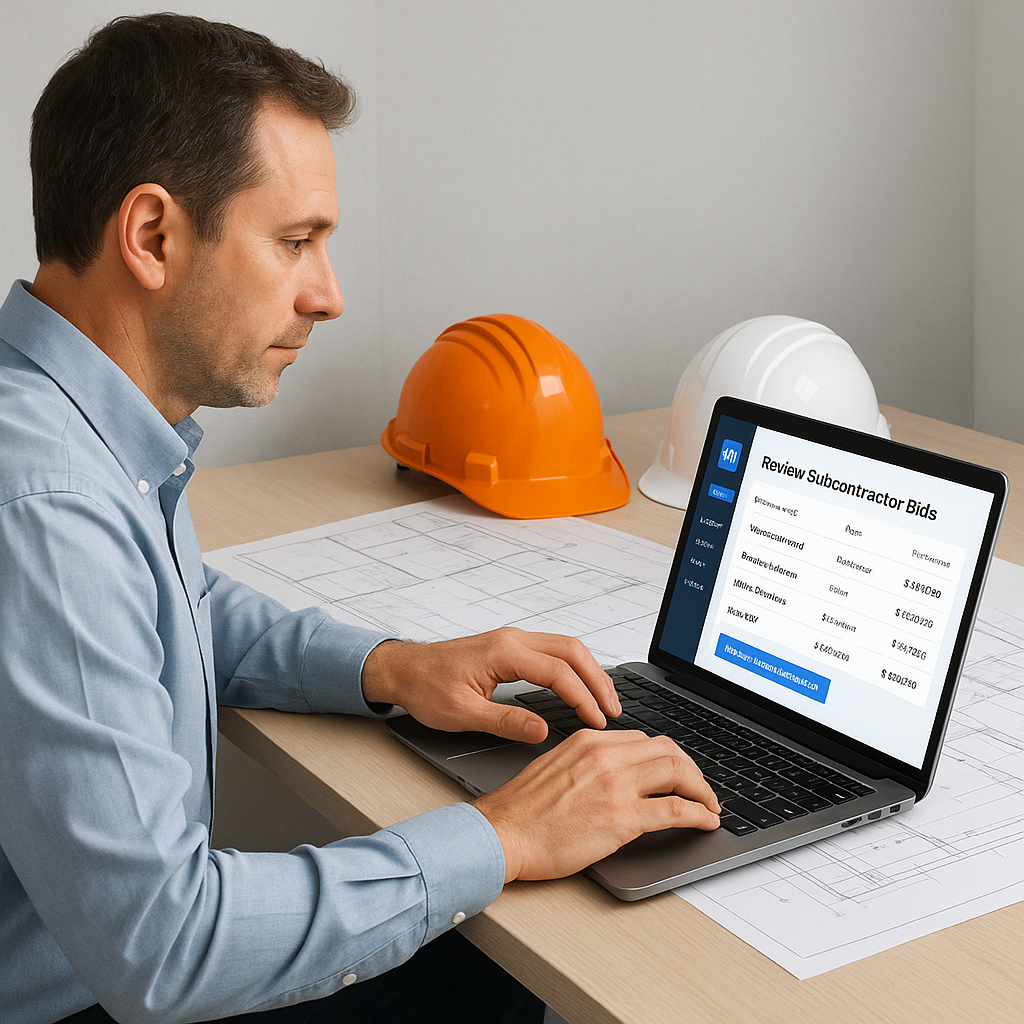
The Problem No One Talks About: Sub Bid Leveling
Ask any GC estimator about their least favorite task, and chances are they'll mention subcontractor bid leveling. It's tedious, time-consuming, and prone to mistakes. When you've got seven sub bids for the same scope, each quoting slightly different inclusions and exclusions, normalizing them is like solving a Rubik's Cube blindfolded. Add tight deadlines into the mix, and it's no wonder this task feels like an uphill battle.
Here’s the reality: manual bid leveling takes 6–12 hours per bid package, depending on the complexity. For a mid-sized GC handling five GMP pursuits a year, that’s up to 60 hours wasted just comparing bids. For larger firms, the numbers are staggering. Large GCs have reported spending hundreds of hours leveling bids for a single rail bridge project.
If you’re still using spreadsheets and highlighters for bid comparison, you’re not alone—but the inefficiency is no longer sustainable.
How AI Fixes Sub Bid Leveling
Enter AI-powered tools like EstimateNext. These platforms don’t just speed up the grunt work—they fundamentally change how it’s done. Leveraging natural language processing (NLP), they scan and interpret subcontractor bids, extract scope inclusions/exclusions, and normalize them against your master Bill of Quantities (BOQ). The tool then ranks bids as L1, L2, and L3 based on factors like cost, scope coverage, and risk. What used to take 6+ hours can now be done in as little as 30 minutes.
Real-World Example: EstimateNext in Action
Let’s look at a concrete example. A mid-sized general contractor (GC) used EstimateNext for a high-rise project. Their team saved 120 hours on bid leveling—a significant reduction in labor costs. But the time savings weren’t the only benefit. The AI flagged a critical scope gap in the lowest bid, which would have resulted in $342,000 in change orders. By addressing the issue upfront, the GC avoided a costly oversight and delivered a more competitive and accurate GMP proposal.
This isn’t an isolated case. Major national and regional contractors have started adopting AI-powered tools for preconstruction tasks, reporting similar efficiency gains and risk mitigation benefits.
Actionable Steps to Implement AI Bid Leveling
- Audit Your Current Process: Identify where time is being lost. Are you manually extracting exclusions? Flipping between multiple PDFs and Excel sheets?
- Choose the Right Tool: Look for AI platforms with strong NLP capabilities and integration options for your existing software (e.g., Procore, Bluebeam).
- Pilot a Project: Start small. Use AI on a single bid package to understand its workflow and ROI.
- Train Your Team: AI tools are only as effective as the people using them. Invest in onboarding and training sessions.
- Iterate and Scale: Use lessons from your pilot project to refine processes before rolling out AI across all pursuits.
Why Manual Methods Are Risky
You might think, “I’ve been leveling bids manually for years—why change?” It’s a fair question, but manual methods have two significant flaws:
1. Human Error
When you’re juggling multiple bids, it’s easy to miss key details. For example, a single overlooked exclusion (e.g., “waterproofing not included”) could result in unexpected change orders worth tens or even hundreds of thousands of dollars. In fact, a 2022 study by Dodge Construction Network found that 48% of contractors reported profitability issues due to scope gaps in subcontractor bids.
2. Time Sink
Leveling bids isn’t just labor-intensive—it’s a poor use of valuable time. Every hour spent comparing bids is an hour not spent negotiating better pricing, refining your GMP proposal, or managing client relationships. Over time, this inefficiency compounds, especially for firms handling multiple concurrent projects.
Actionable Comparisons: Manual vs. AI
| Aspect | Manual Bid Leveling | AI-Powered Bid Leveling |
|---|---|---|
| Time Per Bid Package | 6–12 hours | ~30–60 minutes |
| Risk of Human Error | High (manual data entry) | Low (automated extraction) |
| Ability to Flag Scope Gaps | Manual review required | Automated alerts |
| Scalability | Limited by human resources | Easily scalable |
The ROI Math: Why This Matters
Let’s break down the numbers. A typical GC estimator costs $130/hour. If an AI tool saves 10 hours per bid, that’s $1,300 saved per pursuit. Multiply this by five GMP pursuits per year, and you’re saving $6,500 annually per estimator. For a team of six estimators, the savings jump to $39,000.
But the true ROI extends beyond labor costs:
- Reduced Change Orders: Avoiding a single six-figure change order pays for AI many times over.
- Faster Turnaround: Faster bid leveling means you can hit tight deadlines, improving your chances of winning competitive bids.
- Improved Accuracy: Better data minimizes risks, leading to smoother project execution.
Case Study: ROI in Action
A large GC handling $200M in annual projects adopted EstimateNext. Within one year, they:
- Saved $150,000 in labor costs.
- Reduced change orders by $500,000.
- Completed bid leveling 70% faster, enabling them to pursue two additional GMP opportunities that year.
The Obvious Objection: “But AI Can’t Think Like an Estimator”
This is a common concern: “Sure, AI is fast, but it doesn’t understand construction.” And you’re right—AI doesn’t replace your expertise. What it does is handle the repetitive, low-value tasks so you can focus on high-value work.
Think of AI as Your Assistant, Not Your Replacement
For example, EstimateNext’s bid leveling tool doesn’t make the final decision for you. Instead, it compiles all the data—scope gaps, exclusions, cost breakdowns—into a clear, actionable report. This allows you to make informed decisions faster and with greater confidence. You’re still the expert; AI just makes your job easier.
Final Thoughts
If you’re still spending 6+ hours leveling sub bids by hand, it’s time to rethink your process. AI-powered tools like EstimateNext can save you time, reduce errors, and give you a competitive edge in tight bid cycles. The construction industry is rapidly evolving, and those who adopt technology early will be better positioned to thrive in the long term.
Want to see how it works? Get started free →


