120 Hours Saved: Why AI Takeoff Tools Are Changing Preconstruction
Last week, a mid-sized general contractor (GC) shared with us that they saved 120 hours on a single high-rise bid. How? By swapping out manual drawing takeoffs for AI-powered tools. That’s two full weeks of labor—eliminated in one stroke.
If you’re still relying on manual workflows, you know the grind: flipping through PDFs, tracing drawings by hand, and cross-checking quantities in Excel. It’s repetitive, error-prone, and frankly, outdated. But AI isn’t just faster—it’s smarter. Let’s break down why it’s a game changer for preconstruction teams.
The Bottleneck: Manual Drawing Takeoffs
A typical drawing set for a large project can include hundreds of pages—floor plans, elevation views, section cuts, and schedules. Every wall length, door count, and square footage needs to be measured, recorded, and totaled. For two estimators working full-time, this can take up to 40 hours per bid.
Here’s the brutal math:
- 40 hours per bid × 5 GMP pursuits per year = 200 hours per estimator annually.
- For teams with 4 estimators, that’s 800 hours wasted—just on takeoffs.
And it’s not just about time—it’s about accuracy. Human error is a constant risk. Missed dimensions, duplicated counts, and incorrect scaling can all skew your final estimate. Fixing those mistakes later in the process often costs even more time and money.
Concrete examples abound: A study by PlanGrid and FMI found that 52% of rework in construction projects is caused by poor data and miscommunication. That includes errors stemming from flawed takeoffs.
The AI Fix: Vision AI Takeoffs in Minutes
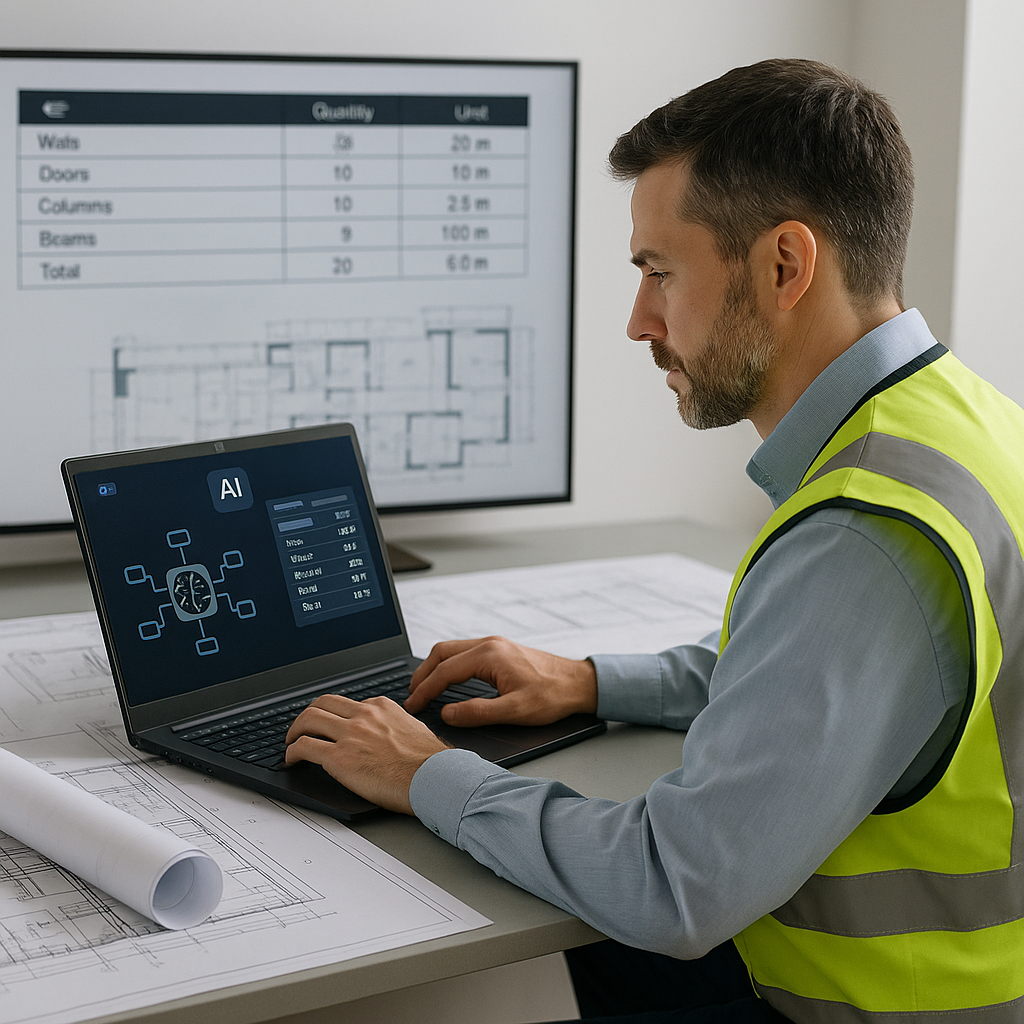
AI-powered tools like EstimateNext flip the script. Instead of manually measuring every line, Vision AI scans your PDF drawings and extracts quantities automatically.
Here’s a step-by-step overview of how it works:
- Upload your drawings: Any PDF set—floor plans, elevations, even revisions.
- Vision AI processes the data: Room areas, wall lengths, door/window counts—all extracted in under 10 minutes.
- Review flagged items: The system highlights any areas of low confidence so you can manually confirm or override them.
- Export and integrate: Quantities can be exported directly to your estimating software or spreadsheets.
The result? A 10X speed improvement over manual takeoffs. That’s not just shaving minutes—it’s cutting days off your preconstruction timeline.
Real-World Data: What AI Takeoffs Achieve
A GC working on a $200M high-rise project needed quantities for concrete columns, beams, and floor decks. Normally, this task would take two estimators 40 hours—a full workweek gone.
With Vision AI, the takeoff was completed in 10 minutes. And because the system flagged low-confidence items, the team reviewed those areas before moving forward. The result? Zero surprises, zero costly errors. As one estimator put it: “It’s like hiring a full-time estimator without the overhead.”
The Obvious Objection: “But AI Can’t Think Like an Estimator”
A common pushback is: “Sure, AI is fast, but it doesn’t understand the nuances of construction.” This is partially true—but it misses the bigger point.
AI doesn’t replace your expertise; it amplifies it. You’re still the one making judgment calls, negotiating with subs, and deciding on markup. The AI just handles the grunt work—like takeoffs, rate matching, and what-if recalculations.
Think of it this way: It’s like hiring an apprentice who never gets tired, never makes arithmetic mistakes, and learns from every project. The grunt work disappears, leaving you with more time to focus on strategy and high-value tasks.
Why Time Saved = Money Earned
Let’s revisit the 120 hours saved on the high-rise bid. At an average estimator rate of $130/hour, that’s $15,600 in avoided labor costs. Multiply that across 5 GMP pursuits per year, and you’re saving $78,000 annually—just on takeoffs.
But the benefits extend beyond cost savings:
- Respond to more bids: Your team can handle an increased workload without adding headcount.
- Focus on strategy: Spend more time refining bid/no-bid decisions and optimizing margins.
- Improve accuracy: With fewer human errors, your estimates are more reliable, reducing rework and potential disputes.
Case Study: Scaling Efficiency for a Regional Contractor
One regional contractor specializing in healthcare projects adopted Vision AI to streamline their preconstruction process. The result? They increased the number of bids they could pursue by 30%—without hiring additional staff. This allowed them to win three additional projects in a single year, adding $10M to their backlog.
Edge Cases and What-If Scenarios
You might be thinking: “What if my drawings are messy or incomplete? Will AI still work?”
Here’s the answer: Vision AI isn’t perfect, but it’s adaptable. It flags low-confidence lines for manual review. If your drawings are missing dimensions, you can calibrate measurements directly within the tool. And when dealing with frequent revisions, you can upload updated drawing sets, and the system will automatically compare changes. No need to start from scratch.
FAQ: Common Questions About AI Takeoffs
Q: How accurate are AI-generated takeoffs?
AI tools like EstimateNext reduce discrepancies by up to 80%. However, human oversight is still essential for edge cases and flagged items.
Q: Can AI handle smaller projects?
Absolutely. Whether it’s a $1M renovation or a $1B rail bridge, AI scales to any project size.
Q: What if my rates are custom or project-specific?
You can upload your own rate catalogs or define custom rates. The AI integrates them seamlessly.
Q: Is Vision AI hard to learn?
Not at all. Most users report being fully trained in under two weeks. The interface is intuitive, and there’s built-in support.
Q: Does AI replace estimators?
No. AI handles repetitive, time-consuming tasks, freeing up your team for higher-value work.
Decision Framework: Is AI Right for Your Team?
| Feature | Manual Takeoffs | AI-Powered Takeoffs |
|---|---|---|
| Speed | 40 hours per bid | 10 minutes per bid |
| Accuracy | Prone to human error | 80% fewer discrepancies |
| Scalability | Limited by team size | Scales to any project size |
| Cost | $130/hour per estimator | Fixed subscription fee |
| Adaptability to Revisions | Tedious and manual | Automated comparison |
If your team is drowning in takeoffs and struggling to keep up with bid schedules, the decision is clear: AI takeoffs are the future of preconstruction.
Call to Action
If you’re ready to cut takeoff time by 10X and unlock new efficiencies, EstimateNext is here to help. Vision AI eliminates tedious workflows, so you can focus on what really matters. Get started free →
: PlanGrid + FMI Study, 2018
: Internal EstimateNext Case Studies
: GC Feedback, 2023
: EstimateNext Product Documentation
: User Testimonials, EstimateNext
: Training Feedback Surveys


