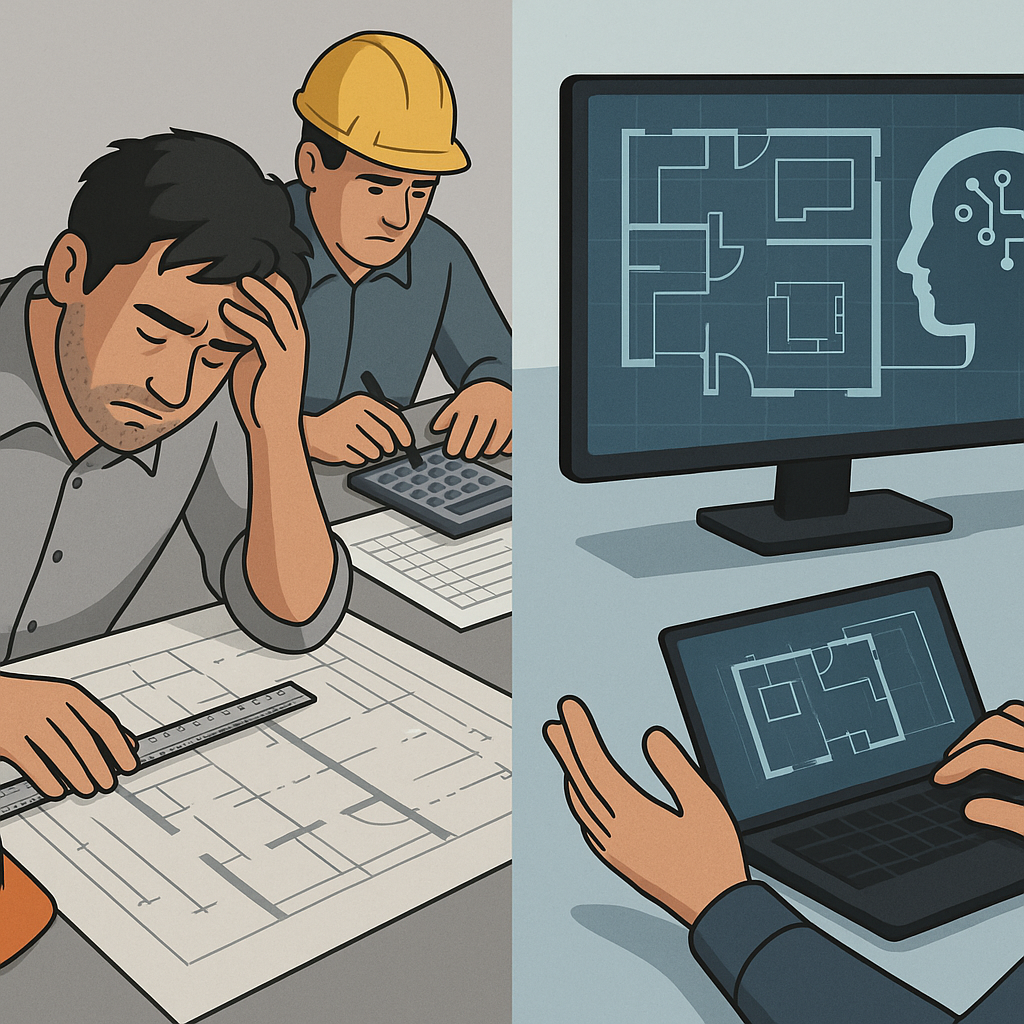
40 Hours to 10 Minutes: Why Manual Takeoffs Are Bleeding Your Projects Dry
Let’s start with some brutal math: the average preconstruction team spends 40 hours on manual takeoffs for a single project. That’s two estimators grinding through drawings, PDFs, and Excel sheets for two full days. At $130/hour (a typical US estimator’s rate), that’s $5,200 per project in labor costs alone.
Now multiply that by five GMP pursuits per year. Or 30 bid packages for MEP subcontractors. Or 60 if you’re in regions like the GCC. Suddenly, you’re staring at $250,000 to $3 million annually just on manual quantity takeoffs. And for what? A process riddled with errors, rework, and missed deadlines.
But here’s the game-changer: AI-powered tools like EstimateNext slash this time from 40 hours to just 10 minutes. Yes, 10 minutes. Let’s break down how this works—and why it matters more than ever.
Why Manual Takeoffs Are Slowing You Down
Manual takeoffs are tedious. You’re measuring room areas, wall lengths, and structural components by hand. You’re flipping through rate books like RSMeans or CPWD DSR to find matches. And every revision means recalibrating your spreadsheet formulas and redrawing measurements. It’s the definition of inefficiency.
Real-World Example: Time Wasted on Manual Takeoffs
A mid-sized general contractor (GC) in Florida estimated that they were losing 15-20% of potential bids because their process couldn’t keep up. Every project required at least 40 hours of manual effort, forcing them to cherry-pick opportunities instead of bidding aggressively on all viable projects. The result? Revenue left on the table.
Actionable Steps to Identify Inefficiencies
- Track Your Time: Start logging how many hours your team spends on takeoffs per project. Break this down by task—measurement, rate matching, revisions, etc.
- Audit Missed Bids: Look at opportunities you didn’t pursue last year. How many could you have bid on if your team had more bandwidth?
- Estimate Labor Costs: Calculate the annual labor cost of manual takeoffs. Use this number to assess whether investing in AI tools makes sense for your firm.
AI Takeoffs: The 10-Minute Workflow
Here’s how AI-powered tools like EstimateNext change the game:
1. Vision AI Extraction
Upload your PDF drawings, and the AI extracts quantities automatically—room areas, wall lengths, door/window counts, you name it. What used to take hours is done in minutes.
Example:
Imagine you’re working on a 200,000-square-foot school facility. Instead of spending an entire day measuring classrooms, corridors, and structural components manually, AI processes the drawings in under 10 minutes, giving you accurate quantities instantly.
2. Rate Matching
Instead of flipping through a 2,000-page rate book, semantic search across 78,000+ SOR items gives you instant matches. No hunting, no guessing.
Comparison:
| Manual Process | AI-Powered Process |
|---|---|
| Flip through rate books manually | Instant semantic search for rates |
| Risk of mismatched cost items | Accurate rate matching via AI |
| Hours of effort | Seconds to find rates |
3. Revision Handling
Upload a revised drawing set, and the AI flags changes automatically. No need to remeasure everything manually.
4. Error Validation
AI tools flag low-confidence measurements for manual review, ensuring critical dimensions aren’t missed. Accuracy can reach 99% or higher when paired with human oversight.
Real-World Impact: Faster Bids, Better Margins
In my view, speed wins every time. Let’s say you’re pricing a 200,000-square-foot facility. Manual takeoffs would take two estimators 40 hours. AI? You’re done before lunch. That’s not just faster—it’s smarter.
Case Study: Texas GC
A regional GC in Texas adopted AI-powered takeoff tools and reduced their average bid prep time by 30%. This allowed them to pursue 20% more projects annually. More bids mean more wins. And more wins mean better margins.
Actionable Steps to Boost Margins
- Automate Takeoffs: Use AI tools to reduce time spent on manual measurements by up to 95%.
- Focus on Strategy: Free up your team’s time to analyze project risks, optimize pricing, and strengthen bid packages.
- Track Win Rates: Measure how faster bid submissions improve your win rates over time.
The Cost of Staying Manual
Let’s be blunt: staying manual is expensive. It costs your team time, it delays bids, and it reduces your competitiveness in a market that’s moving faster than ever.
Real-World Example: Florida GC
A mid-sized GC missed 15-20% of potential bids because their manual process couldn’t keep up. That’s revenue left on the table. And it’s avoidable.
Decision Framework: Should You Switch to AI?
| Question | If Yes... |
|---|---|
| Do you spend more than 20 hours/project on takeoffs? | AI can cut this time down to 10 minutes. |
| Are you missing bids due to time constraints? | AI tools free up resources for more pursuits. |
| Are manual errors costing you money? | AI improves accuracy and reduces rework costs. |
| Do you work on more than 10 projects/year? | AI scales efficiently across multiple projects. |
Ready to Leave Manual Behind?
If you’re tired of wasting 40 hours per project on takeoffs, EstimateNext can help. Our AI-powered tools cut that down to 10 minutes, letting you bid faster, more accurately, and more competitively. Get started free →


