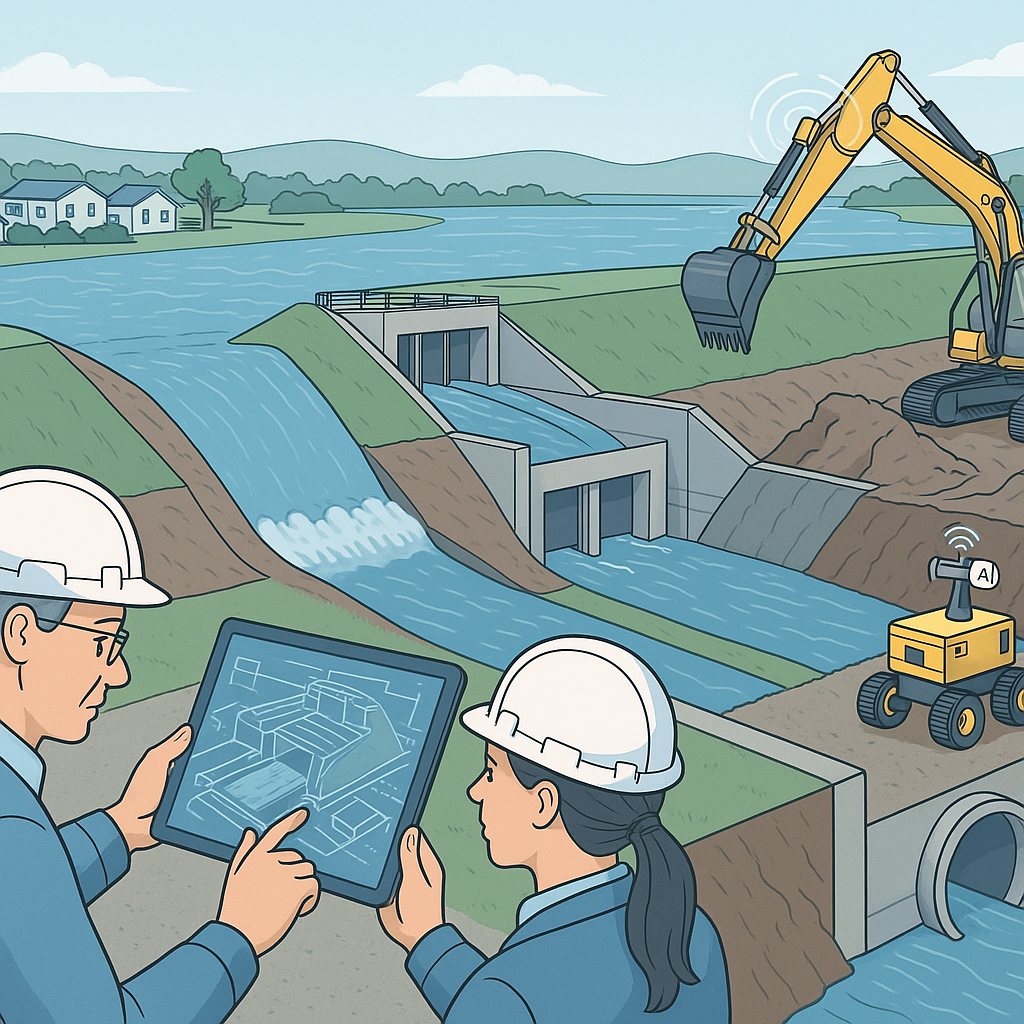
$518M to Solve Virginia’s Flooding Problem
Flooding in Virginia has been a nightmare. Rising water levels, outdated infrastructure, and unpredictable weather patterns have left cities vulnerable. Enter a major infrastructure contractor. Their large floodwater management project is reshaping the region’s defenses. But what’s really driving their efficiency? AI-powered tools that shave weeks off preconstruction workflows.
The Problem: Estimation Bottlenecks
Large-scale infrastructure projects like this one require precision. Miscalculate quantities or costs, and you’re looking at blown budgets, delays, and unhappy stakeholders. Historically, preconstruction estimation has been painfully slow:
- Manual takeoffs: Flipping through hundreds of PDF pages for measurements.
- Rate lookup: Digging through catalogs like RSMeans or Davis-Bacon.
- What-if scenarios: Constantly restarting Excel spreadsheets for every rate adjustment.
Real-World Examples of Bottlenecks
Consider a recent report from Dodge Construction Network. They found that 35% of infrastructure projects exceed their original budgets due to poor estimation practices. This inefficiency isn’t just a time-sink—it creates ripple effects across the entire project lifecycle, from procurement to construction timelines. A Virginia-based contractor, for instance, estimated a bridge repair project at $4 million but later found it ballooned to $6.5 million due to inaccurate takeoffs and unexpected material costs.
For a project the size of a large state floodwater management effort, these inefficiencies can result in hundreds of wasted hours and millions in cost overruns. A contractor on that kind of job needs a faster, more reliable way to estimate.
The Fix: AI-Powered Estimation
A contractor in this situation can turn to tools like EstimateNext to streamline their workflow. Here’s how it made a difference:
1. Takeoff Speed: From Weeks to Minutes
Manual takeoffs can take 40+ hours per project. With EstimateNext’s Vision AI, a team can upload their floodwater management drawings and extracted wall lengths, pipe counts, and earthwork volumes in just 10 minutes. That’s 10X faster.
Actionable Insight:
- How it works: Vision AI scans uploaded drawings (PDFs, DWGs, etc.) and auto-recognizes key elements like walls, pipes, and grading areas. Teams can review flagged items for manual confirmation, ensuring accuracy without losing speed.
- Comparison: While traditional manual takeoffs require hours of human input, Vision AI eliminates repetitive tasks, freeing estimators to focus on high-value decisions.
2. Semantic Rate Lookup: No More Catalog Flipping
Virginia’s floodwater project required compliance with HUD Davis-Bacon rates. Instead of manually searching through rate books, A team can use EstimateNext’s semantic search across 78K+ Schedule of Rates (SOR) items. Matches appeared in seconds, not hours.
Case Study:
A regional contractor in Maryland used similar AI-powered tools to streamline rate lookups for a $12M stormwater project. Before adopting AI, their team spent over 15 hours per bid manually cross-referencing rates. With EstimateNext, they reduced this to just 30 minutes, ensuring compliance with state-mandated labor rates while cutting labor-intensive work.
3. Real-Time What-If Scenarios
Floodwater management is full of “what ifs.” What if material costs spike? What if labor rates change mid-project? EstimateNext lets a team tweak rates in real time without rebuilding workbooks from scratch. Every adjustment propagated instantly with a full audit trail.
Example:
For a levee construction project in Florida, a contractor used EstimateNext to simulate a 15% concrete price increase. The AI instantly recalculated total costs, helping them negotiate supplier contracts in advance and avoid mid-project disruptions.
4. Bid Intelligence: Go/No-Go Decisions Made Simple
With $518M on the table, the stakes couldn’t be higher. A contractor can use EstimateNext’s Go/No-Go Evaluator to predict the win probability and assess tender risks. The AI parsed project docs against a 26-point rubric, giving them a data-backed decision instead of gut feel.
Practical Use:
This feature isn’t just for mega-projects. Smaller firms bidding on $1M–$5M projects can use similar tools to identify risk factors, such as unclear specs or unusually tight deadlines, and decide whether to proceed or pass.
The ROI: Efficiency That Pays
Here’s the math:
- 40 hours saved per estimate: At $130/hr, that’s $5,200 saved per pursuit.
- 10X faster takeoffs: Teams spent their time on planning, not tracing PDFs.
- Better bid accuracy: Avoided overpricing and underbidding, which could risk the project.
Breaking Down ROI Further
A 2022 McKinsey report highlighted that AI-driven tools can reduce preconstruction costs by 15–25%. For a contractor on a large floodwater project, that could translate to potential savings of $10M–$20M over the project lifecycle. These savings can then be reinvested into other critical areas, like contingency planning or advanced materials.
Practical Example: Earthwork Volumes
One major challenge in floodwater management is calculating earthwork volumes for levees and drainage systems. A team can use EstimateNext’s civil tools to:
- Calculate cut/fill volumes for levee construction.
- Optimize pavement slab thickness for flood-prone areas.
- Factor labor rates using MCAA references.
This wasn’t just faster—it was more accurate. Errors in earth volumes can lead to material shortages or surpluses, both of which are costly. For instance, overestimating fill requirements for a 10-mile levee could cost upwards of $1M in unnecessary material purchases.
Why It Matters
Virginia isn’t the only state grappling with floodwater issues. Projects like this set the standard for how AI tools can transform infrastructure estimation. Imagine applying this same efficiency to bridge replacements in California, hurricane defenses in Florida, or wildfire mitigation in the western states.
In a world where climate change is worsening the frequency and severity of natural disasters, the ability to deliver critical infrastructure projects on time and within budget is no longer a luxury—it’s a necessity.
Comparing Traditional vs. AI-Powered Estimation
| Feature | Traditional Estimation | AI-Powered Estimation |
|---|---|---|
| Takeoff Time | 40+ hours | 10 minutes |
| Rate Lookup Time | 10+ hours | Seconds |
| Accuracy | Prone to human error | Consistently accurate |
| Scenario Adjustments | Manual, time-consuming | Instant, with audit trail |
| Bid Risk Assessment | Gut-based decisions | Data-backed recommendations |
Call to Action
If your team is dealing with slow takeoffs or complex rate lookups, EstimateNext might be the solution you need. Start saving time today. Get started free →


