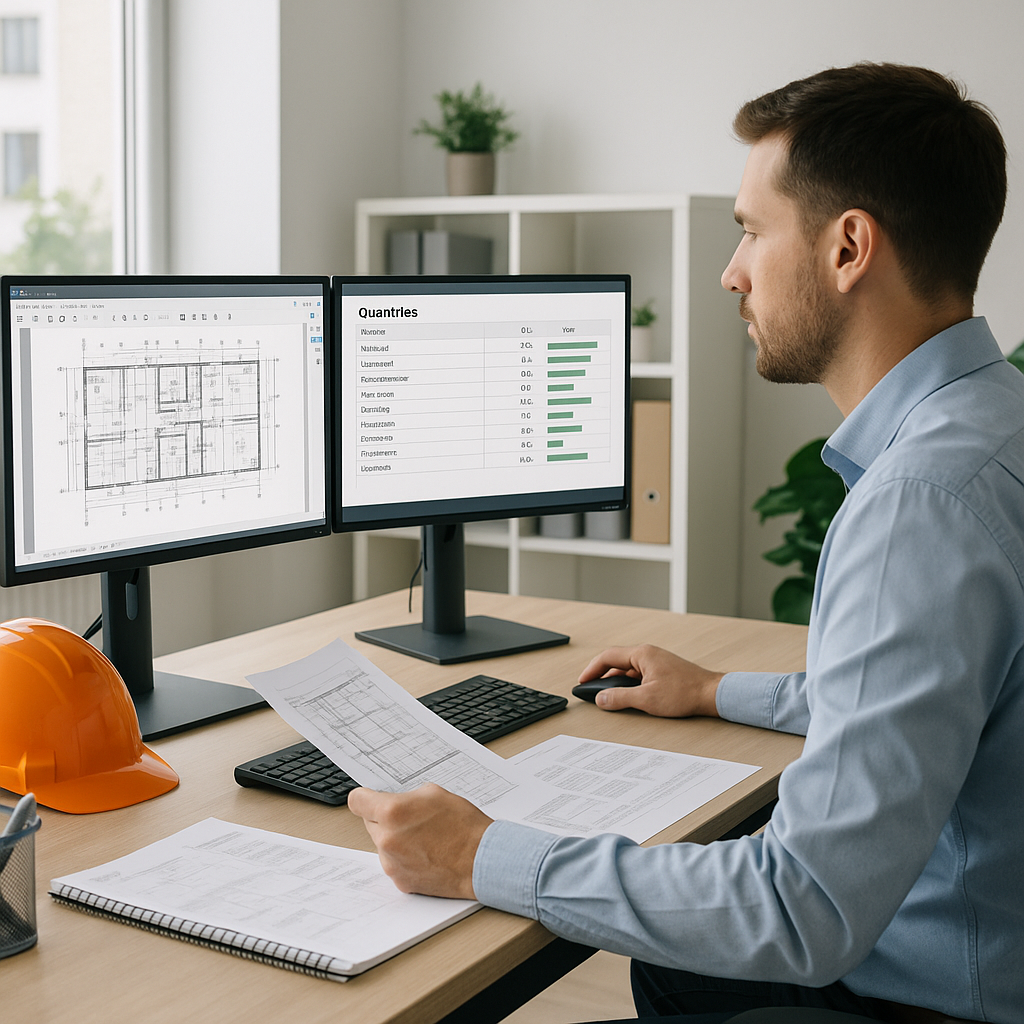
The Brutal Math of Manual Takeoffs
Let’s face it—manual takeoffs are the Achilles' heel of preconstruction. A typical project takeoff eats up 40 hours. That’s two estimators grinding away for two full days. And mistakes? They’re inevitable. Human fatigue makes errors a certainty when you’re measuring line after line on PDFs or tracing drawings by hand. Worse, every revision means going back to square one.
Now consider this: AI-powered tools like EstimateNext can process the same set of drawings in just 10 minutes. Yes, 10 minutes. Imagine the difference that makes when you’re juggling multiple bids with tight deadlines.
Why Speed Matters More Than Ever
General contractors know the stakes. The construction industry isn’t slowing down. Projects keep getting bigger, timelines tighter, and competition fiercer. If your team spends days on takeoffs, you’re losing opportunities. Case in point: A regional GC in Florida estimated they missed $1.2 million in revenue last year because manual takeoffs forced them to skip 15-20% of bids.
Real-Life Example: The Florida GC
One Florida general contractor shared that they could only complete takeoffs for 80% of the bids they wanted to pursue due to time constraints. After adopting AI tools, they were able to process 100% of their bids, increasing their bidding volume by 20%. The result? A $1.4 million increase in awarded projects over 12 months.
Speed wins bids. But speed without accuracy? That’s a disaster waiting to happen. Inaccurate estimates can lead to underbidding (and losing money) or overbidding (and losing the project altogether). Striking the balance between speed and accuracy is where AI-powered tools shine.
Actionable Steps:
- Audit Your Current Process: Track how much time your team spends on manual takeoffs. Identify bottlenecks and repetitive tasks.
- Calculate Missed Opportunities: Estimate the revenue lost from incomplete bids or projects you couldn’t pursue. This can build the case for AI adoption.
- Prioritize High-Impact Areas: Focus on projects where AI can deliver the greatest time savings, such as high-volume or complex takeoffs.
Best Practices for AI Takeoff
1. Start Small and Test the Tool
AI isn’t magic—it’s a tool. Start with a small project to see the difference. Upload your Bill of Quantities (BOQ) into an AI-powered platform like EstimateNext, and let it handle the rate matching and takeoffs. Compare the output to your manual process. Odds are, the results will speak for themselves.
Case Study: California GC A general contractor in California tested EstimateNext on a $5 million school renovation project. The AI tool saved 25 hours on bid preparation. That extra time allowed the team to refine their bid strategy, ultimately winning the project with a more competitive and accurate estimate.
2. Use Confidence Scoring to Validate Outputs
AI takeoff tools aren’t perfect. They’re highly accurate, but no system catches everything. That’s why platforms like EstimateNext include confidence scoring and manual overrides. These features let your team focus on fine-tuning high-risk areas instead of wasting time on grunt work.
Example: Suppose an AI tool flags a complex roof design with an 80% confidence score. Your team can prioritize reviewing this area while trusting the AI’s output for simpler components like walls or flooring. This targeted approach ensures both speed and accuracy.
3. Integrate AI with Your Existing Workflow
Your team likely uses tools like Bluebeam or Procore already. Good AI platforms don’t force you to ditch those—they integrate seamlessly. For example, EstimateNext lets you export estimates directly into your existing workflows, saving you hours on data transfers.
Actionable Steps:
- Check Integration Options: Before choosing an AI tool, ensure it works with your current software stack.
- Automate Data Transfers: Use integrations to eliminate manual data entry, reducing errors and improving efficiency.
4. Leverage Historical Data for Better Accuracy
AI tools learn from every project. They improve with use. Uploading historical projects enables platforms like EstimateNext to classify realized rates, helping future estimates become even smarter. After about three projects, most teams report significant accuracy improvements.
Pro Tip: If you have a backlog of past projects, start by uploading those into the AI tool. This creates a foundation for the system to learn your specific cost structures and standard practices, accelerating its effectiveness.
ROI: The Numbers Are Brutal
Let’s do the math. A GC Director earning $130/hour saves roughly $5,200 per pursuit by shaving 40 hours off manual takeoffs with AI. Multiply that across five GMP pursuits a year, and you’re looking at $26,000 saved annually. All for a tool that costs $99/month.
MEP Contractors: A Bigger Opportunity
For MEP subcontractors, the upside is even bigger. Faster takeoffs mean faster quotes, which lead to more bids submitted. A residential contractor in Atlanta reduced their takeoff time from 12 hours to 45 minutes per project. They submitted 25% more bids and increased their win rate by 18% in six months.
Decision Framework: Should You Automate?
| Question | Manual Process | AI Takeoff Tools |
|---|---|---|
| How long does it take? | 20-40 hours per project | 10-30 minutes per project |
| Risk of errors? | High (human fatigue) | Low (confidence scoring available) |
| Scalability for multiple bids? | Limited by team size | Scalable with minimal cost |
| Initial cost? | None (but labor-intensive) | $99/month (or tool-specific fees) |
| Requires training? | No | Minimal (1-2 weeks) |
Common Pushbacks (And the Fixes)
Objection: “AI can’t handle my custom rates or catalogs.”
Solution: Platforms like EstimateNext let you upload custom rate catalogs. AI integrates them seamlessly for future use.
Objection: “What about accuracy? I don’t trust AI.”
Solution: No system is perfect, but confidence scoring ensures transparency. You can review and override outputs as needed.
Objection: “We don’t have time to learn new tools.”
Solution: Modern AI platforms are designed for ease of use. Training typically takes under two weeks.
Call to Action
If you're wasting hours on manual takeoffs, it's time to switch. EstimateNext processes takeoffs in 10 minutes, saving you thousands annually. Get started free →


