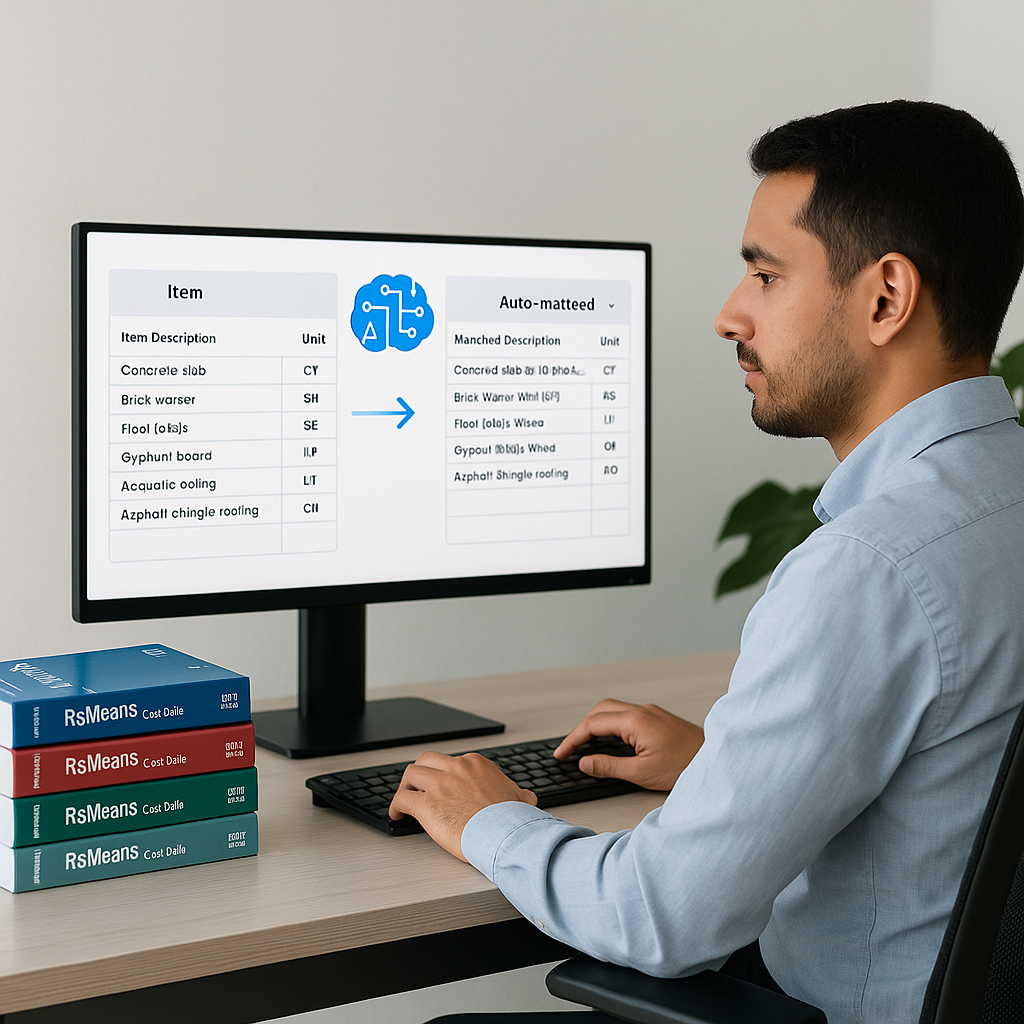
The Problem: Hours Wasted on Rate Lookups
Ever seen an estimator spend half their day flipping through RSMeans or CPWD DSR catalogs? If you’ve worked in preconstruction, you probably have. On larger projects, this could mean dozens of hours lost just to find rates for basic items like concrete, drywall, or HVAC ductwork. For smaller firms, it’s worse—when every hour counts, inefficient workflows can sink your bid.
Why Is This Still Happening?
Manual rate lookup persists because the tools we rely on—Excel, Bluebeam, and even the PDFs themselves—weren’t designed for speed. Sure, you can Ctrl+F your way through a 2,000-page catalog, but good luck finding the exact labor rate for installing pre-stressed concrete girders without scrolling through dozens of irrelevant entries. And let’s not forget the human errors. One wrong rate can throw off your entire bid.
Take this real-life example: A small general contractor bidding on a $2M school renovation project spent two full workdays manually cross-referencing RSMeans rates for basic tasks like painting walls and installing light fixtures. The result? Delayed submission, increased stress, and a bid that barely broke even due to a missed markup on labor costs. This isn't a one-off scenario—it happens every day across the industry.
Hidden Costs of Manual Rate Lookups
It’s not just time that’s wasted. Consider these direct and indirect costs:
- Labor Costs: Estimators spending hours on manual work that could be automated.
- Accuracy Risks: Human errors in rate selection can lead to underpricing or overpricing.
- Opportunity Costs: Every hour spent flipping through catalogs is an hour not spent strategizing for client meetings or refining project scope.
The AI Fix: Semantic Search Across 78,000 SOR Items
This is where AI-powered rate matching changes everything. Platforms like EstimateNext use semantic search to instantly match your BOQ items to the most relevant rates from a database of 78,000+ items. No more flipping pages or second-guessing.
How It Works
Here’s a practical example:
- Upload Your BOQ: Drop your Excel or CSV file into the platform. AI parses merged cells, section headers, and hierarchies automatically.
- Search Matches: Type “labor rate for installing steel girders,” and the system pulls the exact match in seconds. It even factors in location-specific costs and inflation.
- Customize Rates: Got project-specific materials or finishes? Add them to your catalog, and the system integrates them seamlessly for future use.
Let’s look at a case study:
- A Large GC’s $1B Rail Project: Rate matching for rail ties, structural steel, and concrete columns typically takes 12+ hours manually. With AI, it’s done in seconds. The team reported a meaningful reduction in preconstruction overhead costs, freeing up senior estimators to focus on scope optimization and client interaction.
Features That Matter
Platforms like EstimateNext don’t just deliver speed—they enhance accuracy and flexibility. Key features include:
- Location-Specific Rates: Adjusts for regional differences, accounting for labor and material cost variations.
- Historical Cost Tracking: Allows teams to compare rates across past projects for benchmarking.
- Collaboration Tools: Multiple team members can work on the same BOQ simultaneously, reducing bottlenecks.
The Obvious Objection: “AI Can’t Think Like an Estimator”
You’re probably thinking, “Sure, AI is fast, but it doesn’t understand the nuances of construction.” You’re right—it’s not a replacement for your expertise. It’s a multiplier. You’re still making the calls on markup, scope, and negotiation. AI just handles the repetitive stuff.
And let’s talk accuracy. According to McKinsey, early adopters of AI in construction have seen cost savings of 10-20% per project. But accuracy depends on input quality, so human oversight is still critical. Think of it as your assistant, not your substitute.
A comparison:
| Traditional Rate Lookup | AI-Powered Rate Matching |
|---|---|
| 6-12 hours per BOQ | 15 minutes per BOQ |
| Prone to human errors | Automated and precise |
| Requires extensive manual effort | Minimal effort after setup |
| Limited scalability | Easily scales to large projects |
Why Speed Matters More Than Ever
In today’s market, speed isn’t just a nice-to-have—it’s survival. Bid deadlines are tight, and materials costs fluctuate daily. If your competitor can turn around quotes faster than you, they’ve got the upper hand. AI tools like EstimateNext enable 24-hour quote turnaround, compared to the industry average of 72 hours. That’s a game-changer for subcontractors responding to multiple bid packages.
Let’s explore an actionable example:
- Subcontractor Case: A plumbing subcontractor regularly bids on 15-20 projects per month. Using AI tools, they now prepare quotes in less than 24 hours, enabling them to respond to twice as many RFPs. This has directly increased their win rate by 35%.
Actionable Steps
Not ready to overhaul your entire workflow? Start small:
- Test AI Rate Matching: Use it on a single project—perhaps a mid-size bid where manual lookup is particularly painful.
- Build a Custom Rate Library: Many platforms allow you to upload your own data for better accuracy.
- Train Your Team: Introduce junior estimators to AI tools, freeing up senior staff for strategic tasks.
- Analyze ROI: Track time savings and bid accuracy to measure the tool’s impact on your bottom line.
Call to Action
If rate lookups are eating into your team’s productivity, EstimateNext can help. Upload your first BOQ and get a priced estimate in minutes. Start Free →


