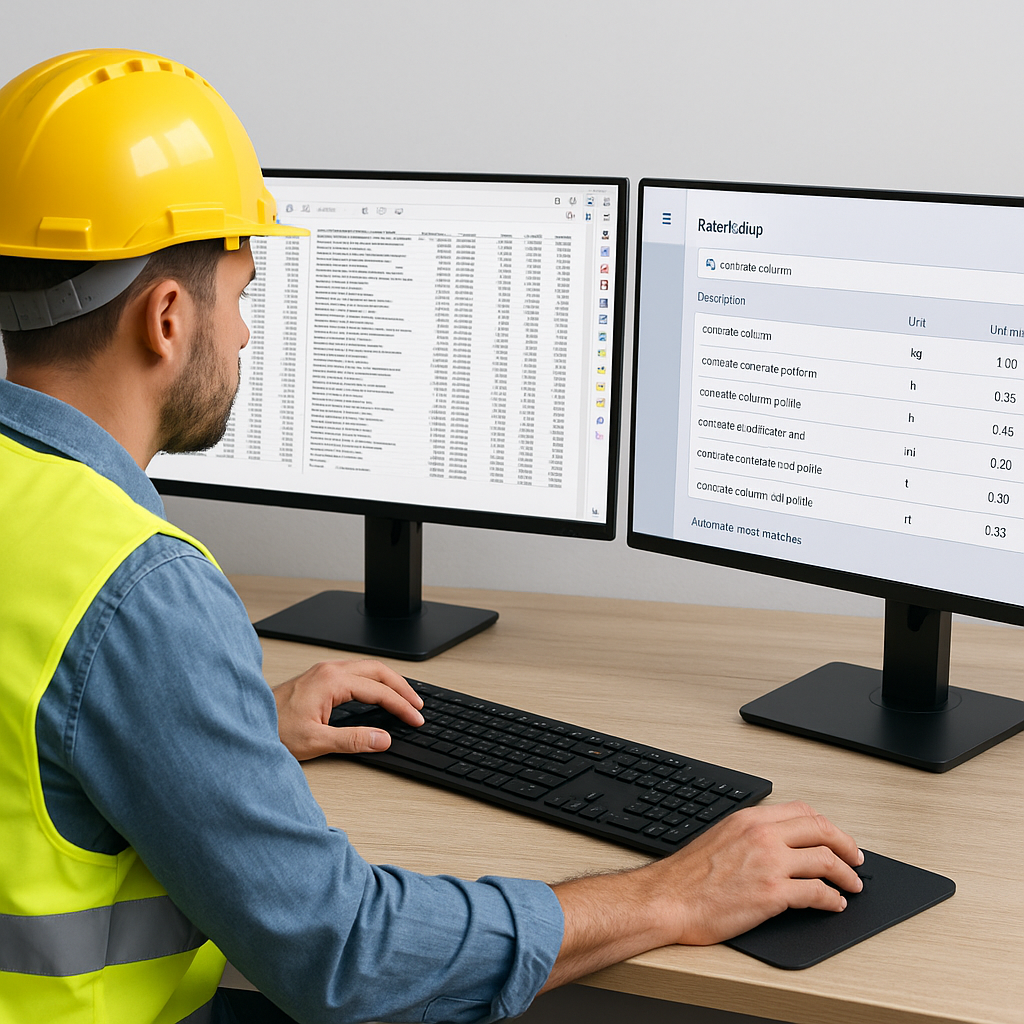
The Hidden Time Sink of Preconstruction Estimation
Let me ask you something: How many hours does your team spend flipping through rate books or hunting for line items in outdated PDFs? If you’re like most general contractors or subcontractors, the answer is too many. Here’s the problem: preconstruction estimation hasn’t kept up with the rest of the construction industry’s tech upgrades. We’ve got drones mapping sites, AI optimizing schedules, and BIM giving us 3D models that are practically alive. But when it comes to estimating costs, most of us are still stuck sifting through 2,000-page PDFs or juggling a mess of spreadsheets.
Let’s talk about the big time-waster: rate lookup. If you’ve ever spent hours searching RSMeans for the cost of installing a specific kind of HVAC duct, you know what I mean. It’s tedious, error-prone, and frankly, unnecessary with today’s technology. That’s where AI-powered tools like EstimateNext come in.
Semantic Search: The Game Changer for Rate Lookup
Here’s the magic of AI in one sentence: It doesn’t look for exactly what you typed—it understands what you meant. That’s semantic search. Instead of manually flipping through pages or searching for item codes, you can just type something like “labor rate for pre-stressed concrete girders” or “cost of installing SMACNA-compliant ducts.” In seconds, AI scans 78,000+ SOR items and delivers the right match.
Think about how much time that saves. On a typical bid, rate lookup can eat up 10-12 hours. Multiply that by 5 or 6 estimates a month, and you’re looking at over 60 hours wasted. AI cuts that down to seconds.
Case Study: Rail Project Time Savings
One general contractor (GC) using EstimateNext reported shaving 56 hours off their process for a single $1B rail project. Their team was able to reallocate those hours to refining their bid and optimizing construction timelines. Imagine what your team could do with that extra time—more bids, better negotiations, or just getting home for dinner for once.
Another Perspective: Subcontractor Wins
A mid-sized subcontractor specializing in HVAC installation used AI-powered estimation to submit bids for three projects in a single week—a task that would’ve taken two weeks with manual processes. By responding faster, they gained an edge over competitors and secured two contracts. Speed isn’t just convenient; it’s a competitive advantage.
Real-World Example: A Mid-Sized GC’s Experience
Let’s get specific. A mid-sized general contractor recently used EstimateNext for a high-rise project bid. Their team uploaded a BOQ with over 1,800 line items. Normally, matching those to CPWD rates would’ve taken two estimators a full week. With AI rate matching, it took less than an hour. That’s 40+ hours saved.
And the kicker? The AI wasn’t just faster—it was more accurate. It flagged discrepancies between the BOQ and the applicable codes, something the team might’ve missed in a manual review.
In their words: “It’s like having a junior estimator who works 24/7 and never makes a mistake.”
More Accuracy, Fewer Headaches
Accuracy matters just as much as speed. A 2019 FMI survey found that 35% of construction professionals cite inaccurate estimates as a major cause of project overruns. By reducing human error in rate matching and BOQ reviews, AI tools help you avoid costly mistakes later in the project lifecycle.
The Obvious Objection: “But AI Doesn’t Know My Project”
You’re probably thinking, “Sure, AI is fast, but it can’t understand the unique needs of my project.” Fair point. AI isn’t perfect—it’s not going to replace your expertise. But here’s the thing: AI isn’t supposed to replace you. It’s supposed to make your life easier. You’re still the one making judgment calls, negotiating with subs, and deciding on margins. The AI handles the grunt work, and you focus on the strategy.
How AI Learns Over Time
Every rate adjustment, every accepted or rejected match—it all feeds into the system, so your next project is even faster and more accurate. Most users see significant improvements by their third project. Think of it like training a junior estimator who gets smarter with each job.
What If You Use Custom Rates?
No problem. AI tools like EstimateNext let you upload your own rate catalogs. Got a custom material spec or a unique labor rate? Add it once, and the system will integrate it into future searches.
Niche Trades Benefit Too
This is especially useful for niche trades like MEP (Mechanical, Electrical, Plumbing) contractors, where standard rates often don’t apply. For example, one electrical contractor uploaded their custom pricing for solar panel installations and saw 70% faster estimations on their next project.
Why This Matters Right Now
The construction industry is under pressure like never before. According to a 2023 McKinsey report, early adopters of AI in construction are cutting project costs by 10-20%. That’s not just saving money—it’s winning more bids. In a market where margins are razor-thin, every hour saved and every error avoided can be the difference between profit and loss.
It’s not just about speed, either. Faster estimates mean you can respond to more RFQs, giving you a better shot at landing the projects you actually want. And when you’re not rushing to meet deadlines, you can spend more time refining your bids and negotiating better terms.
Actionable Steps to Get Started
- Audit Your Current Process: How many hours does your team spend on rate lookup and BOQ matching? If it’s more than 10 per project, you’ve got room for improvement.
- Test an AI Tool: Start with a smaller project to see how AI performs. Most tools offer free trials or low-cost entry plans.
- Train Your Team: AI is easy to use, but there’s always a learning curve. Pair your senior estimators with junior staff and let them explore how the tool fits into your workflow.
- Integrate with Existing Software: Look for tools that work with what you already use, like Bluebeam or Procore.
- Track Your Savings: Measure time saved and accuracy improvements on each project to justify continued investment.
Decision Framework: Manual vs. AI-Powered Estimation
| Feature | Manual Estimation | AI-Powered Estimation |
|---|---|---|
| Speed | 10-12 hours per bid | Seconds per rate lookup |
| Accuracy | Prone to human error | High, with self-learning |
| Scalability | Limited by manpower | Easily handles growth |
| Cost Savings | Minimal | Significant over time |
| Learning Curve | None | Low |
The Bottom Line
AI-powered estimation isn’t about replacing your team—it’s about giving them superpowers. Tools like EstimateNext cut out the busywork, letting your estimators focus on what they do best: building winning bids. If you’re still flipping through rate books or rebuilding spreadsheets from scratch, it’s time to rethink your process.
Want to see how this works in action? Get started free →


