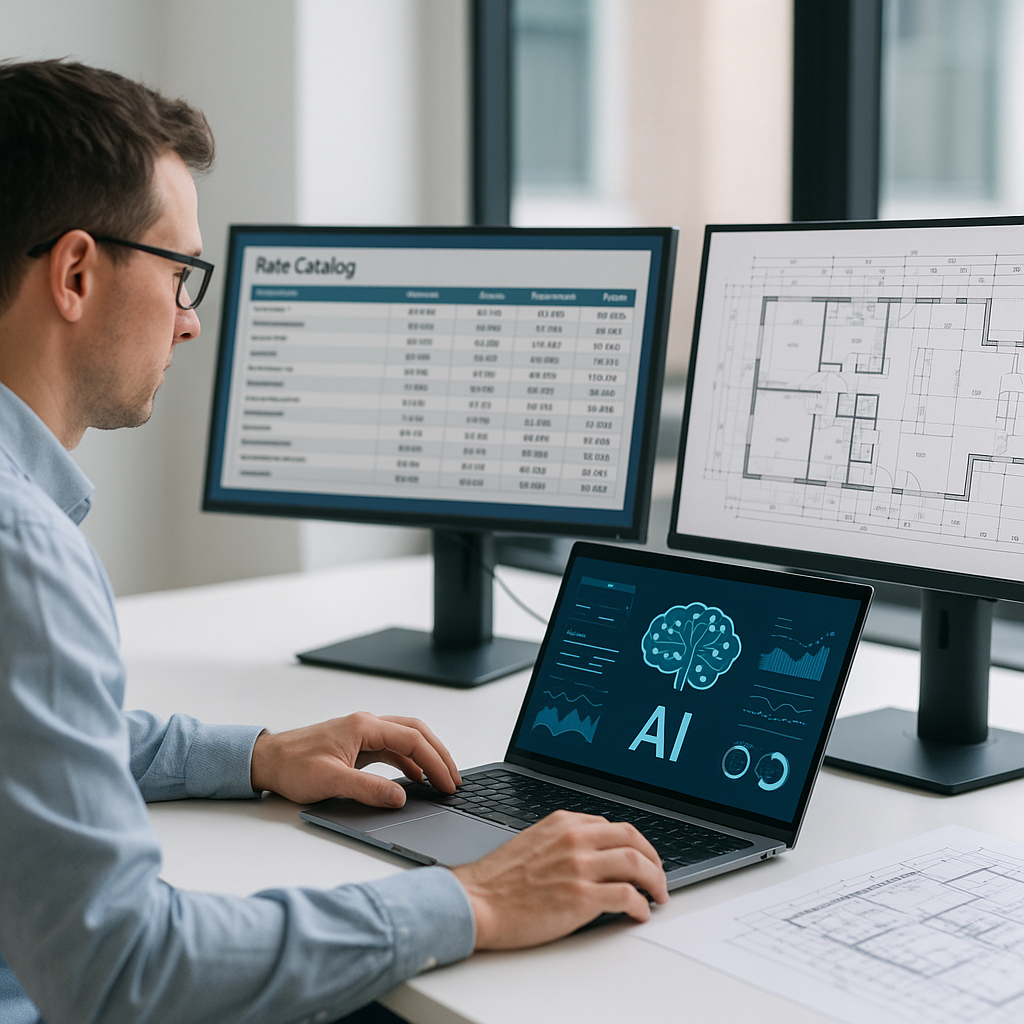
The Pain of Manual Rate Matching
Imagine this: you're pricing a bid for a $1 billion rail project. You need rates for everything—concrete girders, steel ties, drainage pipes. But the rates are buried across 2,000 pages of government-standard catalogs like RSMeans or CPWD DSR. The process? Flip, search, repeat. It eats up 12 hours per estimate, minimum. For smaller contractors with tight deadlines, it's brutal.
The Hidden Costs of Manual Processes
Beyond the time investment, manual rate matching has ripple effects:
- Errors Add Up: Misreading a rate or missing a specification can lead to underbidding and cost overruns. For example, a contractor in Michigan misquoted steel reinforcement rates on a $20 million project due to outdated catalog references. The resulting budget blowout forced renegotiations mid-project.
- Lost Opportunities: Spending 12+ hours on rate matching leaves less time for value engineering, negotiating with subcontractors, or exploring alternative materials.
- Burnout: Estimators—already stretched thin—face high stress from tight deadlines. This leads to rushed work and higher turnover rates.
For every $1 saved on avoiding software tools, contractors often lose $3-$5 in inefficiencies and mistakes.
The AI Fix: Semantic Rate Matching
AI changes the game. Tools like EstimateNext use semantic search across 78,000+ Standard of Rates (SOR) items. Instead of flipping pages, you type "steel beam installation" or "concrete column pour" into the search bar. Seconds later, you get a match—complete with labor, material, and equipment breakdowns.
Case Study: A Major Contractor's Rail Bridge Project
A large national general contractor faced a challenging rail bridge bid. They needed DOT-approved rates for structural steel and rail ties but were under a 48-hour deadline. Using EstimateNext, they pulled matching rates instantly. This wasn’t just faster—it was more accurate. The AI flagged regional cost variations and ensured compliance with the latest catalog editions.
How Semantic Search Works
Unlike keyword-based searches, semantic AI understands context. For example:
- Manual Search: Searching "steel beam installation" in a PDF might bring up hundreds of unrelated mentions of "steel" or "beam."
- Semantic AI: The AI recognizes intent and returns results like "installation of hot-rolled steel beams" with detailed cost breakdowns.
Real ROI: Numbers That Matter
Let’s run the math. A mid-sized general contractor (GC) spends 12 hours per estimate on rate matching. At $130/hour for an estimator, that’s $1,560. Multiply by five GMP pursuits per year? That’s $7,800 in labor costs. And this assumes:
- No errors that require rework.
- No time lost to searching for missing data.
- No opportunity costs from delayed bidding.
AI Cost Savings in Practice
EstimateNext slashes that time to seconds. Assuming five projects a year, here’s the ROI:
| Metric | Without AI | With AI | Savings |
|---|---|---|---|
| Time per Estimate | 12 hours | 0.5 hours | 11.5 hours saved |
| Labor Cost per Estimate | $1,560 | $65 | $1,495 saved |
| Total Annual Cost | $7,800 | $325 | $7,475 saved |
And that’s just rate matching. Freeing up estimator capacity allows for better subcontractor negotiation, deeper contingency planning, and more competitive bids.
Addressing the Objections: Can AI Handle Edge Cases?
What About Custom Rates?
Many projects require custom rates or involve specialized items not included in standard catalogs. This is where tools like EstimateNext shine:
- Custom Integration: Users can upload their own rate catalogs or define project-specific rates.
- Learning Over Time: The AI adapts to your adjustments. By the third or fourth project, most users report 99% accuracy improvements.
Is AI Reliable for Complex Scenarios?
AI tools include features like confidence scoring and manual overrides. For example, if you’re bidding on a multi-market project that spans regions with different labor rules, the AI flags discrepancies while allowing you to make adjustments manually.
Case Study: Specialized MEP Subcontractors
Consider MEP subcontractors handling HVAC, plumbing, or electrical systems. These specialists juggle 30-60 bid packages annually. Rate matching alone can eat up days. EstimateNext’s trade-specific tools integrate directly with NEC Table 220 or ASHRAE standards, cutting quote turnaround to four hours—an 18X improvement. Faster quotes mean more bids submitted, directly increasing your chances of winning work.
Why It Matters Beyond Speed
Speed is great, but reliability is everything. AI doesn’t just pull rates—it validates them. For example:
- Confidence Scores: EstimateNext assigns a percentage score to every match, so you know how reliable the result is.
- Version Control: The tool can identify discrepancies between outdated and current catalog versions, ensuring you’re always compliant.
- Cross-Market Consistency: For bids spanning regions or countries, AI accounts for local labor rules, currencies, and tax regimes.
Actionable Steps to Start Using AI for Rate Matching
- Audit Your Current Process: Track how much time and money you’re spending on manual rate matching.
- Start Small: Use AI tools like EstimateNext for one or two projects to gauge effectiveness.
- Upload Custom Data: If you use specialized catalogs, integrate them into the system early.
- Train Your Team: Ensure estimators know how to use the AI effectively, including features like manual overrides.
- Monitor and Adjust: Track key metrics like time saved, accuracy rates, and bid success rates to measure ROI.
Who Should Care?
This isn’t just for billion-dollar projects. Small contractors, mid-sized GCs, and subcontractors can all benefit:
- Small Contractors: For a $1M office fit-out, every hour counts. AI eliminates wasted time and ensures accurate rates.
- Regional Firms: At $39/month, AI tools like EstimateNext are far more affordable than traditional software like CostX, which can cost $15,000 or more annually.
- Specialists: MEP, landscaping, and other specialty trades can integrate trade-specific standards, further reducing time and improving accuracy.
The Bottom Line
If you're tired of wasting hours flipping through rate books, AI-powered tools like EstimateNext can help. It’s not just about faster rate matching—it’s about more accurate estimates, fewer errors, and better use of your team’s time. Whether you’re bidding on a $1M fit-out or a $1B infrastructure project, the benefits scale.


