Why Rate Matching is Killing Your Team's Productivity
Ever spent half a day flipping through rate books trying to find the labor rate for something obscure—say, installing pre-stressed concrete girders? You’re not alone. Manual rate lookups waste hours on every estimate, and let’s be honest, they’re a magnet for human error. Miss one item, and your bid might be off by thousands. According to a 2022 McKinsey report, inefficient processes in construction cost the industry over $1.6 trillion annually—rate matching is a big part of that inefficiency.
This isn’t just a minor headache. For large-scale projects like a major contractor’s rail bridge or a heavy-civil firm’s water infrastructure build, rate matching involves pulling everything from DOT-approved catalogs to vendor-specific pricing. That’s not a task you can afford to rush—or get wrong.
Enter AI-Powered Rate Matching
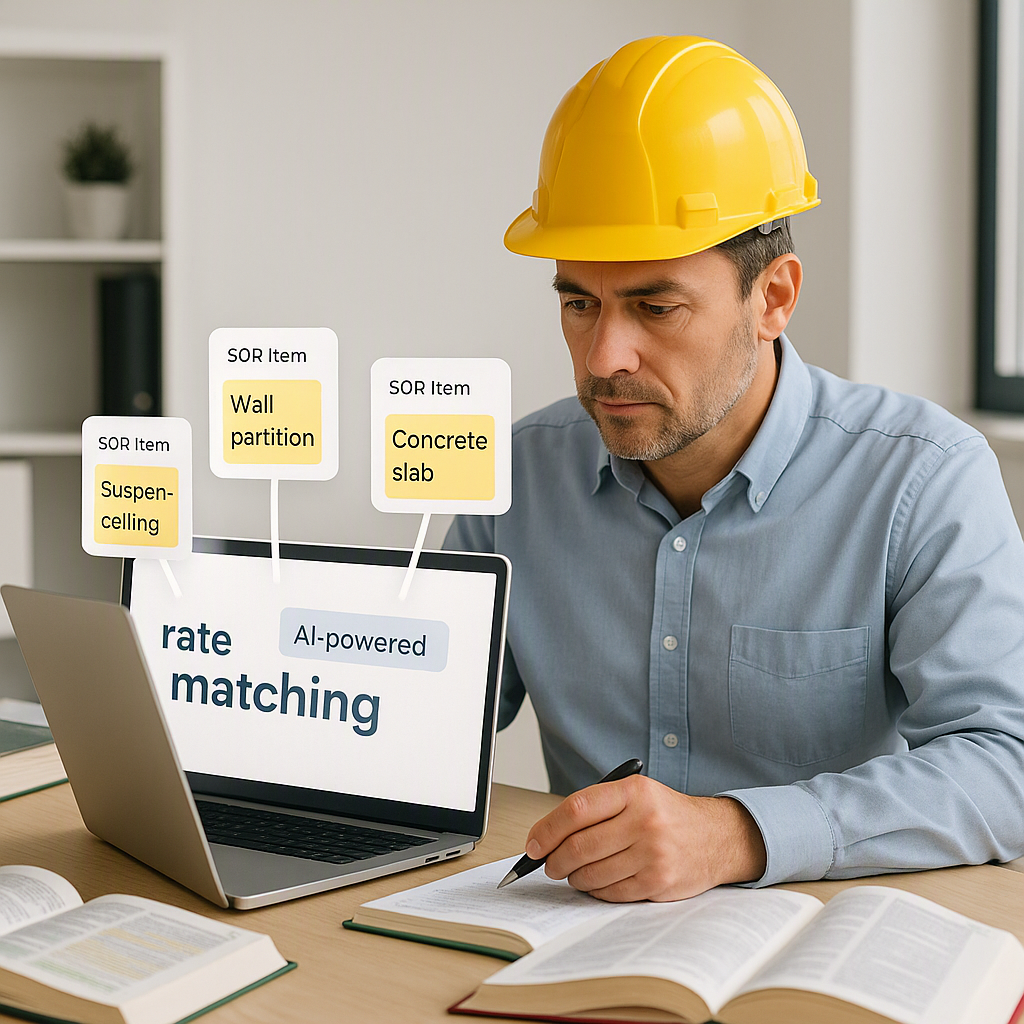
AI tools like EstimateNext are rewriting this process. Instead of flipping through PDFs or Excel sheets, you type in what you need—“labor for pre-stressed concrete girders” or “material cost for structural steel”—and the tool finds the match in seconds. Done.
Here’s the kicker: it’s not just faster. It’s smarter. The AI uses semantic search, which means it understands context, synonyms, and even regional terminology. So whether you’re pricing a project in Dallas or Dubai, you’ll get accurate matches tailored to local standards.
Actionable Steps to Implement AI-Powered Rate Matching
- Audit Your Current Process: Document how much time your team spends on manual rate matching. Look for bottlenecks and common errors.
- Test Drive an AI Tool: Many platforms like EstimateNext offer free trials. Use a small, low-risk project to evaluate its speed and accuracy.
- Integrate Custom Rate Data: Upload your own rate catalogs or project-specific pricing to ensure the AI mirrors your unique needs.
- Train Your Team: Host a quick training session to get your estimators comfortable with the platform. Most tools are intuitive and require minimal onboarding.
Real-World Impact
Let’s talk numbers. A mid-sized general contractor (GC) recently used EstimateNext for a $108M water project. Rate matching alone saved them 12 hours on the estimate—time they redirected into subcontractor negotiations. The end result? A sharper bid and better margins.
For smaller contractors, the ROI is just as compelling. Imagine you’re a regional GC handling $100M in annual placements. If AI saves you 12 hours per estimate and you price 8 GMP pursuits per year, that’s 96 hours back in your pocket. At $130/hour (the typical cost of a senior estimator), you’re looking at $12,480 saved annually. And that’s before factoring in improved accuracy, which reduces costly errors that could inflate bids or squeeze margins.
Case Study: MEP Subcontractor Success
An MEP subcontractor in the Midwest adopted EstimateNext to streamline rate matching for their $12M HVAC retrofit project. Before AI, their estimators spent 20 hours manually verifying labor and material rates. Post-implementation, that time dropped to just 3 hours. The labor cost savings alone were $2,210 per project, and their ability to respond to bids increased by 30%. By the end of the year, they had secured four additional projects, netting $680K in incremental revenue.
The Obvious Objection: “But AI Can’t Think Like an Estimator”
I hear this all the time. “Sure, AI is fast, but it doesn’t understand the nuances of construction.” Fair point—but it’s also missing the bigger picture.
AI doesn’t replace your expertise; it amplifies it. You’re still the one making judgment calls, negotiating with subs, and deciding on markup. The AI just handles the grunt work—like rate matching and what-if recalculations. It’s a tool, not a replacement.
How to Address This Concern Within Your Team
- Start Small: Use AI on non-critical aspects of the estimate to build confidence.
- Compare Outputs: Have your team manually verify AI-generated matches for the first few projects to prove its accuracy.
- Highlight Time Savings: Show how much time AI frees up for higher-value tasks like negotiations and client interactions.
What If Your Rates Are Custom?
Good question. Not every project follows a standard catalog. Maybe you’re working with custom materials or finishes. Maybe your labor rates vary by crew experience.
AI tools like EstimateNext let you upload your own rate catalogs or define project-specific rates. Once added, the system integrates these seamlessly for future use. Over time, it builds a library that reflects how you actually price work—not just what’s in a book.
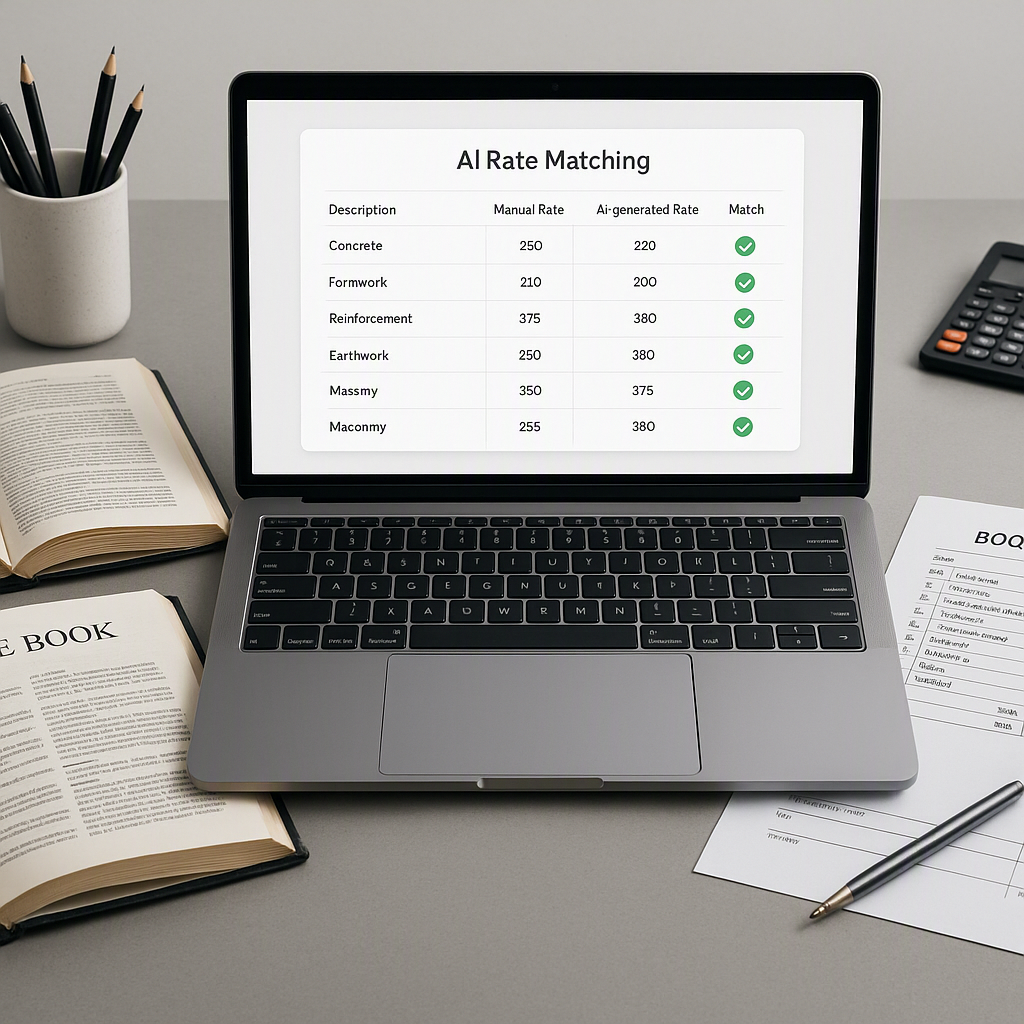
Comparison Table: Manual vs. AI Rate Matching
| Feature | Manual Rate Matching | AI-Powered Rate Matching |
|---|---|---|
| Speed | Hours or even days | Seconds |
| Accuracy | Prone to human error | High, with semantic search |
| Customization | Time-intensive to update | Seamlessly integrates |
| Scalability | Limited by team capacity | Unlimited |
Why Faster Estimates Matter
Speed isn’t just about saving time. It’s about unlocking opportunities. When your team can turn around estimates in hours instead of days, you can respond to more bids. For MEP subcontractors, this could mean responding to 50% more packages annually. If your average win rate is 20%, that’s 4-8 additional wins per year. At $200K per project, you’re looking at $800K-$1.6M in incremental revenue.
And let’s not forget the competitive edge. In markets like India or GCC, where bid deadlines are tight and margins razor-thin, speed can make or break your chances.
The Takeaway
Rate matching might seem like a small part of the estimation process, but it’s one of the biggest time sinks. AI-powered tools like EstimateNext don’t just speed it up—they make it smarter, more accurate, and scalable across any project size.
If you’re tired of wasting hours flipping through rate books, it’s time to try something better. Get started free →