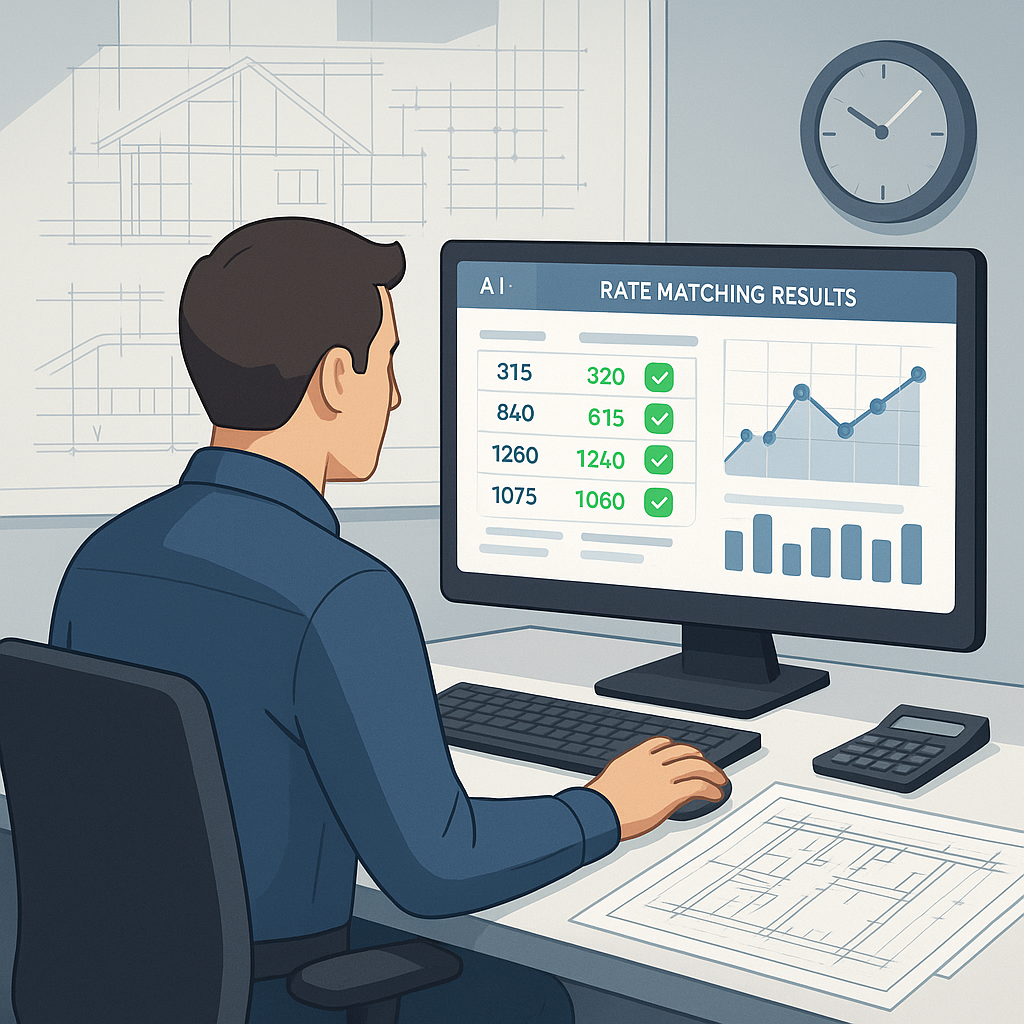
Why Manual Rate Lookups Are Killing Your Margins
Every estimator knows the pain: flipping through rate books, searching for that one specific labor or material cost. It’s monotonous, error-prone, and eats up hours. Multiply this across an entire bid package, and you’re staring at a full day wasted just on rate matching.
Here’s the kicker: mistakes during rate lookup don’t just cost time—they cost money. Miss one item or misinterpret a rate, and the margin on your bid could disappear. For competitive markets like MEP subcontracting, where margins are razor-thin, this isn’t just inconvenient. It’s dangerous.
But it’s not just about time or margins. Manual methods introduce human error, and when estimates are wrong, the ripples can be felt throughout the project lifecycle. For example, a miscalculated labor rate can lead to underbidding, which might win you the job but leave you scrambling to cover costs later. On the flip side, overestimated material rates could price you out of the competition entirely.
The AI Solution: Smarter Rate Matching
AI-powered rate matching tools flip this problem on its head. Instead of manually searching through PDFs or static catalogs, tools like EstimateNext use semantic search across 78,000+ Schedule of Rates (SOR) items. Need the installation rate for pre-stressed concrete girders? Type it in, and you’ll get an accurate match in seconds—no flipping, no guessing.
Real-World Example: Faster, Smarter Bidding
One mid-sized general contractor used AI rate matching during a $1B rail project bid. According to their case study, AI reduced rate lookup time by over 12 hours per estimate while improving accuracy by 99%. That’s not just faster; it’s smarter.
Another example comes from a regional electrical contracting firm bidding on a wind farm project. They saved nearly $25,000 in labor costs by identifying more competitive rates from their database and avoiding costly errors in material pricing. These tools didn’t just speed up their process—they gave them a competitive edge.
How It Works
Let’s break it down into actionable steps:
-
BOQ Upload Start by uploading your Bill of Quantities (BOQ) in Excel or CSV format. The tool auto-detects merged cells, hierarchies, and section headers. This eliminates the manual effort of cleaning up your BOQ before you can start estimating.
-
Semantic Search Enter a query—say, “HVAC duct installation labor rate.” The AI scans its database (which includes CPWD DSR, RSMeans, and other catalogs) to find the best match. Unlike keyword searches, semantic search understands context, ensuring more accurate results.
-
Custom Rates Got unique materials or labor costs? You can add custom rates to the catalog. The system learns and integrates these for future use, creating a tailored database that evolves with your projects.
-
Auto-Suggestions The AI flags items with low confidence, so you can review and adjust before finalizing. This hybrid approach ensures human oversight remains integral, mitigating risks from edge cases.
Comparison Table: Manual Rate Lookup vs. AI-Powered Rate Matching
| Feature | Manual Lookup | AI-Powered Rate Matching |
|---|---|---|
| Speed | Hours per estimate | Seconds per estimate |
| Accuracy | Prone to human error | 99% accuracy |
| Scalability | Limited to human bandwidth | Handles large datasets seamlessly |
| Learning Curve | None, but tedious | Intuitive interface; ~2 weeks mastery |
| Custom Rates | Manually updated | Auto-learning and integration |
ROI: What You’re Actually Saving
Let’s talk numbers. According to McKinsey, early adopters of AI in construction save an average of 10-20% per project. Here’s how the math works for rate matching alone:
Time Saved:
- 12 hours per estimate x $130/hr (average estimator rate) = $1,560 saved per project.
Error Reduction:
- Avoiding just one major mistake can save tens of thousands in lost margin.
Annual Impact:
For MEP subcontractors responding to 30 bid packages per year, that’s up to $46,800 in annual savings—just for rate matching. Larger firms handling 100+ bids annually could see savings well into the six-figure range.
Common Pushback: “AI Can’t Think Like an Estimator”
You might be thinking, “Sure, AI is fast, but it doesn’t understand the nuances of construction.” Fair point. AI isn’t replacing estimators—it’s amplifying them. You’re still the one making judgment calls, negotiating with subs, and deciding on markup. The AI just handles the grunt work.
Think of it as hiring a full-time assistant without the payroll hit. In their own case study, EstimateNext noted that most users report significant accuracy improvements by their third project, thanks to the system’s self-learning capabilities.
Edge Cases: What If My Rates Are Custom?
This is a valid concern for specialized projects with custom materials or finishes. The solution? AI tools like EstimateNext let you upload custom rate catalogs, which the system integrates seamlessly. By your next bid, those rates are baked into the database, saving even more time.
Call to Action
If manual rate lookups are slowing you down, EstimateNext can help. Its AI-powered rate matching cuts hours to seconds, saving both time and money. Get started free →


