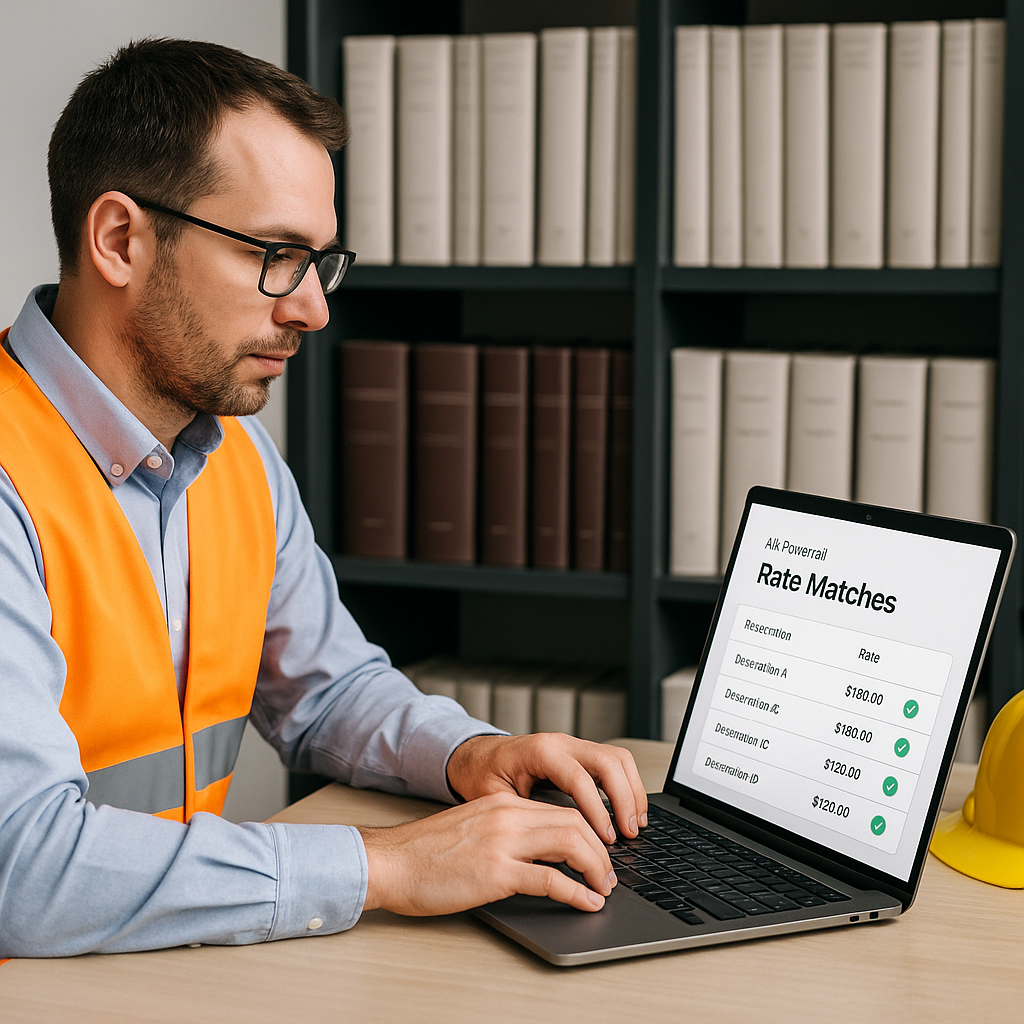
The Problem with Manual Rate Matching
Ever spent an entire afternoon flipping through a 2,000-page rate book? You're not alone. Manual rate lookup is one of the most painful parts of construction estimation. It’s slow, error-prone, and frankly, outdated. Need to find the labor rate for installing pre-stressed concrete girders? First, you have to locate the right catalog. Then, hope the index isn’t missing or inaccurate. Finally, you manually copy numbers into your spreadsheet, praying you didn’t miss a decimal point.
Here’s the kicker: this process eats up an average of 12 hours per estimate. McKinsey reports that early AI adopters in construction save 10-20% per project, partly because they cut out manual tasks like this. If you’re pursuing five GMP bids a year, that’s a full week wasted just on rate matching. Brutal.
The Hidden Costs of Manual Rate Matching
Manual rate matching doesn’t just waste time—it introduces risks that can directly impact your bottom line. Consider these common scenarios:
- Human Errors: A misplaced decimal point or copying the wrong number can snowball into a mispriced bid, jeopardizing your profit margins.
- Missed Deadlines: Spending too much time on rate matching delays your ability to submit bids, putting you behind competitors.
- Opportunity Costs: Time spent flipping through rate books is time not spent refining margins, negotiating with subs, or improving project efficiency.
Let’s look at a concrete example. A GC pursuing a $50M municipal road project manually matched rates for labor and materials. A simple error in the asphalt cost inflated the bid by $150,000—making it uncompetitive. They lost the project to a competitor who used automated tools to ensure accuracy.
How AI Fixes Rate Matching
AI-powered tools, like EstimateNext, completely flip this workflow. Instead of flipping through books, you type what you need into a search bar. EstimateNext’s semantic search scans 78,000+ items across 135+ catalogs in seconds. For example:
- Scenario: Pricing 10,000 cubic yards of structural concrete for a high-rise.
- Manual: Search through RSMeans, cross-check local cost indexes, manually adjust for inflation.
- AI: Type “structural concrete $/CY” into the search. The system pulls rates directly from RSMeans, adjusts for city-specific multipliers, and suggests inflation factors.
Done. No missed pages. No typos. You get accurate rates instantly and can focus on high-value tasks like optimizing bid strategy or negotiating with subcontractors.
Real-World Use Case
Take a $1B rail bridge project. The team needed rates for everything from rail ties to structural steel. Manually pulling DOT-approved rates would’ve taken days. Instead, they used AI tools like EstimateNext. The result? Rates matched in under an hour, and the estimator could focus on refining margins and negotiating with subs. A project like this can save dozens of hours per bid.
Another example: A mid-sized MEP contractor bidding on large-scale commercial HVAC installations used AI for rate matching and cost estimation. With tight deadlines, the AI helped them turn around quotes 50% faster, enabling them to secure 8 additional contracts in a year, worth $1.3M in revenue.
The Obvious Objection
You might be thinking, “Sure, AI is fast, but it doesn’t understand the nuances of construction.” That’s partially true—but it misses the point. AI doesn’t replace your expertise; it amplifies it. You’re still the one making judgment calls, negotiating with subs, and deciding on markup. The AI just handles the grunt work.
Think of it like a power drill. You wouldn’t use a screwdriver for hundreds of bolts on a job site, right? Same logic applies here. AI is the tool that lets you focus on the strategic aspects of estimation rather than the tedious ones.
Edge Cases: What If My Rates Are Custom?
Some projects demand custom rates. Maybe you’re using non-standard materials, or your labor costs vary by union agreements. EstimateNext accounts for this by letting you upload custom rate catalogs. The AI integrates them seamlessly for future use, so you don’t have to start from scratch every time.
Let’s say you’re bidding on a unique green building project that uses proprietary materials not found in standard catalogs. You can upload your supplier’s cost sheet, and the AI will incorporate those rates into its database, ensuring accuracy and speed for future bids.
ROI: Is It Worth It?
Let’s talk numbers. For GC preconstruction directors:
- Time Saved: 40 hours per estimate x $130/hr = $5,200 saved per pursuit.
- Cost: EstimateNext costs $99/month per seat. Even small teams see a 52X ROI.
For MEP subs responding to tight bid deadlines:
- Impact: 50% faster quote turnaround.
- Revenue: Winning 4-8 additional bids/year at $200K avg = $800K-$1.6M incremental revenue.
And it’s not just about money—it’s about competitive edge. Faster, more accurate estimates mean you can outbid competitors and win more projects.
FAQ: Common Questions About AI in Estimation
Q: How accurate are AI-generated rates?
AI tools like EstimateNext are highly accurate, but no system is perfect. That’s why they include features like manual override and confidence scoring, so you can double-check results before finalizing bids.
Q: Can I use AI with existing software like Procore or Bluebeam?
Yes. EstimateNext integrates seamlessly with platforms like Procore and Bluebeam. You can export estimates directly into your workflows, streamlining your entire preconstruction process.
Q: Is AI hard to learn?
Not at all. Most tools are designed for ease of use, with intuitive interfaces and guided tutorials. Training typically takes under two weeks, and many offer responsive customer support.
Q: What happens if the catalog data is outdated?
EstimateNext regularly updates its catalogs to reflect the latest rates, including inflation adjustments and city-specific multipliers. You can also upload your own data for custom projects.
Q: Will AI replace estimators?
No. AI is a tool, not a replacement. It handles repetitive tasks, freeing up estimators to focus on strategic decisions, negotiations, and overall bid optimization.
Decision Framework: Should You Adopt AI for Rate Matching?
Here’s a simple comparison table to help you decide:
| Factor | Manual Process | AI-Powered Process |
|---|---|---|
| Time per estimate | 12+ hours | <1 hour |
| Error risk | High (manual entry mistakes) | Low (confidence scoring + overrides) |
| Cost | Labor-intensive | $99/month per seat |
| Learning curve | N/A | Minimal (2 weeks max) |
| Competitive edge | Reduced (slower bids) | High (fast, accurate bids) |
If your team regularly spends hours on rate matching or struggles with accuracy, AI tools like EstimateNext can dramatically improve your efficiency and competitiveness.
Call to Action
If you’re tired of wasting hours on rate matching, EstimateNext can help. Its AI-powered tools deliver accurate results in seconds, saving you time and money. Get started free →


